6 Best Wire Bending Tools For Wedding Floral Installations
Struggling with complex floral designs? Discover the 6 best wire bending tools for wedding floral installations to simplify your process. Shop our top picks now.
Wedding floral installations require the same structural precision as building a complex, lace-weight shawl on fine needles. Achieving the perfect armature demands tools that provide consistent tension, leverage, and finesse when working with various wire gauges. Just as the wrong needle material can cause snagging in delicate mohair, using subpar pliers in floral design leads to hand fatigue and structural instability. Selecting the right equipment ensures that every bloom stays exactly where it is placed, whether in a sprawling archway or a centerpiece.
Beadsmith 6-in-1 Pliers: Best for Perfect Loops


These pliers feature six graduated steps that allow for uniform, repeatable loops, much like selecting a specific needle diameter to maintain gauge in circular knitting. When structural integrity is paramount, these allow for consistent bend radii across multiple stems.
Uniform loops prevent wire from biting into soft flower stems, acting similarly to how wood or bamboo needles prevent stitch slippage in slippery yarns. Relying on these prevents the common pitfall of uneven tension, which often leads to lopsided floral arrangements.
While versatile, the bulky head can occasionally feel restrictive in tight spaces. Keep them for the initial fabrication stage rather than fine-tuning a finished installation.
Xuron TweezerNose Pliers: For Delicate Detail
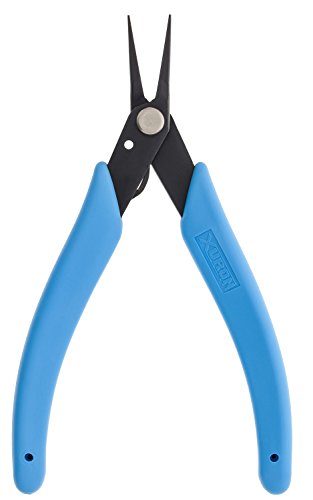
Precision is the hallmark of fine fiber arts, and these pliers offer the same level of control as using a size 000 needle for intricate lace edging. The fine, pointed tips are designed to reach into cramped quarters where standard pliers might crush nearby petals.
These are the primary choice when micro-adjustments are necessary after the main structure is built. Think of them as a tapestry needle—small, sharp, and essential for finishing the work properly.
Avoid using these for heavy-duty cutting or bending thick-gauge wire, as the fine tips are prone to snapping under high torque. Reserve them strictly for manipulation and delicate placement.
Knipex Combination Pliers: The Pro’s Workhorse
Every toolkit needs a robust foundation, and these pliers serve as the project-bag equivalent of a classic set of stainless steel needles. They handle heavy-duty tasks, from twisting stubborn armature wire to tightening support brackets, with ease and reliability.
The serrated jaws provide a superior grip, ensuring wire does not slip during high-tension tasks. Just as a heavy-weight yarn requires a sturdy metal needle to prevent bending, these pliers manage the mechanical stress of rigid installations without failing.
Their weight may be a drawback for all-day use. Use them for the “heavy lifting” at the start of a project, then switch to lighter tools for the final aesthetic assembly.
Oasis Heavy Duty Wire Cutters: For Thick Stems
Wire cutters are the scissors of the floral world, and investing in high-quality blades is non-negotiable for clean, snag-free cuts. Dull cutters leave jagged edges that can tear delicate flower stems or scratch your hands during installation.
These cutters are designed to slice through thick-gauge wire without the crushing effect seen in cheaper alternatives. Think of this as the difference between using sharp fabric shears versus dull craft scissors on silk—a clean cut preserves the integrity of the material.
Never use these to cut anything other than floral wire. Even small nicks on the blade edge will cause them to tear through wire rather than slice cleanly, eventually making them useless.
Wubbers Bail Making Pliers: For Consistent Coils

Consistency is the enemy of the beginner and the best friend of the professional. These round-jaw pliers are engineered to create uniform coils, ensuring every piece of the floral installation has the same spring and tension.
Much like controlling the tension in a brioche stitch, using these pliers allows for predictable behavior in the wire. If the wire is coiled uniformly, the resulting structure will be balanced and aesthetically pleasing across the entire design.
These are highly specialized and lack the gripping power of combination pliers. They are best utilized for creating custom support components before starting the assembly process.
Cousin DIY 3-Piece Set: The Ideal Starter Kit
For those just beginning to build wedding installations, this set provides the necessary trio of round-nose, chain-nose, and wire cutters. It is the equivalent of buying a basic starter set of bamboo needles when first learning to knit—economical and functional for learning the craft.
The ergonomics are standard, which is perfect for gaining familiarity with different bending techniques. If the hobby becomes a regular practice, upgrading individual tools for better comfort is always an option.
Understand that these tools are mass-produced and may not offer the precision or longevity of professional-grade equipment. However, they serve as an excellent diagnostic tool to help identify which specific pliers receive the most use.
Choosing Pliers: Grip, Size, and Your Comfort
The handle design of a pair of pliers is as crucial as the shape of a needle’s tip for ergonomic comfort. If the handles are too thin, hand fatigue will set in within minutes, mirroring the discomfort of knitting for long periods with improperly sized needles.
- Padded Grips: Essential for long-term comfort and reducing hand strain.
- Spring-Loading: Returns the jaws to an open position, saving time and energy during repetitive bending.
- Jaw Length: Shorter jaws offer more leverage; longer jaws offer more reach.
When shopping, test the spring resistance. If the spring is too stiff, the tool will eventually cause repetitive strain, much like an overly tight tension style leads to wrist pain.
Floral Wire Gauges Explained for Your Projects
Floral wire gauges operate on an inverse scale, similar to the American needle sizing system. A lower gauge number indicates a thicker, more rigid wire, while a higher number indicates a thinner, more flexible wire.
- 16-18 Gauge: Structural foundation work, like building the skeleton of an archway.
- 22-24 Gauge: General floral work, supporting heavier blooms.
- 26-30 Gauge: Fine binding and delicate corsage work.
Matching the gauge to the task is equivalent to matching yarn weight to needle size. Attempting to use thin wire for structural support is like trying to knit a sturdy sweater with lace-weight yarn—the physics will simply not hold up under the weight.
How to Care for Your Floral Wire Bending Tools
Good tools are an investment that pays off through longevity and ease of use. Wipe down pliers after every project to remove botanical sap or floral foam residue, which can cause corrosion and pitting on the metal.
Periodically apply a light machine oil to the pivot point of the pliers. This ensures the action remains smooth and prevents the “gritty” feeling that develops when dust or debris enters the hinge mechanism.
Store tools in a dry environment. Humidity is the enemy of steel, leading to rust that can permanently degrade the tool’s performance and potentially damage your floral materials.
Round vs. Chain Nose Pliers: When to Use Each
Round-nose pliers feature conical jaws, which are essential for creating loops and curves. They are the go-to tool for shaping wire into decorative spirals or securely attaching stems, similar to how one uses a tapestry needle to weave in ends.
Chain-nose pliers have flat inner surfaces, providing a superior grip for crimping and straightening wire. They act as a clamp, holding the wire steady while you wrap it or bend it at sharp angles.
Mastering the difference is foundational to clean, professional-looking installations. If you find your loops are looking pinched or angular, you are using the chain-nose when you should be using the round-nose.
The secret to a successful wedding installation lies in the harmony between structural planning and the execution of fine detail. By curating a selection of tools that match the specific demands of your floral designs, you elevate your work from mere decoration to a stable, artistic installation. Trust in the quality of your gear, maintain it with care, and let the tools do the heavy lifting so you can focus on the artistry of the arrangement.