6 Best Knitting Blocking Mats For Lace Projects
Achieve professional results with our guide to the 6 best knitting blocking mats for lace projects. Improve your tension and shape your pieces. Read more today.
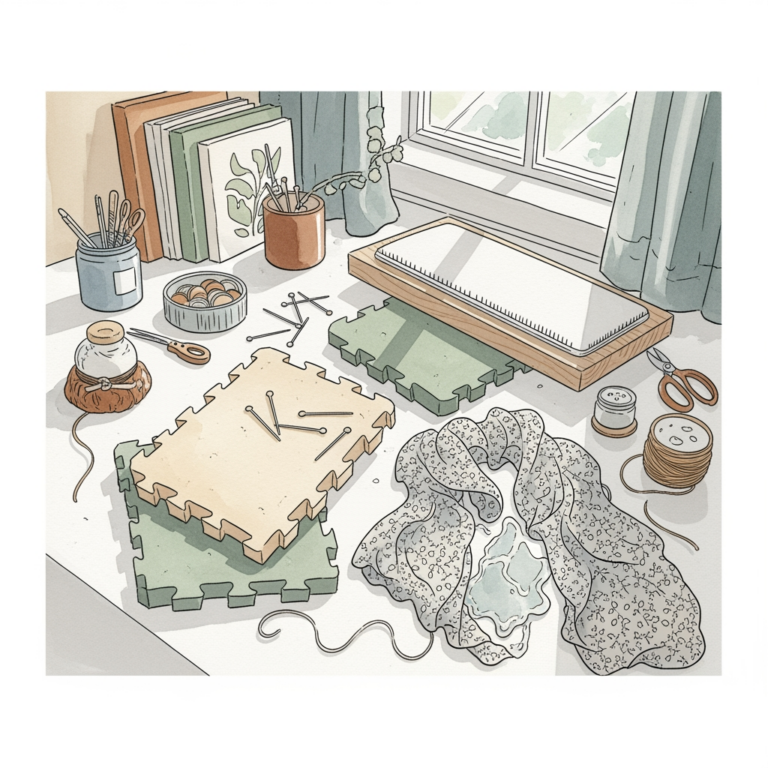
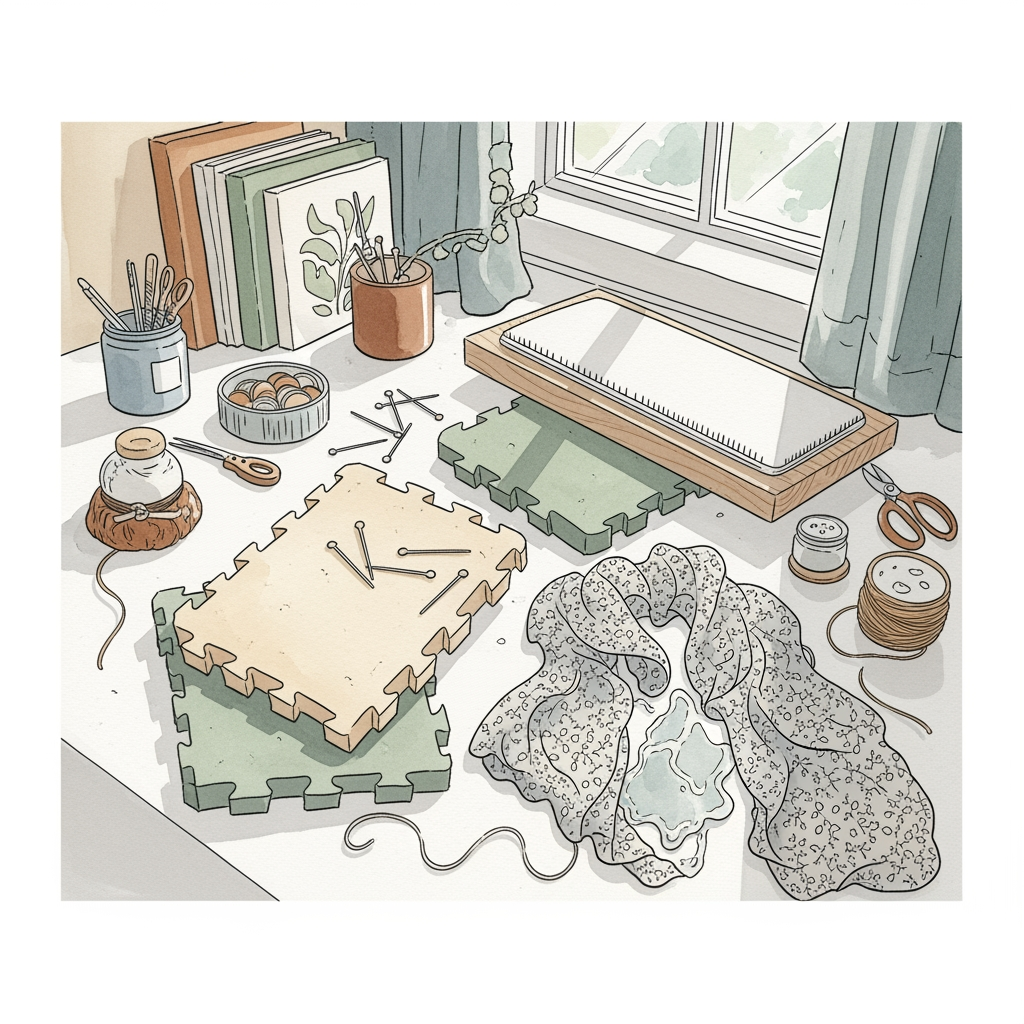
The difference between a lackluster lace shawl and a professional-grade masterpiece often lies in the final finish. Blocking is the structural transformation that opens up stitch patterns, evens out tension, and sets the final dimensions of a piece. Without a reliable surface to pin into, intricate yarn-overs and delicate motifs can remain bunched and obscured. Choosing the right blocking mats ensures the investment of hundreds of hours of knitting is showcased in the best possible light.
KnitIQ Blocking Mats: Best Overall Value Pick


KnitIQ mats offer a balanced combination of thickness and surface area that satisfies most lace knitters. The standout feature is the clear grid markings printed directly onto the foam, which removes the guesswork when trying to achieve perfectly symmetrical shawl wingspans.
These mats are sufficiently dense to hold T-pins firmly without becoming riddled with holes after a single use. The foam remains stable even when saturated with water, preventing the surface from warping or sliding during the critical setting phase of the blocking process.
For those who frequently tackle large, triangular lace projects, these mats provide a reliable and long-lasting foundation. They strike a pragmatic middle ground between professional studio gear and casual craft supplies.
Cocoknits Knitter’s Block: A Premium System

The Cocoknits system elevates the blocking process by focusing on precision and modularity. Unlike standard interlocking squares, this system includes a specialized canvas cover featuring a printed grid, which helps keep delicate lace pinned square and centered.
The primary benefit here is the integration of a heat-resistant, water-absorbent fabric layer over the foam blocks. This prevents the “puckering” effect that can occur when wet lace sits directly on synthetic foam, ensuring a smoother result for fine-gauge fibers like silk or alpaca.
Investing in this system is ideal for the knitter who prioritizes repeatable, professional-grade results. While the price point is higher, the inclusion of dedicated storage and precision tools justifies the cost for serious lace enthusiasts.
KnitPicks Blocking Mats: Top Budget-Friendly Pick
KnitPicks mats provide an straightforward, entry-level solution for knitters who do not want to overspend on accessories. These tiles are lightweight and feature the standard interlocking edge design, making them easy to assemble in configurations suitable for scarves or cowls.
While the foam is slightly softer than premium alternatives, it is perfectly adequate for light-to-medium lace weight yarns. The surface grips pins well enough for most applications, provided the tension is managed carefully to avoid pulling the mats apart at the seams.
This is the logical choice for a beginner who is just starting to understand the mechanics of blocking. These mats offer the essential utility needed to transform a project without requiring a significant financial commitment.
LaceLock Pro Grid Mats: For Intricate Projects
LaceLock Pro mats are engineered with a specific density designed for high-tension applications. When pinning complex lace charts that require hundreds of individual pins to articulate every picot edge, these mats offer superior structural support.
The grid system on these mats is remarkably precise, minimizing the risk of skewed geometry in delicate shawls. Because the foam is more rigid than standard hobby-store varieties, it withstands the repeated puncture of finer pins without losing integrity.
For the advanced knitter working with cobweb or lace-weight wool, this level of stability is a distinct advantage. It ensures that every point of a lace border remains exactly where it was positioned as the fiber dries.
Knitter’s Pride Blocking Mats: Most Versatile
Knitter’s Pride offers a highly modular solution that excels in projects with varying dimensions. The interlocking tabs are engineered for a snug fit, reducing the gaps that can sometimes disrupt the flow of a large blocked piece.
These mats are notable for their resilience to moisture and their ease of cleaning. If a project requires aggressive wet-blocking or if dyes bleed slightly from the yarn, the non-porous nature of the material makes maintenance simple and efficient.
They are an excellent “workhorse” option for the household with limited storage space. The ability to break down the surface into small components for a single sock or expand it for a full-sized blanket makes them a versatile addition to any tool kit.
WEBS Blocking Mats: A Solid, No-Frills Option

The WEBS blocking mats provide a dependable surface without the inclusion of unnecessary bells and whistles. The focus here is on consistent thickness and uniform interlocking edges, which create a level platform for basic blocking needs.
These mats function best for knitters who prefer to rely on their own measuring tapes or existing blocking wires. They lack printed grids, which may be a drawback for some, but they compensate with a sturdy foam composition that handles pins reliably.
This is a utilitarian choice for those who value simplicity and durability above all else. It is a straightforward tool that performs the job of providing a pin-friendly surface without cluttering a workspace with complex layouts.
What to Look For in a Lace Blocking Mat
When selecting a mat, the primary concern must be the density of the material. A mat that is too soft will fail to hold pins securely, causing your tension to shift and the lace to lose its shape as the fibers dry.
Check for an interlocking system that lies flat rather than buckling at the joints. Uneven seams can translate into uneven edges on your final piece, which is particularly noticeable on the straight edges of lace shawls.
Consider the surface area requirements relative to the projects usually on the needles. Purchasing a set that allows for expansion is often smarter than buying a single large, non-modular unit, as it accommodates both small swatches and large garments.
Blocking Wires and Combs: The Perfect Partners
Blocking wires are the hidden secret to perfectly straight edges on lace. By threading a stiff, non-rusting wire through the edges of a shawl and pinning only at intervals, you achieve a continuous, clean line that is impossible to get with individual pins alone.
Blocking combs, which feature multiple pins attached to a plastic spine, act as a time-saving hybrid of traditional pins and wires. They are excellent for quickly securing long, straight stretches of lace without the tedious process of pinning every single stitch.
For the best results, use these in tandem with your mats. Wires create the structure, while individual pins handle the tricky corners and decorative lace points.
How Many Blocking Mats You Actually Need
The number of mats needed depends entirely on the scale of the projects usually completed. A standard set of nine 12-inch tiles is generally sufficient for a large shawl or a pair of adult sweaters.
If the focus is exclusively on socks or small doilies, four mats are often enough to get started. However, those who knit large, circular shawls or heavy blankets should plan for enough tiles to cover at least a 6-foot by 6-foot area.
Always err on the side of having too much surface area rather than too little. Being forced to compress a project onto a space that is slightly too small is the fastest way to ruin the delicate points and drape of a lace piece.
Wet vs. Steam Blocking for Delicate Lace
Wet blocking, which involves submerging the project in water before pinning, is generally the safer choice for natural fibers like wool, alpaca, and mohair. It allows the fibers to fully relax and bloom, which is critical for opening up the yarn-overs in lace patterns.
Steam blocking provides a faster, more controlled method, often used for synthetics or when the knitter needs to see immediate results. However, caution is required; direct heat can easily “kill” the fiber, causing it to lose its bounce and elasticity permanently.
For delicate silk or mohair blends, stick to a gentle wet block to ensure the fibers maintain their structural integrity. Only utilize steam when the specific fiber content is known to respond well to heat, and always use a press cloth to protect the yarn from the iron.
Investing in a dedicated set of blocking mats is one of the most effective ways to elevate the quality of your finished handknits. By selecting a surface that matches the scale and material of your projects, you ensure that every intricate lace motif is given the space and tension it needs to shine. Proper blocking is the bridge between a handmade craft and a professional-grade heirloom.