6 Sewing Clips For Fabric Layering Worth Owning
Struggling with fabric layers? Discover our top 6 sewing clips that make pinning easier and keep your projects secure. Shop our expert recommendations today.
Transitioning from the delicate precision of knitting needles to the structural demands of sewing requires a different set of tools to maintain control over fabric layers. While pins often suffice for lightweight cottons, they become cumbersome and potentially damaging when working with heavy knits, leather, or laminated fabrics. Sewing clips provide a secure hold that keeps layers aligned without piercing fibers or causing structural distortion. Investing in the right clips ensures that seam alignment remains perfect, whether assembling a quilt block or attaching a knitted trim to a garment.
Clover Wonder Clips: The Gold Standard for a Reason
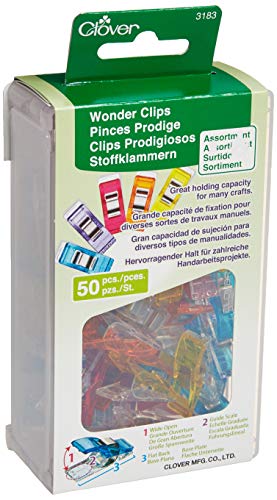

Clover Wonder Clips set the benchmark for consistency and reliability in the sewing room. Their strong tension spring ensures that layers of fabric—or even bulky knitted swatches—stay firmly in place throughout the sewing process.
These clips feature a flat base that allows them to glide smoothly across the bed of a sewing machine without catching or tilting. The clear markings on the back help with measuring seam allowances, providing a secondary function that proves invaluable during assembly.
While the price point is higher than generic alternatives, the durability of the plastic and the strength of the spring justify the investment. These are the go-to choice for anyone who values precision and wants a tool that won’t fail during critical construction steps.
MumCraft Multipurpose Clips: Best Budget Bulk Buy

MumCraft clips serve those who need a large quantity of fasteners without breaking the bank. These are frequently used by quilters managing dozens of patches simultaneously, where the sheer volume of clips required makes individual high-end purchases impractical.
The grip strength is reliable, though perhaps slightly less refined than the industry leaders. They effectively hold multiple layers of fabric together, making them an excellent choice for stabilizing long, straight seams or heavy hems.
Buying in bulk provides the peace of mind that a project will never be held up by a shortage of fasteners. For the maker who is constantly switching between projects, these offer a practical, no-fuss solution for general-purpose fabric holding.
Madam Sew Basting Clips: Built for Bulky Quilts

Managing the layers of a quilt—top, batting, and backing—requires a clip that can open wide without losing its grip. Madam Sew Basting Clips are engineered specifically for this type of extreme thickness, where standard clips might pop open.
The design emphasizes a wide jaw opening, ensuring that the tension remains distributed evenly across the bulky fabric. This prevents the shifting that often happens when wrestling with large, layered pieces under the presser foot.
If the primary focus is quilting or working with thick, double-knit fabrics, these are the heavy-duty workhorses required. They remove the struggle of fighting against layers that want to slide apart before the needle catches them.
Dritz Flat-Bottom Clips: Ideal for Machine Sewing

Dritz Flat-Bottom Clips are designed with the sewing machine operator in mind. The underside is perfectly level, preventing the clip from rocking or snagging as the fabric is fed into the machine.
This design feature is crucial for maintaining consistent stitch length and tension. When a clip doesn’t sit flat, it can lift the fabric, leading to skipped stitches or uneven seam allowances, especially with delicate or slippery materials.
For the precision-focused maker, these clips bridge the gap between temporary holding and structural sewing. They are a staple for those who prefer to keep their clips in place until the very last moment before the needle passes over the area.
Clover Jumbo Clips: Taming Thick, Bulky Layers

When tackling heavy materials like thick wool, denim, or layers of stabilizer, standard clips are often too small to get a solid purchase. Clover Jumbo Clips provide the extra depth needed to secure extreme thicknesses.
The oversized jaw ensures that even the most stubborn, bulky fabric layers remain firmly in place. These are essential for structural sewing, such as inserting heavy interfacing into a winter coat or securing a thick hand-knitted edge to a fabric backing.
While they may be too large for delicate work, they are unmatched when the scale of the project increases. Having a few of these in the kit ensures that no project, regardless of thickness, is beyond reach.
Riley Blake Mini Clips: For Precision & Curves
Small-scale projects, such as intricate doll clothing or tight curved seams, require a delicate touch that standard clips cannot provide. Riley Blake Mini Clips offer a lower profile and a tighter spring for smaller fabric areas.
Their small size prevents them from getting in the way, allowing for better visibility and maneuverability around tight corners. This is particularly useful when sewing small garments or managing narrow binding strips that need to stay perfectly aligned.
These clips are a niche tool, but for specific tasks, they are indispensable. They prevent the bulk of a larger clip from distorting small seams or obscuring the view of the needle.
Sewing Clips vs. Pins: Which Should You Choose?
Pins are the classic choice for precision work, especially when perfect alignment of specific points is required. However, they leave permanent holes in the fabric, which can be disastrous for materials like vinyl, leather, or certain tightly woven synthetics.
Clips, by contrast, offer a non-invasive way to hold fabric layers together. They excel in scenarios where the fabric is prone to fraying or where the structure of the weave might be compromised by piercing.
- Use pins when: You need to match precise registration marks on delicate, lightweight fabrics.
- Use clips when: Working with multiple bulky layers, non-porous materials, or when the fabric is too thick for a standard pin to penetrate easily.
The final decision often comes down to the nature of the project. Many experienced makers utilize a combination of both, relying on pins for pinpoint accuracy and clips for structural stability.
What to Look for in a High-Quality Sewing Clip
The most important factor in a high-quality clip is the strength of the internal spring. If the spring is too weak, the fabric will shift, rendering the clip useless; if it is too strong, it may be difficult to operate during long sewing sessions.
Additionally, observe the base of the clip. A flat base is essential for machine sewing, as it ensures the fabric moves evenly into the machine. Without this, the clip becomes a hindrance rather than a help.
- Material density: Look for high-grade plastic that resists cracking.
- Spring tension: Test for a snappy, secure closing action.
- Base flatness: Ensure the underside is smooth and parallel to the work surface.
Ultimately, the best clip is the one that disappears into the workflow. If the tool requires constant adjustment, it is not serving its intended purpose.
How to Match Clip Size to Your Fabric & Project
Matching the right tool to the project is a hallmark of an experienced maker. For lightweight fabrics like silk or lawn, large clips may be too heavy, causing the fabric to drag or pucker.
Conversely, attempting to use mini clips on heavy canvas or denim will result in the clips popping off or failing to hold the layers together. Always evaluate the thickness and weight of the fabric stack before selecting the size.
- Fine/Lightweight: Stick to minimal-profile clips to avoid adding unnecessary drag.
- Medium/Cotton: Standard clips are the most versatile for almost all garment construction.
- Heavy/Bulky: Always reach for jumbo or wide-jaw clips to ensure a secure bite.
By consciously selecting the tool based on the fabric density, the risk of sewing errors is significantly reduced. Never force a tool to perform outside of its intended scale.
FAQs: Getting the Most Out of Your Sewing Clips
Do sewing clips eventually lose their spring strength? Like any mechanical tool, springs can weaken over many years of heavy use. Store them in a relaxed, open position or simply grouped in a container to prevent unnecessary fatigue.
Can I sew over these clips? No, never attempt to sew over a plastic sewing clip. The needle will strike the plastic, resulting in a broken needle, damage to the machine, or a damaged clip that could fly toward the eyes.
How many clips do I actually need? For most projects, a starter set of 20 to 30 clips is sufficient. As project complexity increases, such as with large quilts, you may find that owning 50 or more saves time by allowing you to pin the entire perimeter at once.
Proper maintenance of sewing clips involves keeping them clean of lint and thread scraps. When not in use, keep them organized in a dedicated tray or bin so they don’t get crushed under heavier equipment.
Integrating sewing clips into a workflow requires a slight shift in habit, but the resulting consistency in seam quality makes the effort well worthwhile. Experiment with these tools to find the balance that suits your specific sewing style and project load.