7 Best Standing Desks For Creative Flow To Boost Focus
Boost your productivity and sharpen your focus with our top 7 standing desks for creative flow. Explore our expert picks and upgrade your workspace today.
Knitting for hours requires a workspace that adapts to the body, not the other way around. Whether working through a complex cable chart or mindlessly stockinette-stitching a bulky-weight sweater, physical tension is the primary enemy of flow. Standing desks provide the necessary flexibility to shift posture, preventing the repetitive strain that often cuts a creative session short. Investing in the right foundation transforms a craft corner into a studio built for endurance and focus.
Uplift V2: The Best Overall for Versatility


The Uplift V2 stands as a workhorse, favored for its exceptional stability at standing heights. When working with fine lacework on delicate silk yarn, even the slightest desk wobble can disrupt the rhythm of picking up stitches. The heavy-duty frame ensures that the surface remains rock-solid while moving through rapid-fire increases or decreases.
Customization is the primary draw here, with options for various grommets and accessories that can house yarn bowls, pattern stands, or LED task lamps. Having a dedicated space to clamp a magnifying lamp or a ball winder makes a measurable difference in project efficiency.
Bottom line: Choose this desk if the goal is a fully modular workspace that scales with an evolving stash of tools and accessories.
Vari Electric Standing Desk: Easiest Assembly
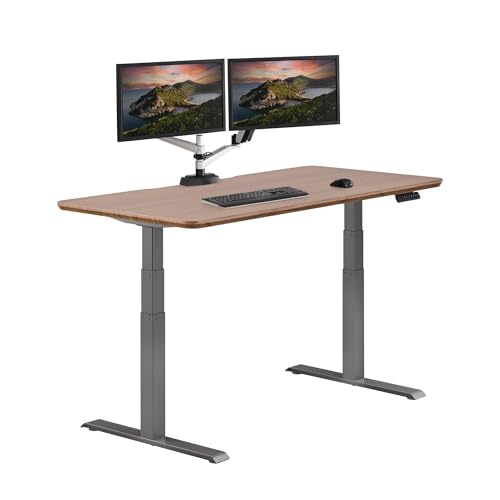
For those who find the prospect of building furniture more daunting than unraveling a mohair lace project, the Vari desk is a relief. It arrives with a simplified assembly process that takes minutes, allowing for immediate setup without the need for specialized tools or a second pair of hands.
The transition mechanism is smooth and quiet, which matters when focusing on a complex stitch repeat. A sudden mechanical clunk can break concentration, leading to errors in a challenging brioche or colorwork pattern. This desk maintains a professional, minimalist aesthetic that fits well in shared living spaces.
Bottom line: The Vari is for the knitter who wants an instant, high-quality solution without the weekend-long construction project.
FlexiSpot E7 Pro: Best for Heavy Equipment

A serious fiber studio often involves heavy equipment like electronic yarn ball winders, bulky sewing machines, or heavy storage bins full of wool. The E7 Pro features an impressive weight capacity that accommodates these heavy-duty tools without struggling to lift or straining the motor.
The desk remains steady even when loaded with heavy skeins, spinning wheels, or multiple project bags. Sturdy construction prevents the dreaded vibration that can rattle tools off the surface during long knitting sessions.
Bottom line: If the desk acts as a foundation for heavy machinery and a vast, weighted stash, this is the most secure choice available.
Fully Jarvis Bamboo: The Most Eco-Friendly
Knitting often centers on natural fibers, so it makes sense to seek out a workspace that respects those origins. The Jarvis Bamboo desk uses sustainable materials that are durable, moisture-resistant, and aesthetically warm.
Bamboo is surprisingly hard and resilient, offering a surface that holds up well against the occasional snag of a needle point. It provides a natural, organic feel that complements the tactile nature of handling wool, alpaca, or linen.
Bottom line: This desk is the ideal choice for the environmentally conscious maker who values sustainable materials as much as high-quality yarn.
Branch Standing Desk: The Most Stylish Pick
Design-conscious knitters often prioritize a clean, uncluttered visual space to foster clarity during project planning. The Branch desk features a sleek, refined look that hides its mechanical parts, blending seamlessly into modern home interiors.
Beyond its appearance, the desk provides excellent cable management, which is essential when using electric yarn winders or keeping an iPad charged for digital pattern reading. A clean surface leads to a clean mind, making it easier to track row counts and stitch markers.
Bottom line: If the studio is also a living area, the Branch offers the most sophisticated aesthetic without sacrificing core functionality.
iMovR Lander Desk: Top Premium Experience
The Lander desk arrives nearly fully assembled, showcasing its premium pedigree through sophisticated electronics and high-end materials. It offers a “paddle” controller that allows for intuitive adjustments, which is helpful when switching between complex chart reading and long, repetitive stretches of knitting.
The build quality is exceptional, featuring a level of refinement that justifies the higher investment for a lifelong maker. Every component is engineered for longevity, mirroring the intent behind a hand-knit garment meant to last for decades.
Bottom line: This is a long-term investment for the dedicated artisan who views their studio as a permanent, high-performance creative sanctuary.
IKEA Trotten Sit/Stand: Best Budget Option
The Trotten utilizes a hand-crank mechanism, which eliminates the need for power outlets and simplifies the setup. It is a no-nonsense, affordable entry point for knitters looking to improve their ergonomics on a budget.
While it lacks the memory presets of electric models, the manual crank is smooth and reliable. It provides the essential health benefits of standing while remaining accessible to those just starting to build their dedicated workspace.
Bottom line: The Trotten is perfect for a starter studio where simplicity and cost-effectiveness are the primary constraints.
How to Choose the Right Desk Size for Crafting
When measuring for a crafting desk, account for the “wingspan” of a knitting project. A sprawling lace shawl or a sweater in progress requires significantly more surface area than a computer mouse and keyboard. Ensure the desk is deep enough to hold a large pattern binder, a yarn bowl, and a drink without feeling cramped.
Width is equally important; a wider desk allows for staging multiple projects at once. Avoid the temptation to buy the smallest model available, as knitting projects have a habit of growing larger as they progress.
Bottom line: Prioritize depth over width to ensure there is plenty of room for hands to maneuver without bumping into equipment.
Standing vs. Sitting: What’s Best for Flow?
Flow is a state of total immersion, and physical discomfort is the quickest way to end it. Sitting for too long compresses the hips and can lead to rounded shoulders—a posture that restricts breathing and makes it harder to hold needles comfortably.
Standing intermittently helps engage the core and improves posture, which translates to better tension control. However, standing all day can lead to foot fatigue, which is why the best approach is a sit-stand cycle. Move to standing when starting a new section or fixing a mistake, and sit when settling into the rhythmic, meditative phases of a project.
Bottom line: The secret to sustained flow is the ability to change positions, not the act of standing alone.
Ergonomics for Crafters: Setting Up Your Desk
Correct ergonomics for knitting differ from those for typing. Aim to set the desk height so the elbows form a slightly open angle, allowing the shoulders to remain relaxed and down. If the desk is too high, it creates tension in the neck and traps, leading to soreness after just a few rows.
Position the work surface so that the pattern is at eye level, perhaps using a magnetic board or a tablet stand. Looking down at a flat desk causes “tech neck,” while an upright view preserves the spine.
- Height: Adjust the desk so forearms rest comfortably without hunching.
- Support: Use an anti-fatigue mat to protect the feet during long standing sessions.
- Lighting: Position task lamps to illuminate the stitches from the side to reduce glare and highlight yarn texture.
Bottom line: Prioritize neutral joint alignment to ensure the body can support the creative work for years to come.
Selecting a standing desk is as much about protecting the longevity of a craft as it is about comfort. By investing in a workspace that accommodates the specific, tactile needs of knitting, the risk of repetitive strain is minimized and the joy of creating is preserved. Focus on stability, space, and ease of use to create an environment that truly supports the creative journey.