6 Best Led Task Lights For Accurate Color Perception
Struggling with color accuracy? Discover our top 6 LED task lights designed for professional precision and vibrant hues. Read our expert guide and shop today.
Struggling to distinguish between subtle shades of navy and black during a late-night knitting session is a rite of passage for many crafters. Poor lighting not only leads to eye strain and headaches, but it can also mask dropped stitches or botched increases in complex lace patterns. Investing in a high-quality LED task light ensures that every ply of yarn is visible, allowing for accurate color matching and precision work. Selecting the right light involves balancing color accuracy, reach, and stability to suit a specific crafting environment.
Brightech Litespan LED: The All-Around Best
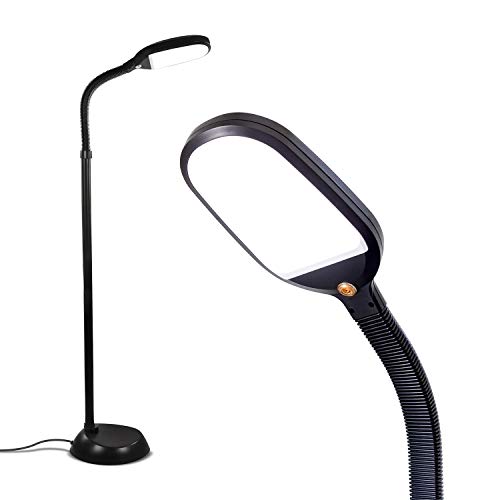

The Brightech Litespan stands out for its versatility and steady, flicker-free illumination. Its flexible neck allows for precise positioning, which is vital when working with dark, low-contrast yarns like charcoal wool or navy mohair.
The light offers a wide range of color temperatures, making it a reliable workhorse for various fiber types. Whether working under soft warm light to reduce glare or cool daylight to spot dropped stitches, the controls are intuitive and accessible.
This lamp is an excellent entry-level choice for knitters who need a multipurpose solution. It provides a generous spread of light that covers both a pattern book and a project bag, minimizing the need for constant readjustment.
OttLite Dual Head Floor Lamp: True Color Expert

OttLite has long been the gold standard for crafters concerned with color rendering index (CRI). The Dual Head Floor Lamp is specifically engineered to mimic natural daylight, preventing the “color shifting” that often occurs when choosing yarns in a store versus knitting at home.
The dual-head design is particularly effective for those working on larger projects, such as blankets or intricate colorwork sweaters. By angling the two heads, you can eliminate harsh shadows that often obscure fine details in complex stitch patterns.
While the footprint is larger than a standard desk lamp, the ability to illuminate a wide area is worth the floor space. It is the ideal companion for long-term projects where color fidelity is the highest priority.
Daylight Lumi Task Lamp: Sleek & Powerful Pick

The Daylight Lumi Task Lamp is designed for the knitter who demands high-intensity light in a compact form factor. Its wide shade provides a broad, even glow that is exceptionally good at highlighting the texture of luxury fibers like silk or alpaca.
The dimming function is a standout feature for those who suffer from light sensitivity during late-night knitting. You can dial down the intensity when working with high-contrast, light-colored yarn to prevent glare, or crank it up when taming difficult, dark-colored variegated wool.
Because it clamps to the edge of a table or crafting frame, it saves valuable surface space. This is a perfect solution for knitters who rotate between a sewing machine, a computer, and a knitting chair.
Neatfi XL Magnifying Lamp: For Intricate Detail

When working with fine-gauge lace or tiny sock needles, general illumination is often insufficient. The Neatfi XL Magnifying Lamp combines high-output LEDs with a crystal-clear lens, making it a lifesaver for identifying stitches in projects with high twist or dark colorways.
The massive, wide-view lens allows for comfortable, ergonomic viewing without requiring the knitter to hunch over the needles. This posture support is essential for preventing the neck and back strain that often accompanies long, detail-oriented projects.
It is an investment piece for the serious maker tackling complex charts or intricate cables. By removing the guesswork from identifying individual loops, it significantly speeds up the process of fixing mistakes in delicate work.
BenQ e-Reading Desk Lamp: A Premium Investment

The BenQ e-Reading lamp is a masterpiece of design, offering an unusually wide light range that covers an entire knitting chart and multiple skeins of yarn simultaneously. Its “curved” light bar is specifically shaped to minimize screen glare and reflection, which is helpful if a tablet is used to follow digital patterns.
This lamp is highly intelligent, featuring an ambient light sensor that adjusts automatically to the room’s conditions. For those who knit in changing natural light, this feature prevents the need to constantly flip switches or toggle brightness settings.
Though it commands a higher price tag, the build quality and performance are unmatched for long-term comfort. It turns a standard workspace into a professional-grade studio for the dedicated fiber artist.
Glocusent Neck Light: Best Portable Solution
Sometimes a stationary lamp isn’t enough, especially when knitting on a sofa or in a travel chair. The Glocusent Neck Light sits comfortably around the shoulders, directing focused beams of light exactly where the hands are working.
This is the most portable option for knitters who enjoy working in communal settings or during travel. It frees the user from being tethered to a wall outlet, allowing for knitting in low-light environments like planes, trains, or dim living rooms.
While it lacks the sheer power of a floor lamp, its targeted, adjustable settings are perfect for most standard knitting tasks. It is an affordable and indispensable tool for knitters who refuse to leave their WIPs (Works In Progress) behind.
How to “Read” a Light: A CRI and Kelvin Guide
Understanding light specifications is the secret to avoiding buyer’s remorse. The Color Rendering Index (CRI) measures how accurately a light source reveals the true colors of a fiber, with a score of 90 or higher being the gold standard for knitters.
Kelvin (K) ratings determine the “warmth” or “coolness” of the light. For knitting, a range between 4000K and 5000K is generally preferred as it mimics mid-day sunshine, ensuring that a forest green yarn doesn’t look like a murky brown.
- Look for 90+ CRI: Ensures color accuracy for matching yarn lots.
- Target 4000K–5000K: Provides “daylight” clarity without excessive blue tones.
- Avoid “Warm White” (under 3000K): Often hides imperfections and shifts color tones.
Key Features in a Knitting & Craft Task Light
A dedicated craft light must prioritize ergonomics as much as brightness. The ability to adjust the height and angle of the lamp head is non-negotiable, as it allows the light to follow the movement of the needles.
Stability is the next critical factor to consider, especially when using magnifying lamps that carry extra weight. A heavy, weighted base or a high-quality clamp ensures the light stays put, even when the craft table is jostled during a session of intense row-counting.
- Flicker-Free Technology: Prevents eye strain during long sessions.
- Dimmable Controls: Vital for balancing light based on yarn color and material.
- Adjustable Reach: Must cover the entire needle span plus pattern instructions.
Floor vs. Desk Lamps: Which is Right for You?
Choosing between a floor lamp and a desk lamp usually comes down to the physical layout of the crafting space. Floor lamps are superior for dedicated knitting chairs, as they can be positioned to hover directly over the lap without needing a side table.
Desk lamps are the logical choice for those who craft at a multi-use surface, such as a dining table or a sewing desk. They provide a more concentrated light, which is excellent for detailed work, but they do require a surface to clamp or stand on.
Consider the “reach” of the lamp arm if choosing a desk model. If you tend to move around while you knit, a floor lamp with a wide, swing-arm reach will ultimately provide more flexibility than a fixed-position desk lamp.
LED Craft Light FAQ: Your Top Questions Answered
Many knitters wonder if LED lights will heat up the yarn. Because LEDs generate very little heat compared to old-fashioned incandescent bulbs, they are perfectly safe for natural fibers like wool and alpaca.
Others ask if a higher Kelvin rating makes a light “brighter.” It does not; Kelvin only describes the color tone, while “Lumens” determine the actual brightness intensity.
- Will the light fade my yarn? LEDs emit virtually no UV radiation, making them safe for long-term use.
- Does CRI matter for monochromatic projects? Yes, because higher CRI helps differentiate between texture and stitch definition in single-color cables or lace.
- Can I use a smart bulb with these lamps? Most high-end task lamps have integrated bulbs, so verify compatibility before attempting to swap them out.
Lighting is the most overlooked tool in the knitter’s kit, yet it is arguably the one that provides the most immediate improvement to the quality of one’s work. By prioritizing high CRI and adjustable color temperatures, knitters can protect their vision and ensure their color choices are as vibrant in the finished piece as they were on the shelf. Investing in a quality task light is, quite simply, an investment in the longevity of the crafting practice itself.