
6 Charm Connectors For Adding Personality To Chains
Elevate your jewelry designs with these 6 charm connectors for adding personality to chains. Discover unique ways to customize your necklaces and shop styles now.
Knitting is a rhythmic practice, but keeping track of row counts, stitch patterns, and project progress requires more than just focus. Integrating charm connectors into your knitting toolkit turns a functional accessory into a personal expression of your craft. Whether organizing stitch markers or securing progress, the right connector ensures that your tools remain as reliable as they are beautiful. Choosing the right hardware is the difference between a seamless workflow and a frustrating snag in your favorite mohair blend.
Hinged Gate Rings: Best for Grouping Charms


Hinged gate rings function like a miniature version of a carabiner, offering a secure, circular frame for your charms. They are ideal for knitters who like to keep several stitch markers or decorative dangles on a single project bag or cable needle. Because the gate snaps shut, your markers stay put even when the project is tossed into a crowded tote.
The primary advantage here is the easy-access loop, which allows for quick swaps between projects. Simply press the hinge, slip on your decorative charms, and release to lock everything in place. These are perfect for managing a collection of varying stitch markers, allowing for a personalized “charm cluster” that makes identifying different segments of your lace or cable work much easier.
Be mindful that the hinge itself can occasionally snag on delicate, loosely spun single-ply yarns if it isn’t closed fully. Always check that the gate is flush against the ring before setting your work aside. These are best reserved for secondary storage or project bag organization rather than sitting directly on your working needle.
Swivel Lobster Clasps: For Tangle-Free Use
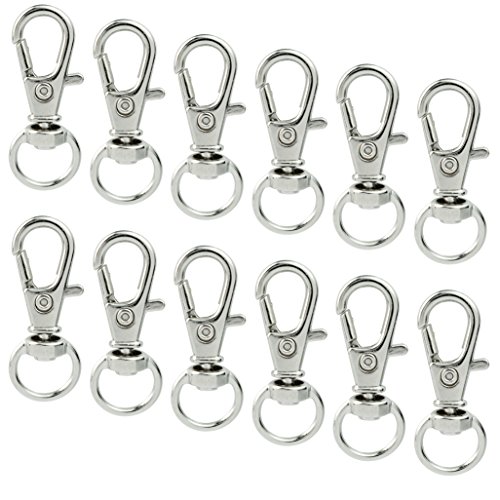
Swivel lobster clasps are the workhorse of the knitting accessory world, featuring a rotating base that prevents your charms from twisting and flipping. If you frequently use charms as progress keepers, the swivel action is essential for preventing the weight of the charm from pulling the yarn into a distorted loop. The spring-loaded trigger is intuitive, making it a favorite for makers who frequently move markers between rows.
These clasps provide a distinct, professional finish to hand-knitted items, especially when attached to a giftable shawl or cowl. Because they hang freely, they don’t put undue stress on the stitches, which is vital when working with fragile fibers like silk or fine-gauge alpaca. The rotation ensures that your charms always face outward, keeping your project looking tidy while you work.
The trade-off is the moving part: the spring inside the lobster claw can wear out over years of heavy use. If you notice the gate no longer snapping back firmly, it is time to retire that specific clasp to prevent losing your progress markers. Opt for high-quality metal alloy or stainless steel to ensure the spring mechanism remains responsive for hundreds of projects.
Gourd & Bulb Pins: The Knitter’s Go-To Choice
Gourd-shaped bulb pins are essentially safety pins designed specifically for fiber arts, and they are the undisputed kings of the removable stitch marker. Their narrow base fits easily between stitches, while the rounded bulb allows the pin to glide through the fabric without splitting individual plies. These are remarkably lightweight, ensuring they won’t cause “laddering” or unwanted stretching in your fabric.
For knitters who tackle complex colorwork or intricate lace patterns, these pins are invaluable for marking the start of a round or indicating a specific decrease point. Because they are so inexpensive, you can use them in bulk without worrying about the cost of losing one. They are the most unobtrusive option available, making them ideal for long-term project storage where you don’t want metal hardware denting your yarn.
The downside is that they can be fiddly for those with limited dexterity, as the wire must be manually unhooked from the protective coil. If you find the wire end sharp, a quick touch with an emery board can smooth it out. Always ensure the pin is fully snapped into the protective cap to avoid it catching on your sweater while you knit.
Mini Screw Carabiners: For Ultimate Security
Mini screw carabiners offer the highest level of security for your charms, using a threaded barrel that locks the gate firmly in place. These are the gold standard for long-term project storage, especially if you have expensive or heirloom-quality charms that you cannot afford to lose. Once screwed shut, there is virtually no chance of the charm detaching during transit.
These are best used on your project bags or knitting needles cases rather than inside the knitting itself. The threaded sleeve adds a bit of bulk and weight, which can interfere with the drape of delicate lace. If you have a charm that marks a significant milestone, like finishing a complex cardigan, this is the most secure way to attach it to the finished garment as a commemorative tag.
Take care not to overtighten the screw, as the small threads can become stripped over time. A light turn until it is snug is sufficient to keep the gate immobile. Use these when you want permanent, worry-free attachment for your favorite knitting charms.
Leverback Clasps: An Elegant, Secure Option
Leverback clasps provide a sophisticated, jewelry-grade closure that feels significantly more permanent than a standard lobster claw. The mechanism uses a hinged lever that snaps into a small notch, creating a smooth, snag-free surface. This design is excellent for knitters who want to add an element of luxury to their handmade accessories, such as a charm dangling from the corner of a triangular shawl.
Because of their slim profile, they won’t tangle with your yarn while you are working in tight spaces. They are particularly well-suited for adding charms to knitting needle cases or to the pulls of a project bag. They look intentional and polished, elevating even a basic set of markers into something that feels like an heirloom tool.
The primary challenge is the tight closure; if you have very thick charms, the lever may not snap shut properly. Always measure the thickness of your charm loop before selecting a leverback size. They are the ideal balance of style and security for knitters who appreciate the finer details of their equipment.
S-Hook Connectors: Simple, Quick, and Stylish
S-hooks are the minimalist’s choice, functioning as an open-ended bridge between your chain and your charm. They require no moving parts, which means there is nothing to break, snag, or wear out over time. Simply slide the loop of your charm onto one end of the ‘S’ and hook the other end through your chain link.
These are incredibly fast to use, making them perfect for knitters who rotate their charms frequently based on the season or the current project. If you are knitting a sweater that requires multiple size changes, you can use S-hooks to quickly swap out different progress markers without undoing any clasps. They provide a rustic, handcrafted aesthetic that pairs beautifully with hand-dyed wools.
The inherent risk is that they can slip off if the hook opening is too wide. A light squeeze with a pair of flat-nose pliers once the hook is in place will lock it permanently to the chain. This is a small trade-off for such a durable and versatile connector.
How to Pick the Right Connector for Your Project
Choosing the right connector depends heavily on the weight of the charm and the sensitivity of the yarn. If you are knitting a delicate lace shawl using a fine mohair or silk yarn, avoid heavy metal connectors that could tear the fibers or leave permanent impressions. Instead, opt for lightweight, snag-free options like bulb pins that sit flat against the fabric.
Consider the frequency of use when making your selection. If you move your markers constantly, choose a swivel lobster clasp for ease of motion. If the charm is a permanent fixture on a bag or a finished garment, a screw carabiner or a crimped S-hook provides the security necessary to ensure you never lose your progress markers.
Finally, match the finish of your connector to the vibe of your project. Brass or copper connectors often pair well with earthy, rustic wools, while bright silver or gold-plated connectors complement modern, synthetic, or superwash blends. Your choice should reflect both the utility of the tool and the aesthetic of your creative space.
Metal Finishes: Plated vs. Solid Explained
When purchasing connectors, you will often find options ranging from base metal to sterling silver or solid brass. Plated items are budget-friendly and offer a variety of colors, but the finish will inevitably wear away with friction from your needles and yarn. Over time, this can expose the base metal, which may tarnish or leave dark marks on light-colored wools.
Solid metals, such as stainless steel or brass, offer superior longevity and are much less likely to react with the natural oils on your hands or the humidity in your knitting bag. While the initial investment is higher, these will not chip or flake, making them a one-time purchase for the lifetime of your hobby. Always look for nickel-free options if you have sensitivities, as many base-metal connectors contain trace amounts that can cause skin reactions.
If you are working with light-colored yarns, specifically whites or pastels, steer clear of cheap plated items. The combination of moisture and friction can cause low-quality plating to bleed onto your knitting. When in doubt, stainless steel is the safest, most neutral choice for any fiber color.
Using Connectors as Progress Keepers & Markers
Charm connectors serve a dual purpose: they hold your favorite trinkets and act as functional markers for your work. By attaching a progress marker to your knitting, you gain a physical way to keep track of your rows, increases, or pattern repeats. This is particularly helpful for “mindless” knitting or when you are frequently interrupted and need to know exactly where you left off.
A common mistake is using a connector that is too large, which can stretch out the stitches around it. Choose a connector that is proportional to your needle size and yarn weight. For a chunky weight project, a large carabiner works fine, but for a fine-gauge sock project, a small, snag-free bulb pin is essential to maintain the integrity of your gauge.
Ultimately, your progress marker should be a source of encouragement, not a point of failure. If you find yourself constantly snagging a specific charm while knitting, don’t hesitate to remove it. The best tool is the one that stays out of your way until you need it.
Opening and Closing Clasps Without Damage
To maintain the life of your connectors, always handle the gates with care and avoid using excessive force. If a lobster claw or leverback is stiff, a tiny drop of specialized lubricant or even a graphite pencil rub on the hinge can make it glide smoothly again. Never force a gate open beyond its natural range of motion, as this can permanently misalign the metal.
When closing S-hooks, use smooth-jawed pliers to prevent scratching the finish. If you use pliers with teeth, you will mar the surface of your beautiful connector, creating rough edges that will then snag your yarn. If you don’t have jewelry-making pliers, wrapping the tips of household needle-nose pliers in a bit of masking tape works perfectly as a protective barrier.
Periodically inspect all your connectors for sharp edges or loose parts, especially after a project is finished. A quick check of your tools before casting on a new sweater will prevent the frustration of snags later. Proper maintenance ensures your connectors remain a seamless part of your knitting experience for years.
Integrating these connectors into your workflow allows you to organize your projects and celebrate your individual style, making each stitch a little more personal. By choosing hardware that respects the needs of your fiber and the requirements of your project, you ensure that your knitting remains as enjoyable as it is beautiful. Happy making.