
7 Best Hat Steaming Tools For Brim Shaping To Own
Achieve the perfect curve with our top 7 hat steaming tools for brim shaping. Explore these expert-recommended options and upgrade your hat care kit today.
Mastering the silhouette of a hand-knit or felted hat requires more than just careful stitch work; it demands precise finishing. A well-shaped brim can transform a project from a lumpy accessory into a professional-grade wardrobe staple. Achieving that clean, crisp line requires the right combination of moisture, heat, and structural support. This guide evaluates the essential tools required to take full control of your hat’s final form.
Conair Turbo ExtremeSteam: Best Overall Steamer


The Conair Turbo ExtremeSteam earns its top spot because of its consistent, high-velocity steam output. When shaping a brim, the goal is to relax the fibers just enough to be pliable without saturating them to the point of distortion.
This unit offers multiple steam settings, which is vital when working with different yarn weights. If you are steaming a dense, felted wool brim, a higher setting provides the necessary penetration, while lighter settings protect delicate mohair or fine alpaca blends from over-steaming.
The real advantage here is the steady, dry-leaning steam. Unlike cheaper models that sputter, this steamer delivers a dry mist that penetrates the yarn structure to soften the memory of the stitches. It allows for controlled, incremental shaping rather than forced, uneven manipulation.
Rowenta Steam Iron: The Multipurpose Powerhouse

A high-quality steam iron remains a staple in any serious knitter’s toolkit. The precision tip of a Rowenta iron is indispensable for maneuvering around the tight curve where the crown meets the brim.
Many knitters mistakenly assume irons are strictly for flat blocking, but the weight and heat of the metal plate provide a unique advantage. When you hover the iron just above the surface, you apply heat evenly across the entire brim circumference.
The drawback is the risk of accidental contact. Touching a hot iron plate directly to synthetic fibers like acrylic can cause immediate, irreversible melting. Always rely on the steam function rather than the plate itself to avoid permanent damage.
Hilife Handheld Steamer: Best for Small Spaces

Compact and lightweight, the Hilife steamer is the perfect solution for knitters who lack a dedicated studio or large laundry area. It provides sufficient steam to relax stitches without taking up valuable table space.
While it lacks the heavy-duty output of larger units, its portability makes it ideal for quick touch-ups before a project is gifted or photographed. If you are shaping a smaller brim, such as that on a bucket hat or a cloche, the smaller steam head allows for surgical precision.
Be mindful that its smaller reservoir requires more frequent refills during long blocking sessions. It is best suited for light-to-medium weight yarns rather than heavy, thick wools that demand sustained heat.
Cuisinart Electric Kettle: The Low-Tech Method

The classic tea kettle method is far from obsolete and remains a favorite for those who prefer absolute simplicity. By directing steam through the spout, you can target specific areas of a brim with remarkable accuracy.
This approach offers excellent control over the intensity of the steam. You can choose to pass the brim through the steam jet rapidly for a light set or hold it longer for a more dramatic structural change.
However, the risk of steam burns is significantly higher with this method. Always wear heavy-duty heat-resistant gloves when using a kettle, as the steam is often hotter and more concentrated than what comes from a dedicated handheld steamer.
Styrofoam Wig Head: The Essential Shaping Form

No amount of steam will produce a professional result if the hat is left to sag while it cools. A Styrofoam wig head provides the necessary rigid structure to hold the crown in place while you work on the brim.
These forms act as a mannequin, ensuring the hat maintains a human-like dimension while the fibers set. They are particularly useful for beanies or hats with decorative lace panels that need to be held open to look their best.
Keep in mind that standard wig heads are often smaller than the average adult head circumference. To prevent the hat from stretching too much, you can wrap the form in a soft towel to create a custom, perfect fit before sliding the project on.
Wooden Hat Jack: For A Perfectly Sized Crown
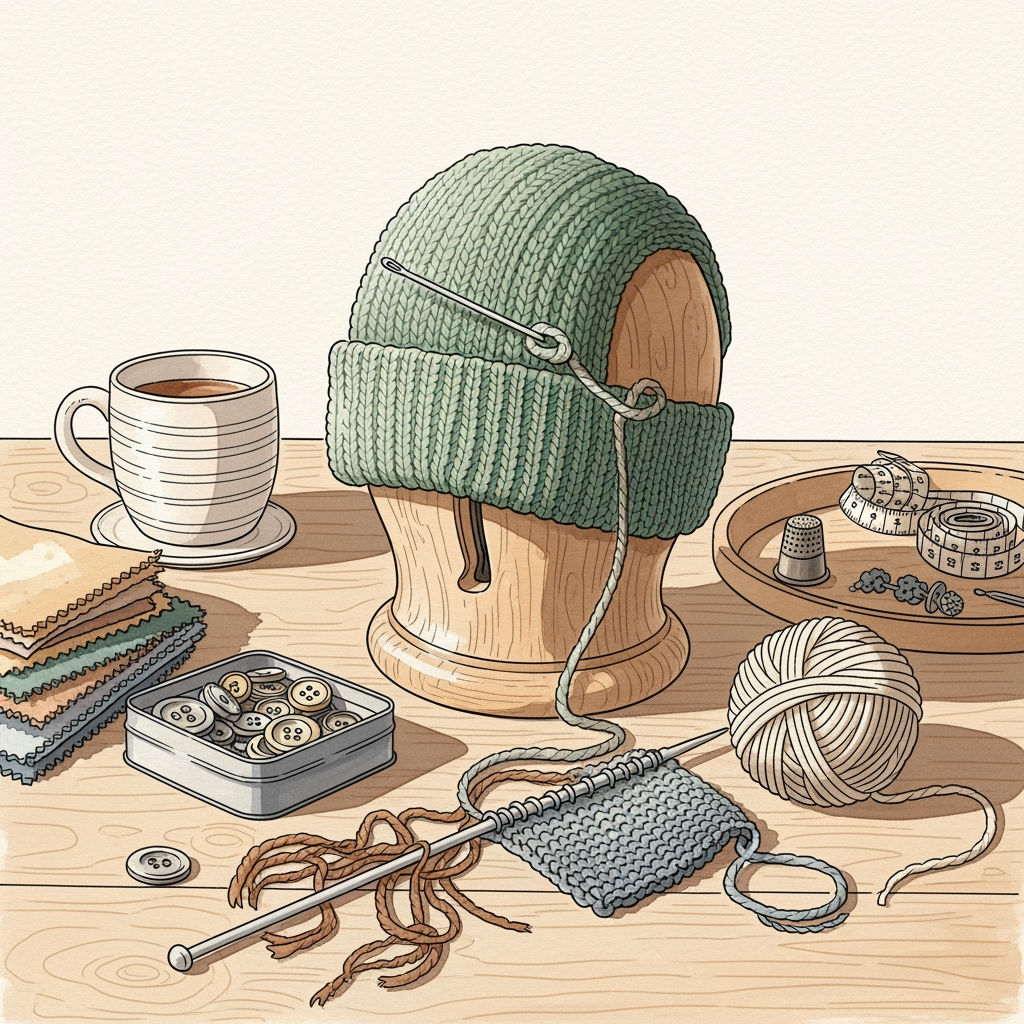
A wooden hat jack is the heavy-duty upgrade to a basic wig head, specifically designed for stretching and maintaining crown diameter. It is an investment piece, but it is essential if you knit custom-sized hats.
The mechanical nature of the jack allows you to expand the hat to the exact centimeter required. This is vital for felted hats, where the shaping must be forced into place as the item dries.
Using a jack also prevents the “collapsing” effect often seen in brimmed hats. By maintaining tension on the crown, the brim naturally follows the intended line, making the final steam-setting process much easier.
KnitPicks Blocking Mats: For Perfect Flat Brims
While wig heads handle the crown, flat blocking mats are essential for hats with wide, horizontal brims. If your project features a sun hat or a fedora-style brim, you need a flat, pinnable surface to create a crisp edge.
The grid lines on these mats help ensure the brim is perfectly symmetrical. Misalignment here is immediately visible, so using a mat to verify evenness on all sides is a step that separates amateurs from pros.
When blocking flat brims, always pin the edge securely. This prevents the brim from curling upward as the fibers dry, which is a common issue with natural protein fibers that have high elasticity.
How to Steam a Hat Brim: A Step-by-Step Guide
- Prep the Form: Place your hat on a wig head or blocking form that matches the intended size.
- Steam the Crown: Apply steam to the crown first to establish the base shape, using gentle hand movements to smooth out any bumps.
- Set the Brim: Steam the brim in circular sections, using your hands to gently coax the fibers into the desired curve.
- Pin and Hold: If the brim requires a specific shape, pin it directly to a blocking mat or use heavy weights to hold it in place.
- Dry Completely: Allow the hat to remain on the form for at least 24 hours. Never handle a hat while it is still damp, as moisture makes fibers susceptible to accidental stretching.
Steam Safety: How Fiber Type Changes Everything
Steam is a powerful tool, but it interacts differently with every fiber. Natural fibers like wool and alpaca absorb moisture and become highly malleable, making them ideal for aggressive blocking.
Conversely, synthetic fibers like acrylic are heat-sensitive and do not “block” in the traditional sense. They respond to heat by slightly melting; this can set a shape permanently, but it risks “killing” the yarn, resulting in a shiny, limp fabric.
Always perform a swatch test if you are unsure of the fiber’s heat tolerance. If the swatch loses its elasticity or changes texture significantly under steam, reduce the heat or switch to a wet-blocking method instead.
Steam Blocking vs. Wet Blocking: Which is Best?
Steam blocking is a surface-level treatment that is excellent for quick shaping and refreshing the silhouette of a hat. It works best when the stitches are already well-formed and only require minor alignment or structural adjustment.
Wet blocking involves soaking the entire garment and is superior for setting the final gauge and “evening out” uneven tension throughout the hat. If you have just finished knitting a hat and want to ensure every stitch is perfectly uniform, wet blocking should always be the first step.
Think of wet blocking as the foundation and steam blocking as the final polish. Use wet blocking to fix the overall sizing, and save your steam tools for the fine-tuning of the brim and the final style presentation.
By selecting the right combination of tools and understanding how your specific fiber responds to heat, you can elevate your hat knitting to a professional level. Consistency is the secret to a polished finish, so take your time and allow your work to set fully before wearing it. Happy knitting.

