6 Best Needle Felting Awls For Hole Punching To Try
Struggling with tough materials? Explore our top 6 needle felting awls for precise hole punching and elevate your crafting projects. Shop our expert guide today!
Finding the perfect tool for creating pilot holes in dense wool or hard-packed felt is essential for success in needle felting and mixed-media projects. A high-quality awl acts as a guide, preventing needles from snapping and ensuring hardware like glass eyes or metal joints sit securely. While many crafters reach for a spare felting needle to poke a hole, a dedicated awl provides the necessary structural integrity for clean, precise entry points. Choosing the right implement makes the difference between a professional-looking finished creature and one that appears makeshift or frayed.
Clover Tapered Awl: Best for General Felting Use


The Clover Tapered Awl stands out as a reliable staple for those who frequently transition between various felting densities. Its smooth, tapered shaft allows the user to control the size of the hole simply by adjusting the insertion depth.
This tool is particularly useful when working with core wool that has been felted to a firm, rock-like consistency. Because the shaft is polished and free of barbs, it glides through fibers without catching or pulling, preserving the integrity of the surrounding structure.
For general purpose use, this awl strikes a balance between portability and utility. While it may lack the specialized grips of more expensive tools, its simplicity makes it an excellent choice for a well-rounded studio kit.
Dimensions Wood Handle Awl: Most Comfortable Grip
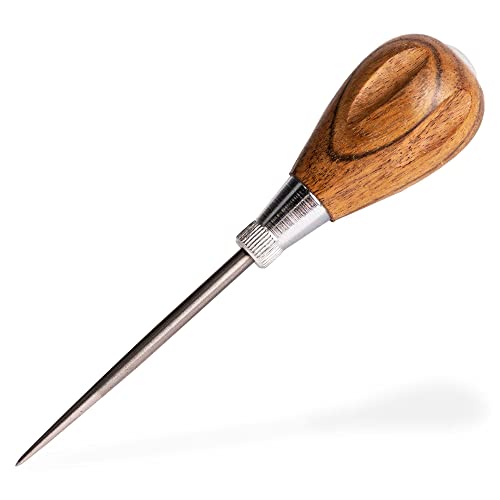
An ergonomic grip is non-negotiable for fiber artists dealing with repetitive motion or lengthy construction sessions. The Dimensions Wood Handle Awl features a contoured, natural wood body that fits snugly into the palm, reducing strain during extended assembly.
A thick, rounded handle provides superior leverage when piercing through multiple layers of felt or fabric-backed projects. This is especially important for crafters who find thin, metal-handled tools difficult to hold steady during detailed work.
Although the wood handle adds a bit more weight compared to plastic alternatives, many find the tactile feel more grounding. It serves as an excellent companion for those who appreciate traditional, durable tools that age well with frequent use.
FeltCraft Pro Awl: Best for Punching Dense Wool
When the goal is to attach heavy hardware or thick stems to a project, a robust, industrial-strength tool becomes necessary. The FeltCraft Pro Awl is engineered specifically to penetrate tightly felted surfaces without buckling or losing its tip shape.
Its hardened steel point ensures that the hole remains uniform, which is vital for preventing the dreaded “wobble” in attached limbs or eyes. Using a weaker needle for this task often leads to bent metal, but this tool maintains its structural rigidity under significant pressure.
This awl is best suited for advanced projects where dimensional accuracy is the top priority. While the larger diameter may be too aggressive for delicate, wispy textures, it is the premier choice for structural felting.
FiberFiend Multi-Tool: The Most Versatile Awl Set
Versatility is the hallmark of the FiberFiend Multi-Tool, which offers interchangeable heads to accommodate different hardware gauges. Rather than juggling multiple standalone tools, this system allows for quick transitions between a fine-point tip and a thicker gauge spike.
The modular design is ideal for creators who work on a variety of project scales, from miniature needle-felted animals to large-scale textile sculptures. Having the correct diameter immediately at hand prevents the common mistake of forcing a large eye into a hole that is too small, which can cause the felt to tear.
Keep in mind that the trade-off for modularity is a slightly higher risk of parts being misplaced. If organization is a strength, this tool will streamline the workflow immensely.
PrecisionPokes Fine Point Awl: For Detail Work

Detail work requires surgical precision, especially when installing tiny beads or minute hardware on delicate faces. The PrecisionPokes Fine Point Awl features an ultra-slim profile that creates barely visible entry points.
This tool is invaluable for high-detail finishing touches where an oversized hole would be visually distracting. Because the point is so fine, it minimizes the disturbance to the surrounding wool fibers, allowing for a seamless transition between the hardware and the felt.
It is best reserved for the final stages of a project after the primary structure is complete. Using it on overly dense or thick materials might risk bending the delicate tip, so gentle, controlled pressure is required.
CraftBasics Felting Awl: Top Budget-Friendly Pick

Not every fiber artist needs a high-end tool to achieve professional results. The CraftBasics Felting Awl offers essential functionality at a price point that makes it accessible for beginners or those building out a secondary kit for workshops.
While the handle may be simpler than premium models, the steel quality is more than adequate for standard hole-punching tasks. It effectively creates pilot holes in moderate-density wool, providing a straightforward solution for securing eyes and joints.
This tool proves that performance does not always require a significant financial investment. It is the perfect entry point for those just starting to experiment with permanent assembly techniques.
What to Look For in a Needle Felting Awl Handle
Handle shape determines how much force can be applied without slipping or causing hand fatigue. A tapered or contoured handle is generally superior to a straight, cylindrical one as it fills the hollow of the palm.
Weight distribution also plays a critical role in stability. Heavier handles made of wood or weighted metal allow gravity to assist with the initial piercing, meaning the user can focus more on accuracy than brute force.
Look for a surface finish that offers a slight grip, such as sanded wood or a matte-texture plastic. Avoid overly slick, polished surfaces that might slide out of the hand when pressure is applied to firm felt.
How to Safely Punch Holes with a Felting Awl
Safety begins with proper stabilization of the project piece. Always place the wool on a firm, supportive felting mat or a block of high-density foam that will catch the awl point once it emerges from the other side.
Approach the puncture with a steady, vertical motion to ensure the hole is uniform rather than slanted. Avoid wiggling the tool excessively, as this will result in a stretched or distorted opening that may not hold hardware securely.
If the felt is extremely dense, consider using a rocking motion to slowly work the tip through the layers. Patience prevents the tool from slipping and potentially piercing the hand holding the project.
Creating Evenly Spaced Holes for Eyes and Joints
Symmetry is often the difference between a amateurish piece and a professional sculpture. Use a tailor’s marking pen or a small stitch marker to pre-calculate the location of the eyes before ever touching the project with an awl.
When installing joints in limbs, ensure the awl passes completely through the limb and the corresponding body section at once. This ensures that the alignment remains perfectly matched, preventing one leg from being positioned higher than the other.
If the eyes are meant to be deeply inset, use a longer awl to create a channel rather than just a shallow hole. This allows the hardware to sink into the wool for a more realistic, “life-like” look.
Awl Maintenance: Keeping Your Tool Sharp and Clean
Over time, even the best steel can become dull or accumulate residual wool oils and static. Gently wipe the shaft with a microfiber cloth after every session to prevent fiber buildup from affecting the puncture diameter.
If the tip begins to feel blunt or catches on the fibers, a light pass with a fine-grit honing stone can restore the point. Never use power tools to sharpen an awl, as the heat generated can ruin the temper of the metal.
Store awls in a protective case or a dedicated block rather than tossing them loosely into a supply bag. Protecting the sharp point is not just about tool longevity, but also about maintaining consistent hole sizes for every future project.
Investing in a dedicated awl transforms the assembly process from a potential frustration into a clean, precise step. By selecting the right tool for the density of the project and maintaining it with care, every fiber artist can ensure their work remains secure and structurally sound for years to come.