6 Best Notebook Sleeves For Pattern Storage To Organize
Organize your collection with our top 6 notebook sleeves for pattern storage. Protect your designs and streamline your workspace today. Explore our best picks now.
Every knitter knows the frustration of searching for a misplaced pattern page while in the middle of a complex lace chart. A scattered collection of printed instructions is the fastest way to lose momentum on a project. Protecting these documents from spilled tea, errant yarn ends, and general wear ensures that a well-loved pattern stays usable for years to come. Investing in proper storage is as essential to your craft as choosing the right yarn weight or needle material.
Della Q Pattern Holder: The Premium Folio Pick


The Della Q Pattern Holder stands out as the gold standard for makers who view their projects as long-term investments. This folio is constructed from high-quality canvas, offering a tactile durability that plastic alternatives simply cannot match. It is designed to stand upright, functioning as a hands-free reading desk while you work through stranded colorwork or intricate cables.
The internal magnetic strips are the real functional stars here. These allow for precise line tracking on complex charts without the need for adhesive tape that might leave residue on paper. Because the exterior is robust, this holder keeps paper edges from curling or fraying, even when tossed into a heavy project bag filled with metal circular needles and wooden DPNs.
While the price point is significantly higher than standard office supplies, the value lies in its longevity. If the goal is a singular, reliable workspace that organizes charts and essential notions in one place, this is the definitive choice. It is a one-time purchase that eliminates the need for repeated replacements of cheaper, flimsy plastic sleeves.
The Knitter’s Pride Folio: An All-in-One System

This folio is built specifically for the knitter who prefers to keep their entire project workflow contained in a single, compact unit. It functions like a book, with dedicated sleeves that protect pattern pages from blocking water, humidity, and dye transfers from vibrant fibers. The design is sleek enough to slide into a tote without adding unnecessary bulk.
A standout feature is the inclusion of pockets for stitch markers, needles, and a tape measure. By centralizing the tools needed to manage gauge swatches and row counts, this folio reduces the time spent digging through various notions cases. It essentially turns every knitting session into a mobile studio.
Understand that this is a closed system; the capacity is finite. It works best for those who prefer to keep one or two active projects organized at a time. For the project hopper who has five different garments on the needles simultaneously, the lack of expandability might be a limiting factor.
Avery Heavyweight Sleeves: The Most Durable Option

Sometimes, the best solution is found in the office supply aisle rather than the craft store. Avery Heavyweight Sleeves are engineered to withstand decades of handling, making them ideal for the archives of a prolific pattern collector. These sleeves are significantly thicker than standard protectors, preventing the “crinkle” and eventual tearing that happens when patterns are frequently referenced.
These sleeves are non-stick, meaning toner or ink from your printer will not lift off the page and adhere to the plastic over time. This is a critical feature if you print patterns on high-quality paper with detailed, heavy-ink illustrations. Even if a sleeve gets caught on a sharp point of a bamboo needle, it is unlikely to puncture or rip.
The tradeoff here is the texture. The thick plastic has a slight glare under bright task lighting, which can sometimes make reading fine-print charts a bit more straining on the eyes. However, for long-term storage of cherished vintage patterns, the superior protection provided by the heavyweight construction is unmatched.
C-Line Project Folders: Best for Portability
If the primary concern is carrying a single, active pattern from a local yarn shop to a knit night, C-Line project folders are the most practical solution. These are essentially L-shaped, clear plastic jackets that allow for instant access to a pattern. There is no need to open rings or slide paper into a narrow slot; simply pull the sheet out and get to work.
The material is thin and flexible, conforming to the shape of the bag rather than forcing the bag to conform to a rigid folio. This makes them ideal for small project bags used for sock knitting, where space is at a premium and a heavy binder would be cumbersome. They keep the pattern clean but allow for rapid, intuitive retrieval.
Be aware that these folders do not offer the same level of moisture protection as sealed sleeves. A spilled drink will seep into the open edge if you are not careful. Use these as a day-to-day workhorse rather than a long-term storage archive.
AmazonBasics Sheet Protectors: Budget-Friendly
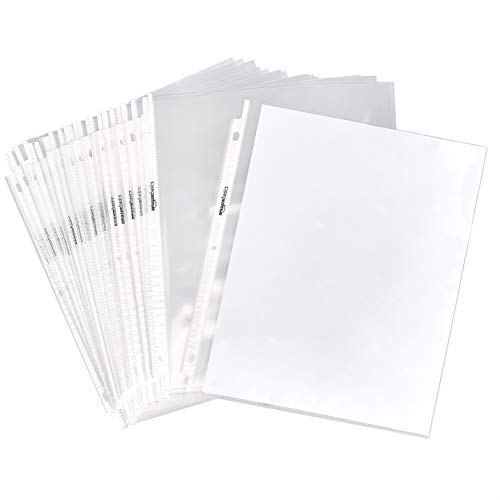
For the knitter with a massive library of printed patterns who needs an economical way to organize everything at once, standard budget sheet protectors are the logical answer. These are sold in large bulk quantities and are designed to slide easily into any standard three-ring binder. They are utilitarian, clear, and perfectly suited for the task of basic organization.
These protectors are lightweight and thin, which is helpful if you are consolidating dozens of patterns into a single binder. They do not add significant weight or thickness to the stack. If you have a collection that spans years of craft magazines and individual pattern downloads, this is the most cost-effective way to get them off your shelf and into a usable format.
Do not expect the same durability as professional-grade sleeves. The punch holes where they connect to the binder can tear if the binder is overstuffed. Keep these strictly for filing purposes rather than high-frequency use at the knitting chair.
At-A-Glance Folio: Best for Multiple Projects
The At-A-Glance system is designed for the knitter who manages multiple complex projects simultaneously. It features a sophisticated, multi-pocket arrangement that allows for high-level organization of active charts, yarn swatches, and handwritten notes. It acts as an administrative hub for the craft.
The structure is rigid, which provides excellent support if you prefer to prop your pattern up while working. It is professional enough for a designer or a dedicated workshop teacher, providing enough space to separate different project requirements without cross-contamination. It encourages a highly disciplined approach to project management.
The primary drawback is the footprint. It occupies a considerable amount of table space, which might be inconvenient in a small living area. Use this if your knitting space is a dedicated desk or a large side table where you can keep your tools stationary and organized.
How to Choose the Right Sleeve for Your Needs
Selecting the right sleeve depends entirely on how you move through a project. If you are a mobile knitter, prioritize flexibility and weight, choosing folders or slim sleeves that adapt to your bag. If you are a stationary knitter who works at a dedicated desk, a rigid folio or a high-capacity binder system will serve you better.
Consider the complexity of your patterns as well. Intricate cable or lace work requires a sleeve that can support a magnetic row counter or allow for marking with dry-erase pens. If you only knit simple stockinette items, a basic, clear sleeve will suffice.
- For the Traveler: Prioritize lightweight, flexible, and slim profiles.
- For the Archiver: Look for acid-free, non-stick, and heavyweight materials.
- For the Project Hopper: Choose systems that can be easily rearranged or expanded.
Binder, Folio, or Sleeve: Which Is Best for You?
The choice between a loose sleeve, a folder, or a full binder system comes down to your organizational personality. Binders are the ultimate choice for the “collector” who wants a searchable, indexed library of every pattern they have ever purchased. Once a pattern is in a binder, it is safe, indexed, and easy to find, but it is not particularly portable.
Folios act as the bridge between storage and the active project. They are the “desk” of the knitting world, housing not just the paper, but the tools required to execute the instructions. They are perfect for those who want their project setup to be “plug and play.”
Loose sleeves are the most versatile but the most prone to getting lost. They are best used as a temporary solution for a current project before filing the final result away. Use them to keep your immediate work surface clear, but don’t rely on them as your sole system of record.
Protecting Your Patterns: Lamination vs. Sleeves
Lamination is a permanent commitment that seals a pattern forever, making it impervious to water, grease, and wear. However, it also makes the pattern impossible to alter, annotate, or fold. Once a pattern is laminated, it is essentially a rigid board, which can be difficult to store alongside standard paper documents.
Sleeves offer the best of both worlds. They provide physical protection from spills and dirt but allow for the paper to be removed if you need to make notes or adjust the pattern as you go. For most knitters, the flexibility of a sleeve is far superior to the permanence of lamination.
Only consider lamination if you are working on a pattern that will be used by many people in a high-traffic environment, such as a community knitting circle or a public classroom. For individual use, the ability to swap, update, and replace patterns within a sleeve is far more valuable.
Tips for Organizing Your Printed Pattern Library
Organization is useless if the system is too complicated to maintain. Start by grouping your patterns by project type: socks, sweaters, shawls, and home decor. This allows you to quickly narrow down your options when you have a specific yarn in your stash you are dying to use.
Use a simple, consistent labeling system on the tabs of your binders or the spines of your folios. Include the needle size and yarn weight used for the project on the front of the sleeve, as this acts as a quick reference for future modifications. It saves you from having to dig through your project journal just to remember what needle you used for that particular gauge.
Finally, purge your collection periodically. If a pattern has been sitting in a sleeve for five years and you know you will never knit it, donate it to a fellow knitter. Keep your library focused on the projects that truly inspire you and fit your current skill level.
Proper pattern storage is the unsung hero of a successful knitting practice, bridging the gap between inspiration and a finished garment. Whether you choose a high-end folio for your precious lace projects or a stack of budget-friendly sleeves for your reliable staples, the investment in organization pays off in every finished row. By keeping your instructions protected and accessible, you free your mind to focus on the meditative rhythm of the needles rather than the frustration of a misplaced chart. Consistent, thoughtful storage will ensure that your library remains a source of joy rather than a source of stress for years to come.