6 Best Led Task Lamps For Color Matching Yarns
Find the perfect lighting for your craft with our top 6 LED task lamps for color matching yarns. Read our guide to shop the best options for your studio today.
Struggling to differentiate between a deep navy and a midnight black during a late-night knitting session is a common frustration for every fiber artist. The right lighting is not just a luxury; it is a critical tool that prevents eye strain and ensures that gauge and color transitions remain consistent. When working with complex stranded colorwork or subtle heathered yarns, ambient room lighting rarely provides the clarity needed to spot dropped stitches or subtle color shifts. Proper illumination transforms a dim workspace into a professional-grade studio, allowing for hours of strain-free crafting.
OttLite 24W Floor Lamp: Best Overall Color Clarity


The OttLite 24W floor lamp remains a gold standard for those who demand uncompromising color accuracy. Its signature technology is engineered to mimic natural daylight, which is essential when matching skeins for large-scale projects like blankets or sweaters where dye lots might vary slightly.
When dealing with high-contrast yarns, such as white against charcoal, this lamp eliminates the color-skewing yellow tint found in standard household bulbs. It provides a crisp, neutral illumination that allows the true undertones of the fiber to shine through.
While the footprint is larger than some desk models, the stability and reach of the adjustable arm make it ideal for floor-standing craft chairs. It is the premier choice for makers who spend long sessions working on detailed textures or complex cable patterns.
Brightech Litespan LED: Top Budget-Friendly Choice
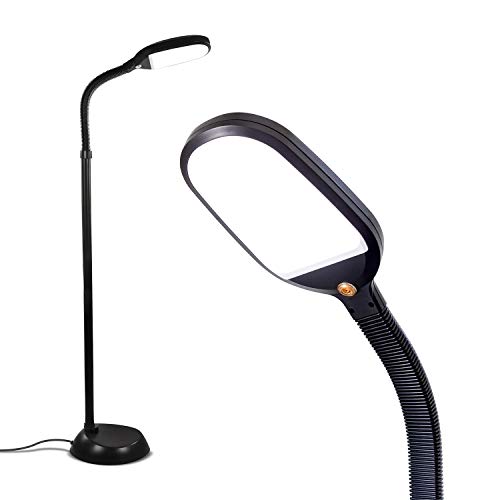
The Brightech Litespan LED serves as a practical, high-value solution for knitters who need reliable task lighting without a premium price tag. It offers a clean, bright beam that effectively reduces the eye fatigue often associated with dark yarns or fine-gauge lace work.
The lamp features a gooseneck design that allows for pinpoint adjustments, moving easily from a knitting chair to a desk setup. This versatility is perfect for crafters who share their workspace or need to move equipment frequently.
While it lacks the advanced spectrum-adjusting features of more expensive models, it excels at providing steady, flicker-free light. It is an honest, utilitarian tool that does exactly what a knitter needs: it illuminates the work clearly so that every stitch remains visible.
Daylight DuoLamp Magnifier: For Intricate Lacework
The Daylight DuoLamp Magnifier is an essential piece of equipment for knitters working with lace-weight yarn on tiny needles. The integrated magnifying lens allows for close-up inspection of delicate stitches, making it easier to identify mistakes in a complex lace chart before they propagate.
The dual-mode lighting allows for both task-specific precision and wider area coverage. This is particularly helpful when checking the tension of a delicate mohair or silk blend, where stitch consistency is difficult to see with the naked eye.
Be aware that the magnifying element takes some getting used to; initial use may feel disorienting during active knitting. For those struggling to see tiny stitches on dark needles, however, the clarity it provides is unmatched.
Neatfi Clip-On LED Light: Best for Portability

The Neatfi Clip-On LED light is designed for the knitter who frequently transitions between a home studio and a local knitting group or travel project. Its heavy-duty clamp attaches securely to a variety of surfaces, ensuring the light stays exactly where needed without taking up valuable table space.
The wide lamp head provides an expansive pool of light, covering large sections of knitting without the need for constant repositioning. This is especially useful when knitting on a 32-inch circular needle where the fabric is spread across a large area.
While it is portable, ensure the mounting surface is sturdy enough to support the weight of the lamp. It offers a professional, focused beam that can elevate the lighting quality of even the most makeshift knitting nook.
BenQ e-Reading LED Lamp: Best for Color Adjusting
The BenQ e-Reading LED lamp stands out for its ability to adjust color temperature and brightness based on the surrounding environment. For a knitter, this means the light can shift from a warm, cozy hue in the evening to a sharp, cool white during the day when accurate color matching is paramount.
The curved design of the head is deliberate, casting light across a wider surface area rather than just a single point. This creates a soft, balanced light that prevents harsh shadows on the knitting project, even when working with bulky yarns that can obscure stitch definition.
The price point is significantly higher, reflecting its advanced sensor technology. However, for a dedicated fiber artist who knits across all hours of the day, the ability to customize the light to the specific yarn color is a game-changer.
Cricut Bright 360 Desk Lamp: Crafter’s Favorite
The Cricut Bright 360 is widely popular among multi-disciplinary crafters because it offers exceptional, uniform light coverage with a significant range of motion. The arm moves smoothly, allowing the light to hover perfectly over the needles, whether the project is held in the lap or placed on a table.
What sets this model apart is its color rendering capability; it is designed to show the true nature of colors, which is vital when mixing different yarn brands or fiber types. If you are blending wool, alpaca, and silk in a single garment, the light accurately reveals how these fibers capture and reflect light differently.
It is a substantial piece of equipment that commands a fixed spot in the studio. For the serious knitter who views their craft as a long-term investment, the build quality and consistent light output are well worth the space it occupies.
How to Choose a Lamp for True-to-Life Yarn Color
When selecting a lamp for fiber arts, color accuracy should take precedence over sheer brightness. A lamp that is too bright but has poor color rendering will wash out the nuances of hand-dyed yarns, making it impossible to check for consistency.
Consider these three factors before making a final decision: * Color Temperature: Aim for a range between 4000K and 5000K to achieve a “daylight” feel that prevents color distortion. * Adjustability: A flexible arm or head allows you to move the light source closer to the needles, which is crucial for dark yarns or complex cables. * Flicker-free Technology: Low-quality LEDs can pulse at a frequency that causes eye strain, which often goes unnoticed until the end of a long knitting session.
Always prioritize lamps that advertise a high Color Rendering Index (CRI). If a product does not specify its CRI, it is usually a sign that color accuracy was not a design priority.
What is CRI and Why It Matters for Color Matching
The Color Rendering Index (CRI) is a measurement on a scale of 0 to 100 that indicates how accurately a light source displays colors compared to natural sunlight. For knitters, a CRI of 90 or higher is highly recommended to ensure that the yarn color you see indoors is the same color that will appear once the project is finished.
Low CRI lighting can make blues look greenish and reds look muddy, which is detrimental when working on colorwork projects like Fair Isle or Intarsia. Without a high CRI, the subtle differences between two shades of green might look identical under a standard desk lamp, only to clash once the project is blocked and worn.
Think of CRI as the “truth-teller” for your yarn stash. A high-CRI light allows the fibers to show their true character, helping you identify subtle differences in ply and tone that would otherwise be hidden.
Natural Light vs. LED: A Knitter’s Comparison
Natural daylight is the gold standard for yarn color matching, but it is rarely consistent enough for the average knitter. As the sun moves, the color temperature of the room shifts from warm yellow to cool blue, which changes the appearance of your yarn while you work.
LEDs provide a consistent, stable environment that eliminates the variability of the sun. While sunlight is the benchmark, high-quality, full-spectrum LEDs are designed to mimic that consistency throughout the day and night.
For the most accurate results, use LED lamps to supplement natural light rather than compete with it. If the goal is to finish a project with perfect color transitions, a high-quality lamp is an essential partner to the fluctuating, yet beautiful, natural light of the morning.
Lamp Placement Tips for Shadow-Free Knitting
Proper lamp placement is just as important as the quality of the bulb. The goal is to position the light source to eliminate shadows caused by your hands, the needles, or the yarn itself, which can mask the definition of individual stitches.
- Positioning: Place the light slightly to the side of your dominant hand to minimize the shadow cast by your needles or hooks.
- Height: Keep the light source low enough to provide focused intensity but high enough to avoid creating a harsh glare on your project.
- Angles: Experiment with tilting the lamp head at different angles to highlight the texture of the yarn, which is particularly helpful for moss stitch or cables where depth is key.
If you find yourself hunching over to get a better look at your work, the light is either not bright enough or is positioned too far away. Adjusting the light source to be closer to your hands, rather than moving your body toward the light, will significantly improve your comfort over long sessions.
Finding the right lamp is an investment in the longevity of your craft and the quality of your finished garments. By focusing on high color rendering and ergonomic adjustability, you can ensure that every stitch is placed with precision, regardless of the time of day. Investing in these tools allows you to focus on the rhythm of the needles rather than the frustration of poor visibility.