6 Weaving Shuttles For Pattern Creation To Consider
Looking to level up your craft? Explore these 6 weaving shuttles for pattern creation to improve your designs and streamline your loom work. Read the guide now.
Weaving is the natural evolution for many fiber artists who have mastered the nuances of yarn tension and fiber memory through years of knitting. While a loom provides the structure, the shuttle acts as the conduit, dictating how a pattern flows across the warp. Choosing the right shuttle is not merely about convenience; it is about matching the weight, friction, and mechanics of the tool to the specific fiber and design goals of the textile. Understanding these six essential shuttles ensures that every pick contributes to a professional, finished result.
Schacht Stick Shuttles: The Versatile Go-To


Stick shuttles are the bedrock of manual weaving, offering a direct, tactile connection to the warp threads. Their flat, simple profile makes them ideal for beginners who are still refining their control over edge tension.
Because they lack moving parts, these shuttles are exceptionally durable and rarely require maintenance. They excel when working with thicker yarns or intricate pick-up patterns where the weaver needs to manipulate individual warp ends by hand.
However, stick shuttles require the weaver to physically throw or slide the tool through the shed, which can become labor-intensive on wide looms. Choose a length that corresponds to your loom width to ensure efficient movement without the shuttle tipping or snagging.
Ashford Boat Shuttle: Best for Smooth Weaving
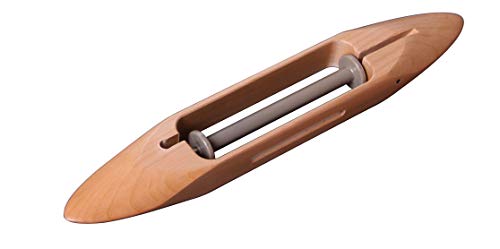
The boat shuttle is designed for speed and consistency, operating on the principle of a weighted, aerodynamic base that glides effortlessly through the shed. By housing a bobbin, it allows for a continuous, steady feed of weft yarn, which is vital for maintaining an even gauge across long yardage.
For those transitioning from knitting, the boat shuttle provides a rhythm similar to the mechanical consistency of a high-quality circular needle. It significantly reduces the physical effort required to pass the weft, allowing for longer weaving sessions without wrist fatigue.
The weight of the shuttle is a critical factor here. A heavier shuttle helps beat the weft into place, but one that is too heavy can cause undue stress on fragile fibers like hand-spun silk or lace-weight mohair.
Bluster Bay End-Feed: For Perfect Pattern Edges
End-feed shuttles are the secret weapon for achieving professional, perfectly straight selvedges. Unlike standard boat shuttles that release yarn from the side, these tools use a tensioning system to pull the yarn from the end, ensuring it is delivered with consistent pressure.
This uniform tension prevents the “draw-in” common in beginner weaving, where the edges of the fabric pull inward and create an uneven profile. For weavers accustomed to the precision of blocking a stranded colorwork sweater to perfect dimensions, the end-feed shuttle offers the same level of structural control.
These are an investment and require a learning curve to properly wind and thread. They are best reserved for projects where high-quality finishing and uniform width are the primary design objectives.
Leclerc Ski Shuttle: For Bulky, Textured Designs
The ski shuttle features a unique curved underside that allows it to glide over the warp threads without snagging, making it a favorite for rug weaving and thick, textured blankets. Its shape mimics the runners of a sled, providing a smooth path even when the shed is tight or the warp is densely set.
This tool is specifically suited for working with heavy, rustic yarns, such as bulky wools or novelty textures that would struggle to fit through the narrow opening of a traditional boat shuttle. It is an essential choice for those who value the “thump” of a heavy, substantial piece.
Because of its design, it is less suited for delicate, fine-gauge weaving. The sheer surface area can be cumbersome on narrow looms, so reserve this tool for projects where the scale of the yarn demands extra clearance.
Glimakra Belt Shuttle: Essential for Band Weaving
Band weaving requires a tool that can navigate narrow spaces while remaining easy to handle during complex pattern pick-ups. The Glimakra belt shuttle is slim, tapered, and designed for high-tension work, which is common when crafting sturdy straps, bookmarks, or decorative trim.
When you are creating patterns that involve changing colors frequently or manipulating warp threads to form geometric motifs, the compact size of a belt shuttle keeps the workspace clear. It is the shuttle-equivalent of using double-pointed needles for a small-circumference project.
Always consider the wood finish when selecting these tools. A smooth, polished surface is vital to prevent snagging on fine cotton or linen warps during the repeated friction of band weaving.
Schacht Tapestry Bobbins: For Intricate Colorwork
Tapestry bobbins are designed to carry small amounts of yarn for isolated blocks of color, acting similarly to a fair-isle technique where bobbins are used to prevent tangling. They allow for precise control in weft-faced designs, where the pattern is created by the color of the weft rather than the structure of the weave.
These tools are lightweight and allow for rapid maneuvering, which is necessary when working multiple small color patches at once. They are indispensable for weavers who are “painting” with yarn.
Managing a dozen or more bobbins simultaneously can be overwhelming, similar to managing floats in a complex colorwork sweater. Start with a smaller number of colors to master the tension before attempting more intricate, multi-hued pictorial designs.
Choosing a Shuttle: Match the Tool to Your Loom
The primary constraint in shuttle selection is the size of the loom’s shed, which is the opening created between warp threads. A shuttle that is too tall will jam, while one that is too short may lack the weight needed to clear the shed cleanly.
Always measure the height of the warp opening when the shed is at its maximum. A general rule of thumb is that the shuttle should occupy no more than two-thirds of the total shed height to ensure smooth, snag-free passage.
If you are working on a rigid heddle loom, boat shuttles are often too bulky, making the stick shuttle the most practical choice. Floor loom users have more versatility, but should match the shuttle weight to the durability of the warp yarn.
Boat vs. Stick vs. Belt: Which Shuttle is Best?
Stick shuttles offer the highest level of control for complex hand-manipulated patterns but are slow for standard production. Boat shuttles represent the best balance of speed and tension for standard garments or household textiles.
Belt shuttles occupy a niche for narrow-width weaving where maneuverability is the priority. There is no single “best” shuttle; instead, there is the right tool for the specific architectural demands of the pattern being created.
For beginners, owning one of each—a stick shuttle for pick-ups and a boat shuttle for plain weave—will cover 90% of all potential project needs. Invest in quality wood, as it will naturally absorb oils from the hands and become smoother and more efficient over time.
How to Wind a Bobbin for a Flawless Fabric
Improperly wound bobbins are the leading cause of “jerkiness” in the weft, which results in uneven fabric texture. A bobbin should be wound evenly from end to end, creating a slightly convex shape that prevents the yarn from spilling over the edges.
If the yarn is wound too tightly, it will lose its elasticity and snap during the beat, leading to broken threads. If it is too loose, the bobbin will unspool uncontrollably, causing tangles within the shuttle.
Use a bobbin winder to ensure consistent speed and tension, especially when working with high-twist wools or inelastic linens. Test the tension by pulling the yarn manually after winding; it should flow smoothly without dragging against the shuttle sides.
Using Multiple Shuttles for Complex Color Patterns
Using multiple shuttles is the weaving equivalent of intarsia knitting, where different sections of the fabric are worked with different yarn sources. This technique is used for creating bold color blocks or large-scale motifs that are too wide for a single shuttle to handle comfortably.
When working with multiple shuttles, the transition points—where two colors meet—must be overlapped or twisted to prevent vertical gaps in the fabric. This requires careful attention to the “join” to ensure the weight of the weft is consistent at the transition point.
Keep the work area clean and organized; tangled bobbins are the quickest way to lose the rhythm of a project. Using a shuttle rack or designated trays will keep the shuttles ready for immediate use and prevent the frustration of crossing threads.
Selecting the right shuttle is a journey of refinement, much like choosing the perfect needle for a delicate lace project. By matching the weight, shape, and mechanics of the shuttle to your specific fiber and loom, you bridge the gap between technical execution and artistic expression. As you develop your preferences, trust in the way the tool feels in your hand and the resulting consistency of your selvedges. Happy weaving.