7 Best Weaving Kits For Total Beginners To Try
Discover the 7 best weaving kits for beginners. These curated sets provide all essential tools and instructions to help you master basic loom techniques easily.
Stepping into the world of weaving is a natural progression for any knitter who has spent years obsessed with the structure of yarn. While knitting builds fabric through interlocking loops, weaving creates a stable, structural grid that offers a completely different tactile experience. These seven kits provide the perfect entry point for those looking to expand their fiber arts repertoire. Choosing the right loom is the first step toward mastering the interplay of warp and weft.
Schacht Cricket Rigid Heddle Loom: Best Overall
The Schacht Cricket is the gold standard for a reason: it is incredibly sturdy and intuitive for someone used to the ergonomic flow of knitting. Its rigid heddle design simplifies the shedding process, allowing you to create clean, consistent shed openings for your shuttle to pass through.
For a knitter, the "warp" is essentially your foundation, much like the setup rows of a long-tail cast-on. The Cricket handles tension beautifully, which is vital because uneven tension in weaving—much like uneven knitting tension—will result in wonky, distorted fabric.
The beauty of this loom lies in its versatility. You can weave anything from airy cotton scarves to dense, woolly table runners, making it a reliable workhorse for your studio.
Ashford SampleIt Loom: Best Compact Starter Kit
If you are tight on space, the Ashford SampleIt is a brilliant solution that tucks away into a closet between projects. It is designed specifically for sampling, which is a concept every knitter should embrace before committing to a ten-skein sweater project.
This loom allows you to test how different yarn weights behave when woven, helping you understand the "draw-in" effect where your fabric shrinks slightly in width. It is a low-stakes environment that encourages experimentation without the pressure of a massive project.
While it is small, the build quality is high, ensuring that your warp doesn’t sag or lose tension. It is the perfect choice for those who want to weave while sitting on the couch, much like working on a small circular needle project.
Beka 20-Inch Weaving Loom: Best For Large Projects
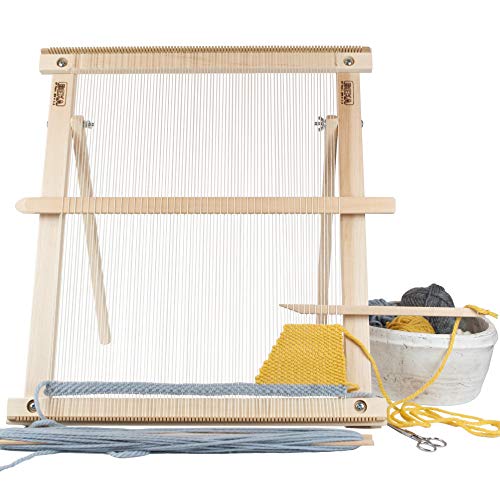

When you are ready to graduate from scarves to wider home textiles, the Beka 20-inch loom provides the necessary real estate. This frame loom is excellent for those who prefer a more tactile, hands-on approach without the complexity of a rigid heddle mechanism.
Because it is a frame loom, you have total control over the warp spacing, which is ideal if you are working with handspun art yarns. Handspun yarn often varies in thickness, and a rigid heddle might struggle with thick slubs, whereas a frame loom lets you weave around those irregularities.
Be aware that you will need to manage your own tension manually, which requires a bit more focus than a geared loom. It is a fantastic tool for learning the fundamental "over-under" rhythm of weaving.
Melissa & Doug Multi-Craft Loom: Best For Budget
Don’t let the "toy" label fool you; this loom is a surprisingly effective way to learn the mechanics of weaving without a heavy financial investment. If you are curious about the craft but aren’t ready to commit to a professional-grade setup, this is a great place to start.
It is perfect for practicing basic techniques like plain weave or adding fringe, which can then be applied to more complex projects later. Think of it like a set of bamboo needles—it gets the job done and teaches you the basics without the bells and whistles.
The tradeoff is stability; you may need to secure it to a table to prevent it from sliding while you work. For the price, it is an unbeatable entry point into the world of warp and weft.
Kromski Harp Forte Rigid Heddle: Best Professional

The Kromski Harp Forte is for the knitter who knows they are going to fall in love with weaving and wants a "buy it for life" piece of equipment. The craftsmanship is exquisite, featuring beautiful European alder wood that feels as good as it looks.
One of the standout features is the built-in warping board on the back of the loom. This is a game-changer for efficiency, as it allows you to measure your warp threads directly on the loom frame, saving you significant setup time.
If you are a knitter who appreciates the feel of high-quality wooden needles, you will appreciate the finish on this loom. It is an investment, but it offers a level of precision that makes complex colorwork and intricate pick-up patterns much easier to manage.
Harrisville Designs Lap Loom: Best For Portability

Harrisville Designs is legendary in the fiber arts community for their commitment to traditional quality. Their lap loom is compact, lightweight, and designed to be taken anywhere, much like a project bag full of sock yarn.
This loom is ideal for tapestry weaving, where you are working with small sections of color at a time. If you enjoy intarsia knitting, you will likely find the color-blocking process of tapestry weaving to be a natural extension of your skills.
Because it is a lap loom, you don’t have the mechanical heddle to lift your warp threads, so you will be doing more manual manipulation. It is a slow, meditative process that rewards patience and precise hand movements.
Ashford Knitters Loom: Best For Travel Weaving
The Ashford Knitters Loom is specifically designed to fold in half, even while warped. This is a massive advantage for the weaver who wants to take their project to a guild meeting or on a retreat, ensuring you never have to stop your momentum.
It comes with a padded carry bag, which protects the loom from dings and keeps your shuttle and tools contained. For a knitter, this is the equivalent of having a secure, organized project bag for your circular needles and notions.
The tensioning system is robust enough to handle the rigors of travel without shifting. It is a highly practical choice for the maker who refuses to leave their craft behind when they leave the house.
Essential Tools Every New Weaver Should Acquire
Just as you wouldn’t knit without a tapestry needle or a pair of scissors, weaving requires a specific set of tools to ensure success. These tools help manage the tension and structural integrity of your cloth:
- A warping peg: Essential for measuring out your warp threads to the correct length.
- A shuttle: The "needle" of the weaving world, used to carry your weft yarn through the shed.
- A pick-up stick: Used to create patterns by lifting specific warp threads.
- A measuring tape: Precision is just as important in weaving as it is when checking your knitting gauge.
Understanding Basic Weaving Terms and Techniques
Weaving has its own vocabulary, but it maps surprisingly well to knitting concepts. Understanding these terms will help you troubleshoot your projects and follow patterns with confidence:
- Warp: The vertical threads held under tension on the loom; think of these as your "live stitches" waiting to be worked.
- Weft: The horizontal yarn that you weave through the warp; this is your "working yarn."
- Shed: The opening created between the warp threads, through which the shuttle passes.
- Beat: The act of pushing the weft yarn into place with your reed or comb; this determines the density of your fabric, similar to how needle size affects knitting gauge.
How to Select Your First Weaving Project Yarn
When choosing yarn for your first project, prioritize stability and visibility over luxury fibers. Avoid dark, fuzzy, or mohair-like yarns, as these will make it nearly impossible to see your warp threads or fix mistakes.
- Choose smooth, plied yarns: A standard wool or cotton blend with a tight twist is much easier to manage than a single-ply yarn.
- Check the WPI (Wraps Per Inch): This helps you determine the weight and how closely you should space your warp threads.
- Opt for light colors: You need to see the structure of your warp to ensure you haven’t skipped a thread.
Weaving is a rhythmic, rewarding craft that will fundamentally change how you look at the fabric you create. Whether you choose a compact frame loom or a professional rigid heddle setup, the key is to start with a project that teaches you the basics of tension and shed management. Remember that every weaver, like every knitter, develops their own unique style and rhythm over time. Embrace the learning curve, keep your tension consistent, and enjoy the process of turning simple strands of yarn into a cohesive, structural work of art.