
6 Best Hand Carders For Fiber Preparation For Spinners
Discover the top 6 hand carders for spinners. This guide compares key features to help you choose the best tools for smooth, efficient fiber preparation.
Hand carding is the meditative bridge between a raw, tangled fleece and the smooth, consistent yarn you dream of knitting into your next heirloom. Choosing the right tool isn’t just about moving fiber; it’s about matching the density and length of your wool to the specific geometry of the carding cloth. Whether you are prepping a lofty woolen-spun sweater or a tight, worsted-spun sock yarn, your carders are your most important prep tool. Here is a guide to selecting the perfect pair for your fiber journey.
Strauch Petite Hand Carders: Best Overall Pick
If you find yourself prepping everything from fine Merino to medium-staple Corriedale, the Strauch Petite carders are the gold standard for versatility. They feature a smaller, lightweight paddle that prevents wrist fatigue during long sessions of blending colors or removing vegetable matter.
The carding cloth on these is incredibly high quality, offering a density that grabs fibers effectively without tearing them. Because they are smaller, they allow for a more controlled stroke, which is essential if you are trying to create a smooth, air-filled batt for a lofty, warm garment.
The main trade-off is the surface area; you won’t be processing large amounts of fleece in record time. However, for the knitter who values precision and wants a tool that handles 90% of common fiber types with ease, these are the clear winner.
Ashford Fine Cotton Carders: Best for Fine Fibers
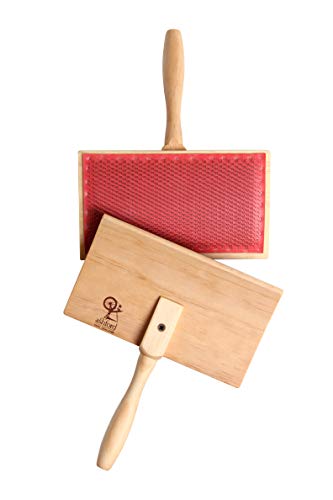

When you are working with delicate fibers like Angora, silk, or ultra-fine Merino, standard carders can be too aggressive, leading to fiber breakage. The Ashford Fine Cotton carders feature a very high TPI (teeth per inch) count, which is specifically designed to tease apart fine, short staples without shredding them.
Think of these as the "fine-gauge needles" of your fiber prep kit. Just as you wouldn’t use size 8mm needles for a lace-weight project, you shouldn’t use coarse carders on delicate luxury fibers. These carders ensure your fiber remains aligned and airy, preserving the crimp and loft that make fine yarns so soft.
Be aware that these are not for the heavy-duty work of opening up a greasy, coarse sheep fleece. They are precision instruments that require a gentle hand to get the best results.
Clemes & Clemes Standard Carders: Best Durability
There is a reason you see these in studios that have been operating for decades; they are built like tanks. If you are the type of knitter who wants to buy one tool and never worry about replacing it, the Clemes & Clemes standard carders are your best bet.
The wood is robust, and the carding cloth is set firmly, meaning you won’t experience the "lifting" or loose teeth that plague cheaper alternatives. They provide a consistent, reliable tension that makes the rhythmic motion of carding almost hypnotic.
They are slightly heavier than the modern plastic-backed alternatives, which some find tiring. However, that weight actually helps the carders do the work for you, letting gravity assist in the flicking and pulling motion.
Louet Curved Back Hand Carders: Best Ergonomics
The physical act of carding can be taxing on the wrists and forearms, especially if you have a large fleece to process. The Louet Curved Back carders are designed to follow the natural contour of your hand, reducing the strain that leads to repetitive stress issues.
The curved surface also changes the geometry of the fiber path, making it easier to load and unload the carders. This is particularly helpful when you are working with slippery fibers like alpaca or mohair that tend to slide off flatter surfaces.
If you have any history of wrist pain or just want to ensure you can keep carding well into your later years, this ergonomic design is a game-changer. They prioritize your physical comfort without sacrificing the quality of the carding cloth itself.
Schacht Coarse Wool Carders: Best for Raw Fleece

When you bring home a raw, greasy fleece from a sheep show, you need a tool that can handle the grit and the density of the wool. The Schacht Coarse Wool carders have longer, sturdier teeth spaced further apart, which is essential for opening up tight locks.
Using fine carders on a raw, coarse fleece will result in a jam that ruins your fiber and frustrates your process. These carders act as the "heavy-duty needles" of your collection, clearing out debris and aligning the fibers so they can be transitioned to a finer carder later if needed.
They are not meant for blending delicate colors or creating smooth batts for fine spinning. They are the workhorses meant to get the heavy lifting done before you refine your fiber.
Howard Brush Mini Hand Carders: Best for Travel
Sometimes you need to prep fiber while sitting at a spinning retreat or traveling to a guild meeting. The Howard Brush Mini carders are compact enough to toss into a project bag, yet they feature the same high-quality teeth found in their professional-grade larger models.
They are perfect for small-batch blending or flick-carding the ends of locks while you are on the go. Because of their size, they are also excellent for children or knitters with smaller hands who find full-sized paddles overwhelming.
Don’t expect to process a whole fleece with these in an afternoon. They are meant for portability and small, intentional projects where convenience is just as important as performance.
Understanding TPI and Choosing Your Carding Cloth
TPI stands for "teeth per inch," and it is the most critical metric for your carding success. A lower TPI (around 54 or 72) is designed for coarse wool and raw fleece, while a higher TPI (90 to 120+) is meant for fine, soft fibers.
- Low TPI (54-72): Best for coarse, long-staple wool and opening raw locks.
- Medium TPI (90): The "all-rounder" for most wool breeds.
- High TPI (110-120): Essential for silk, angora, and ultra-fine Merino.
If you choose a TPI that is too high for your fiber, the carders will clog instantly and tear the wool. If you choose a TPI that is too low, you won’t achieve the smooth blending or alignment needed for a consistent yarn.
How to Properly Clean and Maintain Your Carders
Carders are an investment, and like your favorite wooden knitting needles, they respond well to care. After every session, use a cleaning brush to remove the "fluff" left behind in the teeth.
Never use a metal comb or a sharp object to scrape the carding cloth, as this will bend the teeth and ruin the surface. Instead, store your carders face-to-face with the teeth interlocking to prevent the tips from being crushed or damaged by other tools in your bin.
If you notice the teeth becoming dull or the cloth pulling away from the wood, it is usually time to retire the set or look into a professional re-clothing service. A well-maintained set of carders will last for years of consistent use.
Essential Techniques for Smooth Fiber Preparation
The goal of carding is to create a "cloud" of fiber where all the strands are parallel, not to shred the wool into dust. Start by loading a small amount of fiber onto one carder and using the other to gently "flick" the tips, gradually working toward the base of the lock.
Don’t force the carders together; let the teeth do the work. If you feel resistance, stop and pull the fibers apart gently rather than tugging. Think of it like combing your own hair: start at the ends and work your way up to the roots.
Once the fibers are aligned, you can use the carders to blend colors or add "sparkle" like Angelina fiber. The key is a light touch and patience; rushing the process usually results in neps—tiny, knotted balls of fiber—that will show up in your finished yarn.
Troubleshooting Common Carding and Blending Issues
If your fiber is coming off in clumps or "neps," you are likely over-carding or using too much fiber at once. Start with less wool; it is better to do ten small passes than one big, messy one.
If your fiber is slipping off the carder, try "loading" it more slowly, pressing the fiber deeper into the teeth. If you are blending different colors and getting a muddy result, you are likely over-mixing; stop once you see the desired color effect, even if the fiber isn’t perfectly uniform.
Remember that every sheep and every fleece is different, so don’t be afraid to adjust your technique based on how the fiber feels under your hands. If the wool feels "sticky" or "grabby," check that your carders are clean and that you aren’t trying to process fiber that is still too greasy or dirty.
Mastering the art of carding is a journey that will fundamentally change how you view your finished yarn. By selecting the right TPI for your specific fiber and maintaining your tools with care, you gain total control over the texture and quality of your hand-spun. Take your time, enjoy the tactile experience of the wool, and let your carders do the heavy lifting. Happy spinning, and may your batts always be smooth and your yarn perfectly balanced.
