7 Best Loom Project Journals For Documenting Progress
Track your weaving journey with our top 7 loom project journals. These picks help organize patterns, yarn specs, and progress notes for every unique creation.
There is a unique, bittersweet feeling that comes with binding off a project you’ve spent months perfecting. Without a record of your process, the nuances of your tension, the specific yarn dye lot, and the modifications you made often fade into memory. Keeping a project journal transforms your craft from a series of isolated tasks into a cohesive, evolving body of work. These seven journals offer the structure you need to document your fiber journey with precision and intent.
The Knitter’s Project Journal: Best Overall Pick


This journal strikes the perfect balance between structure and creative freedom. It provides dedicated space for the technical data that matters most, like needle size and gauge, without feeling like a rigid tax form.
For the knitter who enjoys a clean, professional aesthetic, this is a reliable companion. It includes ample room for swatching notes, which is vital because your gauge can shift significantly depending on whether you are using rustic wool or a slippery silk blend.
The bottom line is that this journal accommodates both the data-driven knitter and the creative soul. It is the best choice if you want a comprehensive record that doesn’t feel like a chore to maintain.
Moleskine Passion Journal: Best for Organization
The Moleskine Passion Journal is built for the knitter who treats their craft like a high-stakes research project. It features indexed sections and tabbed dividers that make it incredibly easy to categorize your stash and your active projects.

If you have multiple projects on the needles simultaneously—perhaps a pair of socks in the car and a complex cabled sweater at home—this organization is a lifesaver. You can quickly cross-reference your yarn weights and needle preferences without flipping through dozens of loose pages.
However, the paper quality is geared toward ink pens rather than fiber swatches. If you like to tape in snippets of yarn or glue down labels, you might find the pages filling up faster than expected.
Fringe Association Field Guide: Best for Portability

This guide is designed for the knitter who never leaves home without a project bag. Its slim, compact profile fits easily into a standard tote, making it ideal for documenting progress while waiting at the doctor’s office or riding the train.
Portability often comes at the expense of detail, but the Field Guide manages to keep the essentials front and center. It focuses on the "when" and "where" of your knitting, helping you track how much time you’ve invested in a specific lace motif or colorwork section.
It is an excellent tool for those who knit on the go and want to capture the "vibe" of a project alongside the technical specs. Just be aware that if you prefer writing long-form reflections, the smaller page size might feel restrictive.
The Knitting Journal by Potter Craft: Best Layout
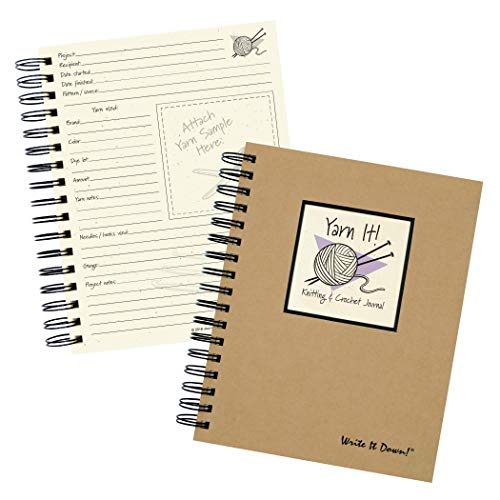
Potter Craft understands that knitting is a visual medium. This journal features a layout that prioritizes space for sketches, charts, and photos, which is essential if you are prone to making modifications to store-bought patterns.
When you decide to add a thumb gusset to a mitten pattern or adjust the length of a sweater body, having a dedicated space to map out those changes is invaluable. This journal encourages you to treat your projects as designs rather than just copies of someone else’s work.
The layout is intuitive, guiding you through a project from the initial yarn selection to the final blocking. It is the best option for knitters who want to grow their skills and eventually branch out into custom pattern writing.
Mindful Making Project Planner: Best for Details

Some knitters find peace in the minutiae of their craft. This planner is for those who want to track every single variable, from the specific ply of the yarn to the humidity levels on blocking day.
Tracking these details can be a game-changer when you encounter a project that just doesn’t feel "right." By reviewing your notes, you might discover that your tension was tighter when using bamboo needles compared to nickel-plated ones, or that a specific wool blend relaxed significantly after a soak.
This level of detail is not for everyone, as it requires a high degree of discipline. But for the knitter who wants to master their craft through data, this planner is an essential laboratory notebook.
KnitIQ Blocking and Project Log: Best for Data

Blocking is the final, often overlooked stage of knitting that turns a piece of fabric into a professional garment. The KnitIQ log treats this stage with the respect it deserves, providing space to record measurements before and after the wet-blocking process.
Understanding how your fiber reacts to water—whether it’s a superwash merino that grows or a rustic wool that blooms—is critical for future project success. This log forces you to confront the reality of your fabric’s behavior rather than just hoping it turns out well.
It is a specialized tool, which means it might not be the only journal you need. However, for serious garment knitters, it is an indispensable reference for ensuring your hard work fits perfectly every single time.
Cocoknits Maker’s Journal: Best for Customizing
The Cocoknits system is legendary in the fiber arts world for its modular, thoughtful design. This journal is no different, acting as a flexible home for your project sheets, swatches, and even loose pattern pages.
The beauty of this system is that it grows with you. You aren’t stuck with a pre-printed format if your needs change; you can add, subtract, or rearrange your pages to suit your current workflow.
If you are the type of knitter who likes to keep everything in one place—yarn labels, pattern printouts, and progress notes—this is the most versatile solution. It acknowledges that your knitting style is not static and gives you the tools to adapt.
Why You Should Document Every Knitting Project
Documenting your projects is the fastest way to bridge the gap between "following a pattern" and "understanding knitting." When you record your progress, you create a feedback loop that helps you identify recurring mistakes or successful techniques.
Many knitters rely on memory, only to be frustrated when they can’t remember which needle size they used for a successful sweater three years ago. By keeping a log, you build a personal library of what works for your specific hands, gauge, and style.
Ultimately, documentation turns your knitting into a legacy. It allows you to look back at your growth, celebrate the projects that challenged you, and provide a roadmap for future makers who might inherit your hand-knits.
Essential Details to Track in Your Project Log
To get the most out of your journal, you need to go beyond the basic pattern name. Always record the yarn brand, colorway, and dye lot number, as these are the three factors that can make or break a project if you need to buy more yarn later.
Include your needle material and size, noting whether you used wood, metal, or carbon fiber, as the "grip" of your needles significantly impacts your gauge. Also, document your swatch gauge—both before and after blocking—to ensure your finished piece matches the intended dimensions.
Finally, record any modifications or "oops" moments. If you had to add an extra repeat to a lace section to get the length you wanted, write it down; you will thank yourself the next time you knit a similar pattern.
How to Organize Your Knitting Notes Effectively
Consistency is the secret to a useful project journal. Try to fill out your project page at the start—recording yarn details and start date—and then add a quick "check-in" note every time you finish a section or a milestone.
Don’t feel pressured to write a novel. A few bullet points about how the yarn felt to work with or any tension issues you encountered are often more useful than a long, flowery paragraph.
Use your journal as a living document by taping in your yarn labels or small swatches of leftover yarn. When you look back at a completed journal, these tactile elements will bring the memories of the project to life in a way that words alone never could.
Investing in a project journal is a commitment to your growth as a knitter. Whether you choose a highly structured planner or a flexible modular system, the act of recording your process will inevitably sharpen your skills. Start small, stay consistent, and watch how your documentation transforms your fiber arts practice. Happy knitting, and may every stitch be recorded with purpose.