6 Best Pattern Books For Sock Architecture To Own
Master sock construction with these six essential pattern books. Learn key techniques, structural design, and expert methods to elevate your knitting projects.
Mastering the art of sock knitting requires more than just following a pattern; it demands an understanding of how fabric interacts with the human foot. Whether you are a novice struggling with your first gusset or a veteran looking to refine your fit, the right reference book acts as a mentor on your shelf. These six essential titles bridge the gap between simple repetition and true architectural mastery. By studying these resources, you will transform your knitting from guesswork into a precise, repeatable craft.
Custom Socks: Knit to Fit by Kate Atherley


Kate Atherley’s approach is the gold standard for anyone tired of socks that bag at the ankle or pinch at the toe. She treats sock knitting as a mathematical exercise, providing a framework that allows you to plug in your own gauge and measurements rather than relying on standard sizes.
If you have ever spent weeks on a pair of socks only to find they don’t stay up, this book is your corrective measure. Atherley emphasizes the "math" of knitting, teaching you how to calculate the exact number of stitches needed for your specific foot circumference.
The true value here is the focus on customization over blind following. By learning to calculate your own stitch counts, you gain the freedom to use any yarn weight you desire, from heavy wool for winter boots to fine silk blends for summer.
Sock Architecture by Lara Neel for Every Foot
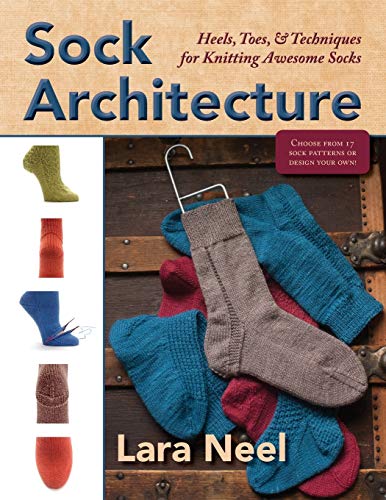
Lara Neel moves beyond the basic "knit a tube" mentality by dissecting the anatomy of the sock into interchangeable parts. She presents a modular system where you can mix and match different cuffs, heels, and toes to create a design that is uniquely yours.
This book is essential for the knitter who feels bored by the monotony of stockinette but is intimidated by complex design work. It provides a visual and structural library, allowing you to swap a classic heel flap for a short-row heel without needing to rewrite an entire pattern.
The trade-off here is the need for a bit of mental heavy lifting. You aren’t just following a line-by-line script, so you must be prepared to track your own progress and stitch counts as you assemble your chosen components.
Sensational Knitted Socks by Charlene Schurch

Charlene Schurch’s work remains a cornerstone for those who love the diversity of sock patterns. This book is less about engineering and more about the sheer joy of texture, lace, and cable patterns tailored specifically for the foot.
If you are looking to move beyond plain socks and into the world of decorative motifs, start here. She provides clear instructions on how to integrate intricate stitch patterns without compromising the elasticity needed for a sock to slide over the heel.
One common mistake knitters make is failing to adjust their gauge when switching from stockinette to cables. Schurch addresses this by explaining how to maintain the necessary "give" in your fabric so your beautiful lace work doesn’t become a rigid, unwearable tube.
The Knitter’s Book of Socks by Clara Parkes

Clara Parkes brings a fiber-focused perspective that is often missing from purely instructional books. She explains how the twist, ply, and fiber content of your yarn dictate the longevity and comfort of your finished socks.
Understanding fiber is the difference between a sock that lasts for years and one that develops holes after three wears. Parkes teaches you why a high-twist yarn is better for stitch definition and why adding nylon is often necessary for heels and toes.
This book is the perfect companion for the knitter who wants to understand the "why" behind their material choices. It turns a trip to the yarn shop from a guessing game into an informed decision-making process based on durability and drape.
Favorite Socks by Interweave Editors Reviewed

This collection serves as a "greatest hits" of sock design, offering a wide array of styles from various prominent designers. It is an excellent resource for seeing how different construction methods—top-down versus toe-up—look and feel in practice.
The benefit of a compilation like this is the variety of techniques introduced in a single volume. You can try a gusset-and-heel-flap on one project and move to a toe-up afterthought heel on the next, allowing you to discover your personal preference.
However, be prepared for inconsistencies in style and notation between patterns. Because these are written by different designers, you will need to pay close attention to the specific abbreviations and instructions provided at the start of each individual pattern.
Getting Started with Socks by Ann Budd Analyzed

Ann Budd is a master of clarity, and this book is the definitive starting point for the absolute beginner. She breaks down the complex process of turning a heel into manageable, logical steps that demystify the most intimidating parts of the sock.
If you have been avoiding socks because of the "scary" heel or toe, Budd’s systematic approach will remove that barrier. She focuses on the mechanics of the work, ensuring you understand the movement of the stitches rather than just memorizing a sequence.
The bottom line is that this book builds confidence through repetition. By the time you finish your first pair, you will have a solid foundation that allows you to tackle more advanced architectural books with ease.
Decoding Foot Anatomy for Perfect Sock Fit
A sock is a three-dimensional object designed to fit a moving, complex surface. Many knitters fail because they knit a flat rectangle and hope it stretches to fit, but true fit requires accounting for the arch, the instep, and the taper of the ankle.
- The Instep: Often overlooked, this area needs enough room to accommodate the height of the foot.
- The Heel: Needs to be deep enough to cup the bone without excess fabric bunching.
- The Toe: Should taper gradually to mimic the natural shape of your toes.
Always measure your foot at the widest point and subtract about 10% for negative ease. This ensures the sock stays snug against the skin, which is vital for preventing blisters and ensuring the fabric doesn’t slide inside your shoe.
Choosing the Best Heel and Toe Construction
The choice between a heel flap and a short-row heel is rarely just aesthetic; it is a choice about fit and durability. A heel flap with a gusset provides a more generous fit that works well for high insteps, while a short-row heel is sleek and perfect for low-profile feet.
- Heel Flap & Gusset: Offers the most adjustability and is easier to repair later.
- Short-Row Heel: Faster to knit and creates a clean, modern look.
- Afterthought Heel: Allows you to work the entire sock as a tube and insert the heel exactly where your foot needs it.
If you are prone to wearing through your heels quickly, consider using a reinforced stitch pattern like a slipped-stitch heel. This creates a denser, more durable fabric that acts as a buffer between your heel and the shoe.
Sock Yarn Selection and Durability Factors
Not all yarn is created equal, and the "sock yarn" label is sometimes misleading. You are looking for a balance of elasticity, abrasion resistance, and moisture management to ensure your hard work doesn’t go to waste.
- Wool: Provides natural elasticity and warmth.
- Nylon/Polyamide: Adds the strength needed to prevent premature wear.
- Superwash: Convenient for machine washing, though it can lose some of its structural "snap."
If you are knitting a delicate lace sock, prioritize a yarn with a high-twist count to prevent pilling. For everyday workhorses, look for a standard 75/25 wool-nylon blend, which offers the best balance of comfort and longevity.
Essential Tools for Precision Sock Knitting
The right tools are extensions of your hands, and for socks, the needle material matters as much as the size. If you are a tight knitter, a slick nickel-plated needle will help you maintain your speed, while a wooden needle provides the grip needed to prevent dropped stitches if you are prone to loose tension.
Always keep a set of double-pointed needles (DPNs) or a long circular needle for the magic loop method on hand. Having a dedicated sock ruler or a small tape measure in your project bag is also non-negotiable for measuring as you go.
Finally, invest in a good pair of blunt-tipped tapestry needles for weaving in ends. A sharp needle will split your yarn and ruin your hard-earned finish, whereas a blunt one will glide seamlessly through your stitches for an invisible, secure result.
Sock knitting is a journey of refinement where every pair teaches you something new about your own tension and foot shape. By utilizing these six books, you move from simply following instructions to becoming an architect of your own comfort. Remember that the best sock is the one that fits your foot perfectly, regardless of the complexity of the pattern. Take your time, choose your fibers wisely, and enjoy the process of turning a simple string into a wearable work of art.