
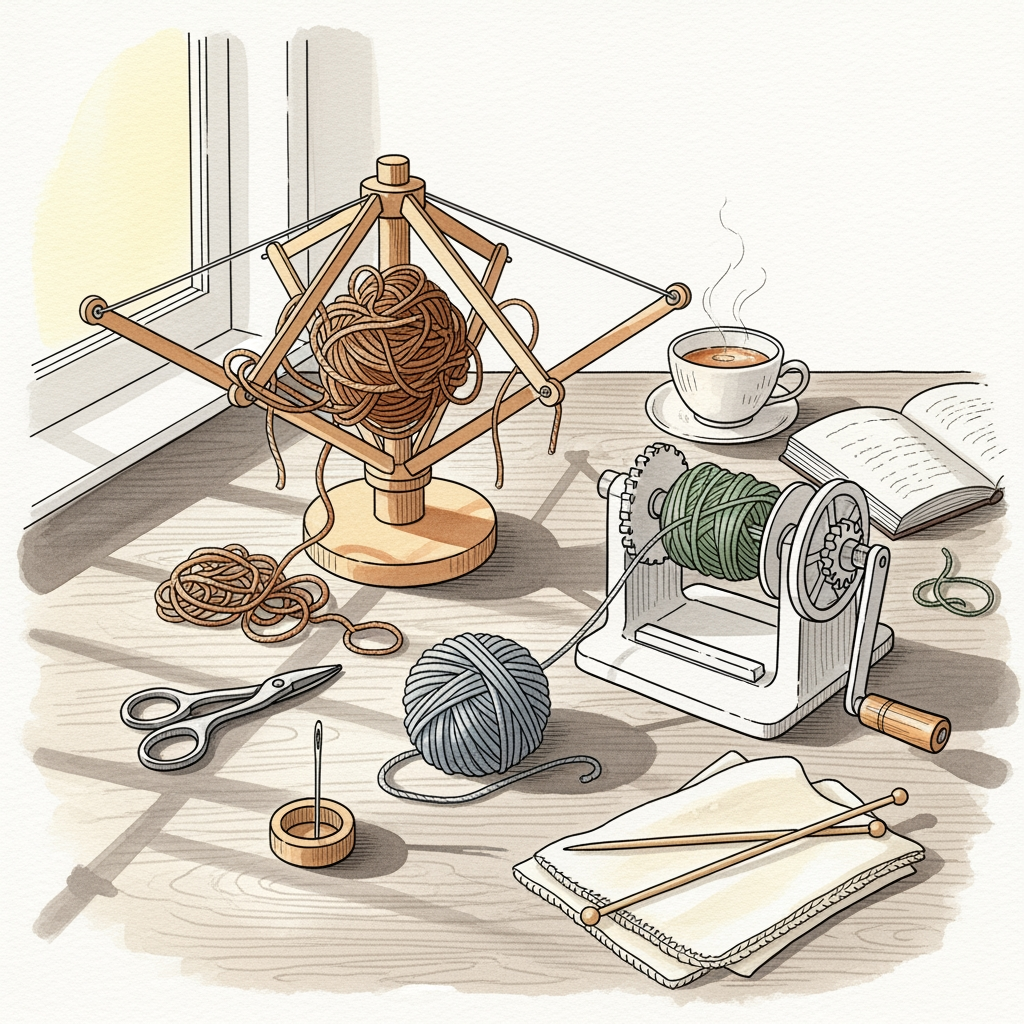
6 Best Collapsible Yarn Swifts for Quick Setup
Simplify your knitting setup with our top 6 collapsible yarn swifts. We review portable, space-saving designs that ensure quick, tangle-free winding every time.
Transitioning from store-bought yarn cakes to hand-dyed hanks is a rite of passage for every knitter, but it quickly reveals the need for proper winding tools. A quality swift transforms the tedious, tangle-prone task of hand-winding into a smooth, efficient preparation process. Without a reliable swift, you risk hours of frustration untangling knots instead of actually knitting your project. This guide explores the best collapsible options to help you spend less time managing yarn and more time creating.


Stanwood Needlecraft Tabletop Swift: Best Overall
When you need a tool that just works every time you sit down to wind, the Stanwood Tabletop Swift is the industry standard for a reason. Its heavy-duty construction and smooth rotation prevent the "jerking" motion that often leads to yarn snapping or uneven tension.

The metal hardware is robust, and the wooden slats are sanded to a glass-like finish, ensuring that even delicate mohair or single-ply wool won’t snag. It clamps securely to almost any table edge, providing a stable base for even the most vigorous winding sessions.
The real beauty lies in its balanced rotation, which keeps the umbrella mechanism from collapsing under the weight of larger hanks. If you frequently work with luxury fibers that require a gentle touch, this is the investment piece that saves your yarn from unnecessary stress.
KnitPicks Wooden Umbrella Swift: Best for Budget

If you are just beginning to build your stash and don’t want to break the bank, the KnitPicks umbrella swift is an excellent entry point. It offers the classic umbrella functionality at a price that leaves more room in the budget for high-quality yarn.
While it lacks the heavy-duty feel of more expensive models, it is perfectly capable of handling standard worsted or DK weight yarns. It collapses down into a slender profile, making it easy to tuck away in a project bag or drawer when not in use.
Be aware that you may need to tighten the hardware occasionally to keep the rotation smooth. It is a fantastic tool for the casual knitter who only winds a few hanks a month and wants a functional, space-saving solution.
Lacis Wooden Umbrella Swift: Best for Durability
Lacis has a long-standing reputation for producing tools that feel like heirloom pieces, and their wooden umbrella swift is no exception. The craftsmanship is evident in the joinery and the density of the wood, which provides a satisfying, solid weight during operation.
This swift is designed to withstand years of heavy use, making it ideal for the knitter who constantly cycles through sweater quantities of yarn. The umbrella mechanism operates with a deliberate, smooth glide that feels more precise than mass-produced alternatives.
Because it is built to last, it handles the tension of larger, heavier hanks without wobbling or losing its shape. If you value tools that feel substantial and reliable in your hands, the durability of this model is well worth the premium.
Strauch Jumbo Ball Winder Swift: Best for Bulk

For those of us who buy yarn by the pound or tackle large-scale projects like blankets, a standard swift often feels too small. The Strauch Jumbo swift is engineered specifically to accommodate the massive hanks that would otherwise cause a smaller swift to buckle.
It handles high-volume winding with ease, preventing the yarn from slipping off the arms during rapid rotation. This is the professional choice for knitters who need to wind multiple hanks in a single sitting without stopping to readjust the umbrella.
Pairing this with a high-capacity ball winder creates a powerhouse setup for your craft room. While it takes up more space than compact models, the efficiency it provides when processing bulk yarn is unmatched.
Amish Style Wooden Yarn Swift: Best Design Choice
The Amish style swift is a distinct departure from the umbrella design, utilizing a horizontal, rotating cross-bar mechanism. Because it doesn’t rely on plastic or metal hinges, it is incredibly sturdy and virtually impossible to break through normal use.
Many knitters prefer this design because it allows you to adjust the diameter of the swift by moving the pegs, giving you total control over the tension of the hank. It is also aesthetically pleasing, often serving as a beautiful piece of functional decor in a knitting space.
Since it sits flat on a table, it is incredibly stable and requires no clamping, which is perfect if you have a delicate table surface you don’t want to scratch. It is a classic, mechanical solution that prioritizes simplicity and long-term reliability.
U-nitt Tabletop Swift: Best Portable Option
Portability is a major factor if you attend knitting retreats, local meetups, or simply move your project from room to room. The U-nitt Tabletop swift is lightweight and designed to fold down into an incredibly compact size, fitting easily into a standard tote.
Despite its small footprint, it is surprisingly stable when clamped to a table. It is the perfect companion for the knitter who likes to wind their yarn right before starting a project, regardless of where they are located.
While it may not handle massive, heavy hanks as well as a jumbo model, it is more than sufficient for the average 100-gram skein of fingering or sport weight yarn. It strikes the perfect balance between daily utility and travel-ready convenience.
Essential Features for a Reliable Yarn Swift
A reliable swift must prioritize smooth rotation above all else, as any resistance will lead to uneven tension in your yarn cake. Look for models with high-quality pivot points and hardware that doesn’t require constant lubrication.
The clamping mechanism is the second most critical feature, as a wobbly base will cause the swift to tip during the winding process. Always opt for a clamp with a wide enough opening and protective padding to prevent damage to your furniture.
Finally, consider the material finish; you want smooth, snag-free surfaces that won’t catch on delicate fibers like silk or mohair. A swift that is easy to adjust and folds down cleanly will ensure you actually use the tool rather than letting it gather dust.
How to Properly Set Up Your Swift for Winding
Start by ensuring your swift is clamped securely to a flat, stable surface that allows for a full 360-degree rotation. Place your yarn hank on the swift and expand the arms slowly until the yarn is taut, but not stretched; over-stretching can permanently alter the elasticity of the fiber.
Before you begin winding, check that the yarn is feeding directly from the swift to your ball winder without any sharp angles or friction points. A smooth, straight path is the best way to prevent the yarn from jumping off the swift arms.
Always remove the label and find the two ends of the yarn before you start. If you don’t secure the ends properly, your hank will quickly become a tangled mess before you even finish the first few yards.
Troubleshooting Common Swift Tangling Issues
Most tangles occur because the yarn was not properly centered on the swift or because the rotation speed was too fast. If your yarn starts to slip, stop immediately, untangle the loop, and adjust the tension of the umbrella arms to be slightly wider.
If you are using a center-pull ball winder, ensure the yarn is not being pulled too tightly, as this can cause the swift to spin out of control. Always keep a hand near the swift to gently guide the rotation if you notice the yarn bunching up on one side.
For very slippery fibers like bamboo or silk, you may need to place a small piece of tissue or a rubber band around the arms to provide a bit of grip. Patience is your best tool; if the yarn is jumping, slow down and check your alignment.
Maintenance Tips for Wooden Yarn Swifts
Wooden swifts are beautiful, but they can be sensitive to changes in humidity, which may cause the wood to warp or the joints to stick. Keep your swift in a climate-controlled environment and avoid storing it in damp basements or hot attics.
If the rotation becomes stiff over time, a tiny amount of beeswax or a specialized wood-safe lubricant on the pivot points can work wonders. Avoid using heavy oils that might stain the wood or transfer onto your precious hand-dyed yarn.
Check the screws and hardware periodically to ensure everything is tight and secure. A well-maintained wooden swift can last for decades, becoming a trusted companion for every project you undertake.
Investing in a quality collapsible swift is one of the smartest decisions you can make to improve your knitting workflow. By choosing a model that fits your specific project needs—whether it’s portability, durability, or capacity—you eliminate the biggest barrier to starting a new project. Take the time to set up your tools correctly, and you will find that winding yarn becomes a meditative, satisfying part of your craft. Happy knitting, and may your yarn always wind smoothly.
