7 Best Project Journals For Design Planning To Use
Elevate your creative workflow with our curated list of the 7 best design journals. Discover the perfect tools to organize, sketch, and track your projects.
Every seasoned knitter knows that the difference between a masterpiece and a frogged mess often lies in the details recorded before the first stitch is cast. Whether you are calculating yarn requirements for a complex stranded colorwork sweater or simply tracking your gauge swatches, a dedicated project journal is an indispensable companion. These tools transform your craft from a series of scattered notes into a structured, repeatable design process. Choosing the right one is about finding a system that matches your unique rhythm at the needles.


The Knitters Planner: Best Overall Design Tool

The Knitters Planner is a powerhouse for those who treat knitting as a serious design pursuit rather than just a casual hobby. It combines a standard calendar with specific knitting-focused pages, making it ideal for managing multiple projects alongside your daily life.
This planner shines because it forces you to confront the logistics of your stash before you start. It includes dedicated sections for project planning, yarn inventory, and needle tracking, ensuring you don’t buy a third skein of the same fingering weight wool by mistake.
However, the sheer volume of pages can be overwhelming for a minimalist. If you prefer a clean, sparse notebook, this might feel like overkill. But for the knitter who loves to map out every row and deadline, it is truly the gold standard.
Fringe Association Field Guide: Best for Notes

The Fringe Association Field Guide is a slim, unassuming companion that prioritizes portability and quick, tactile note-taking. It is designed to be tossed into your project bag without adding significant weight or bulk.
This guide excels when you are at a workshop or a local guild meeting and need to jot down a technique modification on the fly. Its layout is intentionally quiet, leaving you plenty of white space to sketch stitch patterns or record row counts in your own shorthand.
The tradeoff here is a lack of structured templates; you won’t find pre-printed boxes for your gauge or yarn fiber content. It requires you to be disciplined about how you organize your own data. It is perfect for the knitter who finds pre-formatted planners too restrictive.
Cocoknits Maker’s Journal: Best for Organization
The Cocoknits Maker’s Journal is built on a modular system that acknowledges the reality of the modern knitter’s workflow. It uses a clever binder format that allows you to add, remove, and rearrange pages as your project evolves from a swatch to a finished garment.
This is the best choice if you are a "multi-tasker" who often has a sock project, a sweater, and a lace shawl on the needles simultaneously. You can keep all your active project logs in one place without flipping through finished pages.
The primary consideration is the initial investment in the binder system. While it is more expensive upfront than a standard notebook, the ability to customize your pages makes it a long-term investment in your design process. It is a highly functional tool for those who value order.
The Knitting Journal: Best for Project Tracking
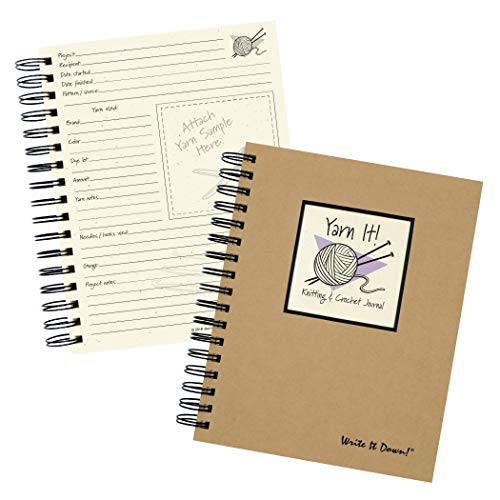
The Knitting Journal is laser-focused on the technical data that keeps a project on track. It provides clear, structured fields for every critical metric: yarn brand, colorway, dye lot, needle size, and your final blocked gauge.
Having this data in one place is a lifesaver when you realize, six months later, that you need to repair a snag in a sweater you knit years ago. You will know exactly which yarn base and dye lot you used, preventing the frustration of a mismatched repair.
It is less about "planning" and more about "recording." If your goal is to build a comprehensive library of your finished works for future reference, this is the most reliable tool available. It turns your history into a valuable reference manual.
Moleskine Pro Collection: Best for Sketching

The Moleskine Pro Collection is a favorite for designers who prefer to draw out their stitch motifs or garment schematics by hand. Its high-quality paper handles ink and graphite beautifully, which is vital when you are drafting complex cable charts.
If you are designing your own patterns, you need a surface that doesn’t bleed or feather, especially when you are using fine-tipped pens to draw intricate lace repeats. This notebook offers a professional, tactile experience that feels substantial in the hand.
The downside is that it has no knitting-specific prompts or fields. You must create your own system for tracking gauge or yarn usage. It is the best choice for the creative who wants complete freedom to design without being boxed in by pre-printed templates.
Leuchtturm1917 Notebook: Best for Custom Layouts

The Leuchtturm1917 is a blank canvas that appeals to the "bullet journal" style of project tracking. Its numbered pages and table of contents make it easy to index your projects, so you can find that specific shawl modification in seconds.
The dot-grid paper is a game-changer for knitters because it acts as a guide for drawing stitch patterns while remaining subtle enough to ignore. You can easily align your rows and columns for custom charts without the clutter of lines.
This requires the most "setup" time of any option on this list. If you don’t enjoy the process of decorating or formatting your own pages, you may find it tedious. However, for those who love a personalized system, it is unmatched in flexibility.
Wool & Pine Project Log: Best for Pattern Design
The Wool & Pine Project Log is specifically tailored for those who are moving beyond following patterns and into the realm of designing their own. It emphasizes the math behind the knitting, providing space for calculations and schematic drafting.
This log is invaluable when you are scaling a pattern to fit a specific body measurement or converting a design from a worsted weight yarn to a lighter sport weight. It encourages you to think about the physics of the fabric, such as drape and stitch definition.
It is a specialized tool that might feel daunting to a beginner. But if you have reached the point where you are ready to modify or write your own patterns, this log provides the structure you need to ensure your math—and your knitting—is sound.
Why Every Designer Needs a Dedicated Project Log
A project log is the external brain that prevents the common "knitter’s amnesia." We often think we will remember which needle size we used for a specific project, but after a few months and several other projects, those details inevitably blur.
- Dye Lot Tracking: Always record your dye lot numbers to ensure color consistency across a large garment.
- Gauge Records: Documenting your pre- and post-blocking gauge is the only way to ensure a sweater will actually fit you.
- Modification History: If you tweak a pattern to improve the fit, writing it down ensures you can replicate that success next time.
Without a log, you are forced to re-calculate your gauge and re-test your needle choices for every single project. A log saves you hours of repetitive work and keeps your knitting progress moving forward rather than backward.
Essential Features to Look for in Knitting Planners
When selecting a journal, prioritize features that solve your specific pain points. If you struggle with needle storage, look for a planner with integrated needle size charts or pockets for interchangeable tips.
- Paper Weight: Ensure the paper can handle fountain pens or markers without bleeding through to the other side.
- Binding Type: A lay-flat binding is essential for keeping your place while you are knitting and holding the book open with one hand.
- Project Templates: Look for dedicated spaces for yarn fiber content, yardage, and washing instructions.
Avoid journals that focus solely on aesthetics over function. A pretty cover is nice, but it won’t help you if the layout doesn’t allow you to track your row counts or yarn consumption effectively.
How to Document Your Fiber Arts Design Process
Start your documentation the moment you decide on a project. Record the yarn fiber content — is it superwash wool, a silk blend, or a lofty alpaca? — because these properties dictate how the yarn will behave once the project is finished.
Next, document your swatch process. Note the needle size used, the number of stitches per inch, and how the fabric felt after washing and blocking. This is your "recipe" for success; if you change your yarn, you must change your needle size to maintain the same gauge.
Finally, keep a running log of your row counts and any deviations from the pattern. If you decide to shorten a sleeve or add a cable panel, document the exact row where the change occurred. This level of detail turns your journal into a permanent record of your evolution as a designer.
Investing in a project journal is a sign that you are ready to take your knitting to the next level of precision and professionalism. Whether you choose a highly structured planner or a simple dot-grid notebook, the act of recording your process will inevitably lead to better-fitting garments and fewer mistakes. Start today by logging the details of your current project, and watch how your craft transforms from a hobby into a deliberate, well-documented art form. Happy knitting, and may your gauge always be consistent.