6 Best Swatch Gauges For Checking Stitch Tension
Achieve perfect stitch tension with our top 6 swatch gauges. This guide compares essential tools to help knitters ensure accurate sizing for every project.
Every knitter knows the sinking feeling of finishing a sweater only to realize it fits like a tent or a tourniquet. Achieving the perfect stitch tension is the bridge between a handmade hobby and a professional-looking garment. Investing in a reliable gauge tool is the simplest way to ensure your hard work results in a wearable masterpiece. This guide explores the best tools to keep your tension consistent and your projects perfectly sized.
Cocoknits Maker’s Keep Gauge and Ruler


The Cocoknits Maker’s Keep is more than just a gauge; it is a wearable solution for the knitter who constantly misplaces their tools. By utilizing a magnetic slap-bracelet design, it keeps your needles and stitch markers within arm’s reach at all times.
The built-in gauge is exceptionally clear, making it easy to check needle sizes quickly during a project. Because it rests on your wrist, you’ll find yourself measuring your swatch more frequently than you would if the tool were buried in a project bag.
However, the magnetic surface can be distracting if you are working with small, metallic items. It is a fantastic tool for those who value ergonomics and organization, but it might be overkill for a minimalist knitter.
Fringe Supply Co. Brass Knitting Gauge
There is something undeniably satisfying about the weight and longevity of a brass tool. The Fringe Supply Co. gauge is a classic in the fiber arts world, offering a clean, minimalist aesthetic that ages beautifully with time.
Because it is made of solid metal, it won’t warp or bend like plastic alternatives, ensuring your measurements remain accurate for years. It is particularly useful for identifying vintage needles that may have lost their printed sizing labels.
The trade-off is that brass can develop a patina, which might make the etched numbers slightly harder to read in low light. If you appreciate tools that feel substantial in your hand, this is a heirloom-quality choice that won’t let you down.
ChiaoGoo Stainless Steel Needle Gauge
ChiaoGoo is a brand synonymous with precision, and their stainless steel gauge is no exception. It is laser-etched, meaning the size markings will never rub off, no matter how many times you slide your needles through the holes.
This tool is incredibly slim, making it an ideal companion for a travel knitting kit. It includes a wide range of sizes, covering everything from delicate lace work to chunky, oversized sweaters.
The steel is quite slick, which can lead to it sliding out of your notions pouch if not secured properly. For the knitter who demands absolute accuracy and a tool that can survive the bottom of a heavy tote bag, this is the gold standard.

Susan Bates Knit-Chek Stitch Gauge Tool
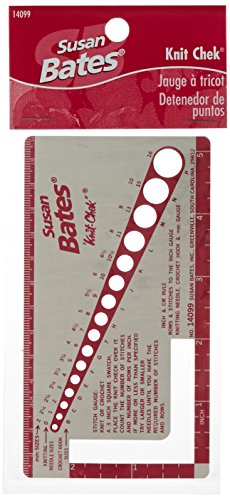
The Susan Bates Knit-Chek is a nostalgic staple that has been helping knitters for generations. It is a multi-functional plastic tool that measures both needle size and stitch count simultaneously.
It is lightweight and inexpensive, making it a perfect "first gauge" for someone just starting their knitting journey. The integrated ruler allows you to count stitches per inch directly on the fabric without needing a separate tape measure.
The downside is that plastic can eventually crack or warp if left in a hot car or under heavy books. While it isn’t the most durable tool on the market, its functionality-to-price ratio makes it a practical addition to any beginner’s kit.
Clover Knitting Needle Gauge with Ruler

Clover’s gauge is widely respected for its clear, high-contrast markings that are easy to read even for those with tired eyes. It features a simple design that focuses purely on utility, providing both metric and US needle sizing.
The inclusion of a 5-inch ruler on the side is vital for checking your stitch count against a blocked swatch. It is made from a durable, flexible plastic that stands up well to regular use without becoming brittle.
If you are working with very dark yarn, the light-colored background of the gauge provides excellent contrast for counting stitches. It is a no-nonsense tool that delivers exactly what it promises without unnecessary flair.
Knitter’s Pride Metal Needle Gauge Tool

The Knitter’s Pride metal gauge is designed for the knitter who wants a sturdy tool that fits neatly into a standard needle case. It is compact, reliable, and features a smooth finish that won’t snag delicate yarns.
This tool is particularly useful for checking needle sizes on the go, as the metal construction is resistant to the wear and tear of daily knitting. It is a dependable workhorse that provides consistent results across various needle materials.
Be aware that because it is a smaller tool, the holes are quite close together, which can occasionally be confusing for beginners. It is a solid, professional-grade choice for those who want a tool that prioritizes durability and portability.
Why Gauge Swatching Is Vital for Fit
Many knitters view swatching as an optional chore, but it is actually the most important step in the design process. Your personal tension—how tightly or loosely you hold your yarn—can change the final dimensions of a garment by several inches.
If you are knitting with a fiber that has little memory, like cotton or linen, your gauge is even more critical because these fibers do not "spring back" like wool. Failing to swatch can result in a sweater that grows significantly after the first wash.
Remember that swatching is not just about the number of stitches; it is about how the fabric feels. If your swatch feels stiff, you may need to go up a needle size, regardless of whether you hit the row gauge.
How to Measure Stitches per Inch Properly
To get an accurate reading, your swatch must be washed and blocked in the exact same manner you intend to treat the final garment. Lay the swatch flat on a hard surface and place your gauge or ruler on top.
Do not stretch the fabric as you measure, as this will give you a false reading. Instead, count the number of stitches across four inches, then divide by four to find your stitches per inch.
- Pro Tip: Use a contrasting color of yarn to mark your starting point if you struggle to keep your place while counting.
- Consistency: Always measure from the center of the swatch, avoiding the edges where tension often fluctuates due to turning stitches.
Common Mistakes When Calculating Tension
The most common error is measuring a swatch while it is still on the needles. The weight of the needles and the tension of the cable can distort the stitches, leading to an inaccurate count.
Another frequent mistake is failing to account for row gauge, which is just as important as stitch gauge for pieces like set-in sleeves. If your row gauge is off, the length of your garment will be incorrect, even if the width is perfect.
Finally, avoid "fudging" the numbers to match a pattern. If your gauge doesn’t match, it is almost always better to change your needle size than to try and compensate by adding or subtracting stitches.
Tips for Maintaining Accurate Swatch Tools
Treat your gauge tools with the same care you give your favorite needles. Keep them in a dedicated notions case to prevent them from being bent or scratched, which could affect the accuracy of the needle sizing holes.
If you use plastic tools, keep them away from direct sunlight or extreme heat, as this can cause them to warp over time. Metal tools should be kept dry to prevent any potential oxidation or rust, especially if you live in a humid climate.
Periodically check your tools against a known standard, such as a high-quality metal ruler, to ensure they haven’t been damaged. A well-maintained tool is the foundation of a perfectly fitted project, so invest in one that you enjoy using.
Mastering your tension is the single most effective way to elevate your knitting from amateur to professional. By using a reliable gauge tool and taking the time to swatch properly, you ensure that every hour spent at the needles results in a garment you will cherish. Don’t let the fear of a little extra work keep you from the perfect fit. Happy knitting, and may your stitches always be even.