6 Best Light Strips For Illuminating Dark Craft Shelves
Brighten your workspace with our top 6 picks for the best light strips for illuminating dark craft shelves. Read our expert guide and find your perfect fit today.
A well-lit stash is the difference between snagging a delicate mohair lace weight and accidentally grabbing a bulky wool blend for your next project. When craft shelving sits in the shadow, color selection becomes a guessing game that leads to mismatched dye lots and frustration during colorwork. Proper illumination allows for the inspection of fiber texture, ply integrity, and true color accuracy before the first stitch is even cast on. These lighting solutions transform a dark corner into a functional, vibrant studio space that celebrates the beauty of every skein.
LUMINOVA LED Tape Light Kit: Best Overall Pick


The LUMINOVA LED Tape Light Kit stands out for its consistent brightness and straightforward adhesive application. It provides an even wash of light across deep shelves, which is essential when trying to distinguish between subtle tonal variations in hand-dyed yarns.
For those with extensive stash collections, the ability to daisy-chain these strips ensures that an entire wall of shelving can be illuminated with a single power source. This prevents the cluttered look of multiple cords running behind precious alpaca or cashmere storage.
If your primary goal is reliability and a clean aesthetic, this kit offers the most balanced performance. It remains the gold standard for crafters who want a “set it and forget it” lighting solution that highlights yarn inventory without drawing attention to the equipment itself.
Govee Smart LED Strip Lights: Best for Techies
Smart lighting brings a level of customization that is particularly useful for fiber artists working with high-contrast projects. These lights allow for dimming or color temperature adjustment via a smartphone app, providing the ability to simulate different lighting environments for your work.
If you are struggling to see your stitches while choosing a yarn for a complex stranded colorwork project, you can toggle the light to a crisp, cool white to reveal the true saturation of the fibers. This precision is invaluable when ensuring that the contrast between two colors of wool is high enough to make the pattern pop.
Be aware that these systems require a stable Wi-Fi connection and a bit of technical setup. They are best suited for the knitter who wants to integrate their workspace into a smart home ecosystem rather than someone who prefers simple, manual switches.
WOBANE Under Cabinet Lighting Kit: Easiest Install
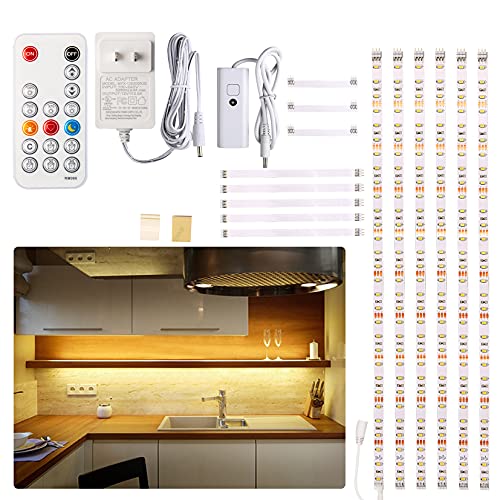
The WOBANE kit utilizes a low-profile design that is incredibly discreet, making it ideal for shelving where you do not want the light source to be visible. The installation process is largely plug-and-play, requiring minimal tools or electrical knowledge.
The adhesive backing is designed to stick firmly to wood, metal, or laminate surfaces, ensuring the strips stay in place even as you shift heavy bins of stash or yarn winders. Because the strips are thin, they remain tucked neatly behind the front edge of the shelf, keeping the focus entirely on your fiber.
This is the perfect choice for the knitter who wants an immediate improvement in visibility without the frustration of complex wiring. It prioritizes functionality and speed, allowing for more time spent at the needles rather than fussing with home improvement tasks.
CRIFTON Rechargeable LED Strip: Best Cord-Free
If your craft shelves are positioned away from power outlets, the CRIFTON Rechargeable LED Strip removes the need for unsightly extension cords. This is a game-changer for those with freestanding shelving units that cannot easily reach a wall socket.
The motion-sensor technology is a clever addition, as it illuminates your yarn the moment you approach the shelf. This saves battery life and provides a welcoming glow when entering your workspace. Keep in mind that these require periodic recharging, so having a rotation of batteries or a convenient USB-C charging station nearby is necessary.
This option is highly flexible and portable, making it the best pick for crafters who move their workspace or live in rental properties where permanent lighting installation is not an option. It is an honest tradeoff: convenience and mobility come at the expense of having to recharge occasionally.
Litever Daylight LED Strips: Best for True Color
Color accuracy is the most critical factor for any knitter matching yarn for a complex project. Litever Daylight LED Strips offer a high-quality light output that mimics natural sunshine, preventing the yellow or blue casts that cheap LEDs often introduce.
When selecting yarns for a project, seeing the true hue is vital to avoid disappointment when moving from a basement craft room to natural light. These strips excel at bringing out the depth in plant-based fibers like linen or cotton, which can look dull under inferior, low-quality lighting.
If you invest in luxury hand-dyed fibers, you need a light source that honors the dyer’s work. This kit ensures that what you see on your shelf is exactly how the yarn will appear when you are holding it in your hands, ready to knit.
Kagedo Puck Lights: A Smart Strip Light Alternative
Sometimes a continuous strip of light is unnecessary, and smaller, directional puck lights offer a more focused approach. These are excellent for highlighting specific sections of a shelf, such as a display of vintage needles or a collection of hand-turned yarn bowls.
Puck lights provide a spotlight effect that adds drama and professionalism to your craft area. They are incredibly easy to position, and because they are localized, you can create zones of light that illuminate only the specific supplies you are currently using.
Consider these if your shelves are segmented with dividers that would interfere with long, continuous LED strips. They provide a high-end look and allow for targeted illumination, though they may require more units to cover a long shelf length compared to a tape light.
How to Choose the Right Light Temperature (Kelvin)
Understanding Kelvin (K) is essential for achieving the right mood and color accuracy in a craft room. For knitting, a temperature between 4000K and 5000K is considered ideal, as it is often referred to as “daylight” or “cool white.”
- 2700K – 3000K: Offers a warm, yellow glow; perfect for relaxation, but poor for checking color matching.
- 4000K – 4500K: A balanced, neutral white that provides clarity without being harsh.
- 5000K – 6500K: Crisp daylight; the gold standard for color accuracy and identifying defects in yarn.
Avoid going too low on the Kelvin scale if you need to differentiate between shades like navy and black or dark emerald and forest green. Always check the packaging for a Kelvin rating before purchasing to ensure the light supports your specific fiber arts needs.
Hardwired vs. Battery vs. Plug-In: Which Is Best?
The choice of power source depends entirely on the location of your shelves and your willingness to commit to a permanent installation. Hardwired lights are permanent and clean, offering the most seamless look, but they usually require professional electrical work.
Plug-in strips are the middle ground; they are reliable, offer full-time power, and are relatively easy to install if there is an outlet nearby. Battery-powered options are the ultimate convenience for portability but carry the downside of needing replacement or recharge cycles.
If your shelving is part of a permanent studio build-out, hardwiring or standard plug-ins are worth the investment. For temporary setups or mobile yarn carts, battery or rechargeable options are significantly more practical and less invasive.
Tips for Hiding Wires on Your Craft Shelving
Visible wires can turn an organized yarn stash into a visual distraction. Use cable management channels, which are small plastic tracks that stick to the back or underside of your shelves, to keep cords hidden from view.
Zip ties or adhesive cord clips are inexpensive tools that bundle loose wires together against the back corner of the shelving unit. For a truly invisible look, run wires down the inside corner of a shelf frame where they will be naturally shadowed and obscured by yarn skeins.
Always leave a small amount of “service loop”—a little extra slack in the wire—to allow for shifting bins or rearranging shelves in the future. Proper cord management is not just about aesthetics; it prevents snagging and pulling that could accidentally dislodge your lighting setup.
Understanding CRI for Accurate Yarn Color Display
Color Rendering Index (CRI) measures how accurately a light source reveals colors compared to natural daylight. For any knitter working with intricate colorwork or fiber matching, a CRI of 90 or higher is non-negotiable.
Lights with a low CRI will make your yarns look muted or “muddy,” which is detrimental when you are trying to judge the drape or luster of a silk-blend yarn. A high CRI ensures that the subtle undertones in an off-white wool or the vibrance of an over-dyed silk are accurately represented.
Think of CRI as the “truth-teller” of your lighting setup; it ensures that the project you planned in your workspace looks exactly the same when you take it outside. Always prioritize a higher CRI rating over raw brightness to ensure the best possible results for your fiber arts projects.
Whether you choose a smart system or a simple cord-free strip, the addition of quality light will fundamentally change how you interact with your stash. By removing the guesswork from color selection and fiber inspection, these tools allow your creative process to flow without the interruption of poor visibility. Select the lighting that best fits your space, and enjoy the clarity that brings out the true potential of every skein you own.