7 Best Screen Magnifying Glasses For Vision Support
Struggling to read your screen? Discover our top 7 picks for the best screen magnifying glasses to improve your clarity and comfort. Find your perfect pair today.
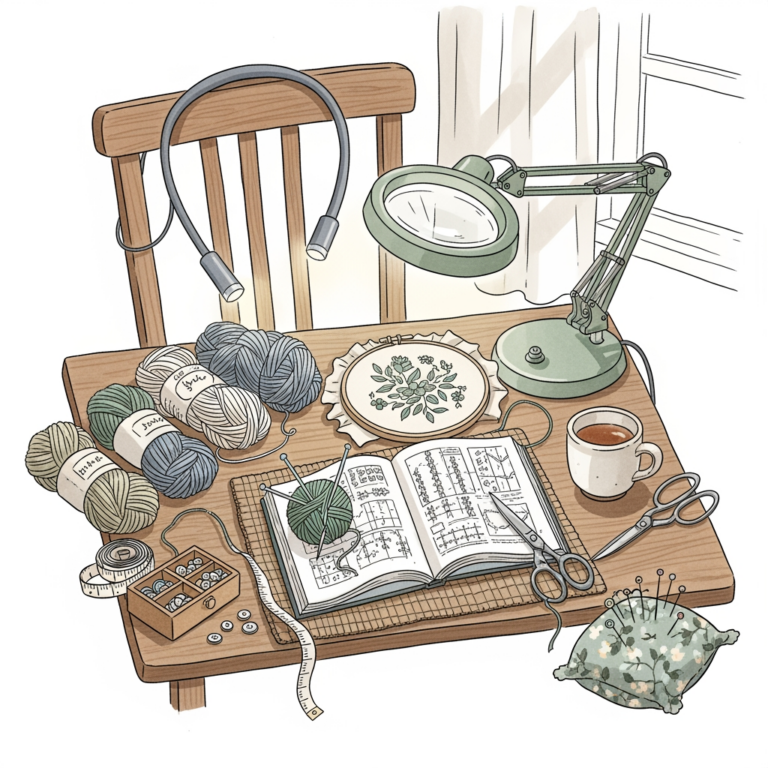
Precision in knitting often hinges on the ability to see the smallest details, from counting delicate lace yarn-overs to spotting a split ply in dark mohair. Eye fatigue can turn a relaxing evening of cabling into a frustrating struggle with dropped stitches and missed decreases. Investing in proper magnification tools transforms how patterns are read and how stitches are executed. Selecting the right support ensures that projects remain a joy rather than a strain on vision.
Donegan OptiVISOR: Best for Hands-Free Work


The Donegan OptiVISOR is the gold standard for knitters who need constant, uninterrupted vision support while keeping both hands firmly on the needles. This head-mounted magnifier allows for effortless switching between the knitting work and a pattern chart without needing to set anything down.
It is particularly useful when working with black or navy lace-weight yarns, where finding the next stitch can be nearly impossible in dim lighting. Because it stays centered on the forehead, the optical clarity remains consistent as the knitter shifts focus.
While the weight of a head-mounted unit takes a moment to adjust to, the trade-off is superior freedom of movement. Ensure the headband is snug but comfortable to prevent slipping during long sessions of stranded colorwork.
Fancii Mega-View: Best for Digital Chart Reading
The Fancii Mega-View provides a wide, rectangular field of vision that aligns perfectly with digital tablets or printed pattern charts. For knitters who follow complex, multi-page charts, this style of magnifier helps keep the entire row of symbols in view at once.
This wide-angle view is an advantage when checking gauge swatches against a ruler or identifying intricate stitch patterns in dense fabric. It reduces the need for the constant head-tilting associated with smaller, circular magnifiers.
However, consider the focal length carefully, as wide-field magnifiers can sometimes distort the edges. Keep the device positioned at the manufacturer’s suggested distance to maintain the sharpest focus on your stitches.
Daylight Lumi: Best Illuminated Desk Magnifier

A dedicated desk magnifier like the Daylight Lumi is essential for knitters who suffer from eye strain during late-night projects. The combination of a high-quality lens and adjustable, high-CRI (Color Rendering Index) lighting is a game-changer for accurate color matching.
Accurate lighting prevents the common mistake of choosing yarn colors that look nearly identical in warm indoor light but clash in daylight. The stable base allows the magnifier to hover over a knitting lap tray or work table, providing steady, flicker-free light.
Choose this option if you have a permanent crafting station where space is not an issue. The heavy base provides stability, but it is not intended for travel or quick transport between rooms.
Carson MagniFold: Best Portable Travel Option

The Carson MagniFold is designed for the knitter who never leaves home without a project bag. Its slim, folding design fits easily into most knitting notions pouches, making it the perfect companion for long commutes or travel to local guilds.
While it lacks the heavy-duty features of a studio lamp, it provides instant magnification exactly when needed. It is ideal for checking a cable twist or verifying a stitch count while waiting for a train or sitting in a car.
Since it relies on the user to hold it or place it near the work, it works best for quick tasks rather than hours of continuous knitting. Use it as a supplemental tool for on-the-go troubleshooting.
Bausch & Lomb Clip-On: For Prescription Glasses
Clip-on magnifiers offer a seamless integration for knitters who already wear corrective lenses. By attaching directly to existing frames, these magnifiers turn standard prescription glasses into specialized task-wear without the weight of a full headset.
This is the most cost-effective way to get hands-free magnification if you have specific optical needs. It allows the knitter to maintain their standard depth perception while adding the necessary power for fine-gauge work.
Be mindful that the extra weight on your frames may lead to pressure on the bridge of the nose over time. Choose lightweight clip-ons to ensure you can finish that final round of a sweater sleeve comfortably.
iMagniphy Handheld: Best Budget-Friendly Choice
For the occasional knitter who only needs a boost when working with very thin needles or dark fibers, a high-quality handheld magnifier is often sufficient. The iMagniphy offers clear optics and built-in LED lights, making it an excellent starter tool for those testing the benefits of magnification.
Handheld magnifiers are versatile and require no complex setup or head adjustment. They are perfect for spot-checking a bind-off row or untangling a small snag in a delicate silk blend.
The limitation is that one hand must remain dedicated to holding the glass. This is best suited for short-term tasks rather than full-length knitting sessions.
Luxo KFM LED: Best Premium Studio Magnifier
The Luxo KFM LED is the professional’s choice, offering unmatched durability and optical clarity for serious knitters who produce high volumes of work. These magnifiers feature high-quality glass lenses that resist scratching and maintain perfectly flat fields of vision.
The flexible arm moves with ease, staying exactly where you place it without sagging or drifting mid-stitch. It is a significant investment, but one that pays off in the longevity of eye health for anyone who knits professionally or spends hours daily on complex lace.
While the price point is steep, the build quality ensures years of consistent performance. If you are a prolific knitter or designer, this tool effectively eliminates the vision-related barriers to your craft.
How to Pick the Right Magnifier for Your Craft
When choosing a magnifier, consider the primary frustration in your knitting sessions. If you struggle with the weight of tools, prioritize the Bausch & Lomb clip-ons or the OptiVISOR. If your issue is poor color perception, prioritize a lamp with high-CRI light output like the Daylight Lumi.
Always match the magnification power to the needle size. Smaller needles—such as 2.00mm to 2.50mm—benefit from higher magnification, while standard worsted-weight knitting on 4.50mm needles requires only a light assist.
Finally, test your preferred posture before buying. If you knit leaning back in a recliner, a desk lamp might not have the reach, making a headset or handheld option a more practical choice.
Understanding Diopter vs. Magnification Power
In the world of optics, diopter and magnification power are related but distinct measurements. Diopter refers to the curvature of the lens, while magnification power tells you how much larger the object appears.
A simple rule is that higher diopter numbers indicate a stronger lens, but usually come with a smaller field of view and a shorter working distance. For knitting, avoid over-magnifying; too much power can actually make it harder to find your rhythm because the depth of field becomes very shallow.
Stick to the “Goldilocks” range: enough magnification to see the stitch anatomy clearly, but not so much that you lose the ability to see several stitches at once.
Headset vs. Desk Lamp: Which Type is for You?
Headsets offer the most consistent experience because they move with your eyes, ensuring you are always in the “sweet spot” of the lens. They are the best choice for knitters who tend to fidget or change positions while working on a long project.
Desk lamps offer better light quality and zero physical burden on the head or neck. They are superior for stationary knitters who enjoy a dedicated crafting area and want to avoid the minor claustrophobia some feel while wearing a headset.
Ultimately, if you knit in various spots around the house, start with a versatile, portable option. If you have a primary “knitting chair,” a high-quality desk lamp will provide the most professional and comfortable experience possible.
Finding the right magnifier is a matter of matching the tool to the specific demands of your projects and your physical comfort. By balancing light, magnification power, and ergonomics, you can significantly extend your knitting longevity. Always prioritize ease of use, as the best magnifier is the one that stays on your workbench rather than in a drawer. Enjoy the clarity of your stitches and the increased precision in every loop.