6 Plastic Storage Bins For Organizing Paper Bundles
Tired of messy desks? Discover our top 6 plastic storage bins for organizing paper bundles effectively. Read our guide and streamline your workspace today.
Knitting patterns, whether printed on standard letter paper or large-format newsprint, require a dedicated storage system to remain crisp and usable. Crumpled, coffee-stained, or misplaced pattern sheets often lead to dropped stitches and confusion during complex cable or lace charts. Investing in high-quality plastic storage ensures that every row-by-row instruction remains in perfect condition for years of repeat projects. This guide examines six essential bin types to help maintain an organized and stress-free pattern library.
Sterilite 12×12 Case: For Oversized Patterns


Large-format patterns, especially those featuring oversized schematic drawings or complex colorwork charts, do not fit neatly into standard folders. The Sterilite 12×12 case offers a generous square footprint that accommodates these larger sheets without requiring unsightly folding or curling.
This bin is particularly useful for storing patterns printed on 11×17 paper, which is common for intricate sweater schematics. Because the internal dimensions match standard scrapbook paper sizes, those extra-wide charts stay flat and readable.
The primary trade-off is the significant shelf space required to house these wide bins. If workspace is limited, consider these only for the most delicate or oversized pattern collection pieces.
IRIS USA Project Case: Best for Grab-and-Go
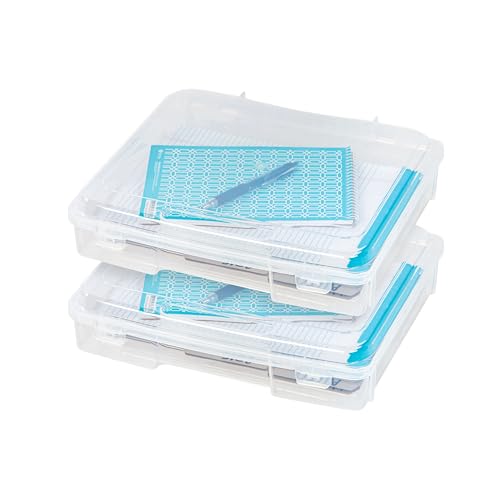
For the knitter who enjoys working on different projects in various locations—perhaps a simple garter stitch scarf at the park and a complex lace shawl at home—portability is vital. The IRIS USA Project Case is a slim, lightweight option that keeps a single project’s pattern, needle gauge, and notes contained in one footprint.
These cases are thin enough to slide easily into a project bag alongside a skein of fingering weight yarn or a set of circular needles. They provide just enough protection to prevent loose papers from wrinkling when carried in a larger tote.
Do not expect these cases to house an entire library, as their low profile limits total capacity. They are best utilized as “active” project containers rather than long-term archival solutions.
ArtBin Super Satchel: The Ultimate Deep Bin

When a pattern library grows into the hundreds, a deep-storage solution becomes a necessity rather than a luxury. The ArtBin Super Satchel is built for volume, offering the depth required to store thick booklets, spiral-bound books, and dozens of loose patterns in one location.
The added depth is ideal for tucking in small notions, like stitch markers or tapestry needles, alongside the patterns they belong to. It allows for a unified storage approach where the pattern and the tools required to complete it live in the same place.
The sheer weight of a fully loaded ArtBin can be substantial, making it less than ideal for frequent transport. Keep these units on a sturdy, permanent shelf to prevent shelf bowing or accidental drops.
Really Useful Box 8.1L: Stackable & Sturdy
Stability is a major concern when stacking plastic bins, as cheaper containers tend to buckle under weight. The 8.1L Really Useful Box is engineered with a vertical, reinforced structure that makes it the industry standard for secure, vertical storage.
Because these boxes are perfectly rectangular and clear, identifying the contents from across the room is effortless. Their stackability allows for the creation of a modular wall of patterns that can be sorted by project type, such as accessories, garments, or home goods.
The locking handles are effective but can be stiff, which may be a consideration for those with hand fatigue or grip sensitivities. However, the trade-off is a very secure, dust-resistant seal that protects paper from ambient humidity.
Akro-Mils KeepBox: For Bulk Pattern Storage
Bulk storage requires a bin that maximizes interior volume without compromising on durability. The Akro-Mils KeepBox is a heavy-duty workhorse designed to handle large quantities of paper without flexing or cracking.
This bin is the best choice for storing vintage patterns or heavy cardstock references that need to stay pristine over time. The structural integrity of these boxes prevents the “slumping” effect that occurs when paper bundles are stored in flimsy containers.
Since these boxes are deeper and wider than standard file bins, they are best suited for closet floors or bottom shelf units. They are not designed for quick access, making them perfect for your secondary or archival pattern stash.
mDesign File Folder Bin: For Active Projects
Sometimes the simplest solution is the most effective for daily tasks. The mDesign File Folder Bin is essentially a drop-in file box, perfect for standing patterns upright so they can be flipped through like a record collection.
Using an upright filing system allows for alphabetical or category-based organization, which is essential when juggling multiple concurrent projects. If you are currently working on a stranded colorwork sweater and a pair of top-down socks, this keeps the current instructions right at your fingertips.
The open top is a convenience for quick access but offers no protection against dust or spills. Ensure these are placed in an area clear of coffee mugs and high-traffic zones to avoid potential water damage.
Choosing the Right Bin Size for Your Patterns
The physical size of the paper is the first variable to address. Standard A4 or letter-sized papers fit comfortably in most bins, but specialty papers or booklet-style patterns may require the extra width of a 12×12 case.
Consider how the patterns will be stored within the bin. Using dividers or plastic sleeves will add thickness to the bundle, meaning you should account for an extra inch or two of total bin width.
Always measure your intended storage shelf before purchasing. A bin that fits perfectly on the floor might be too tall for an existing bookshelf, creating a logistical headache.
Hinged vs. Removable Lids: What’s Best?
Hinged lids offer the advantage of never being misplaced, which is a common frustration with removable designs. They allow for one-handed access to the patterns, which is helpful if the other hand is holding yarn or a set of bamboo needles.
Removable lids provide a cleaner aesthetic and often allow the bin to be used as an open-top tray when working at a desk. If you prefer to keep your patterns in an open tray while knitting, a removable lid is the superior choice.
Consider the environment in your craft room. If the space tends to be dusty or has high traffic, a hinged, latching lid provides a much better seal against debris.
Smart Ways to Organize Your Pattern Library
Effective organization turns a collection of paper into a functional library. Categorizing by project type—such as sweaters, hats, or socks—is a common starting point, but consider organizing by needle size or yarn weight as well.
Use clear, acid-free sleeves to protect patterns from the natural oils on your hands. If you are working on a project that requires heavy marking, keep the original in a safe sleeve and use a photocopy for your working draft.
Labeling is critical for long-term maintenance. Use bold, clear labels on the front of each bin, noting either the category or the date range of the patterns inside to ensure quick retrieval.
Long-Term Storage: Keeping Your Paper Safe
Paper is susceptible to environmental degradation, particularly in damp or hot rooms. Aim to store pattern bins away from exterior walls or areas prone to temperature swings to prevent the paper from warping or becoming brittle.
Avoid placing pattern bins in direct sunlight, as UV exposure can fade ink and turn paper yellow over time. If possible, keep the bins in a climate-controlled room to protect the integrity of your collection.
Periodically inspect your bundles for signs of moisture or pests. A quick review once or twice a year ensures that your years of pattern collecting remain a viable resource for future projects.
By selecting the right storage containers and following best practices for organization, your patterns will remain as reliable as your favorite set of needles. A well-organized library reduces the barrier to starting a new project, allowing you to focus on the rhythm of the work rather than the hunt for the instructions.