6 Best Led Light Pads For Pattern Tracing To Use
Discover the 6 best LED light pads for pattern tracing to improve your craft. Explore our top-rated picks and choose the perfect tool for your projects today.
Tracing intricate motifs for intarsia or mapping out complex cable placements often requires more than just sunlight and a steady hand. An LED light pad acts as a vital bridge between a printed chart and the actual fabric, ensuring every stitch placement is precise before the first loop is even cast on. These tools remove the guesswork from transferring embroidery motifs or alignment grids onto knitting or crochet canvases. Choosing the right one depends on whether the task involves delicate lace work or bold, large-scale color blocking.
Cricut BrightPad Go: Best Cordless Option


Reliability is paramount when moving between a craft room desk and a comfortable armchair for a long evening of pattern drafting. The Cricut BrightPad Go excels because it functions entirely without a tether, allowing for total freedom of movement.
This device features a rechargeable battery that eliminates the risk of snagging cords on yarn cakes or knitting needles. For projects like marking placement for duplicate stitch on a sweater, the cordless nature is a significant advantage.
While the surface area is somewhat compact, it provides a consistent, even glow that does not flicker. The bottom line: if workspace flexibility and a clutter-free zone are priorities, this is the premier choice.
Artograph LightPad Pro: The Professional’s Choice

Precision matters when mapping out detailed chart patterns or scaling down complex stitch motifs. The Artograph LightPad Pro offers high-end build quality with a surface that feels more substantial than basic plastic models.
Adjustable brightness settings are the standout feature here, allowing for fine-tuning based on the opacity of the paper or fabric. If tracing through heavy cardstock for a stencil, the higher lumen output prevents eye strain and ensures clean, accurate lines.
This model is an investment in longevity for those who frequently design their own garments or stitch maps. Expect a professional-grade experience that justifies the higher price tag for serious designers.
HUION A3 Light Pad: Best for Large Projects
Working on full-sized garment schematics or large-scale heirloom blanket layouts requires a generous canvas. The HUION A3 provides ample room to lay out an entire sweater front or back without needing to reposition the pattern repeatedly.
The extra space is beneficial when using large rulers or templates to ensure alignment is perfectly centered before marking fabric. It is a workhorse tool that stays cool even after hours of continuous use.
However, consider the desk footprint before purchasing, as its size can dominate smaller crafting nooks. Select this option if large-format charting is a regular part of the workflow.
LitEnergy A4 Light Box: Top Budget-Friendly Pick

Not every project requires top-tier technology, especially when the goal is simple pattern transfer or basic embroidery alignment. The LitEnergy A4 is a slim, lightweight option that performs the essential task of illumination with surprising clarity.
It remains cool to the touch, which is essential when working near delicate fibers that might be heat-sensitive. Its portability makes it an excellent choice for taking to knitting circles or weekend retreats.
The tradeoff for the low price point is a more utilitarian construction that lacks some of the advanced dimming features of pro models. This is the ideal entry-level pad for the occasional user or those on a strict budget.
GAOMON GB4 Light Box: Best for Portability
Lightweight tools are essential for crafters who divide their time between multiple stations. The GAOMON GB4 is incredibly thin and lightweight, sliding easily into a project bag alongside pattern books and notions cases.
Its design is sleek, offering a smooth surface that won’t snag delicate yarns if a skein happens to brush against it. It is particularly effective for those who draft patterns while traveling.
While it is compact, it lacks the heavy-duty brightness of more expensive units. It serves as the best travel companion for the mobile designer who prioritizes ease of transport over maximum output.
US Art Supply Lightbox: A Solid Mid-Range Buy
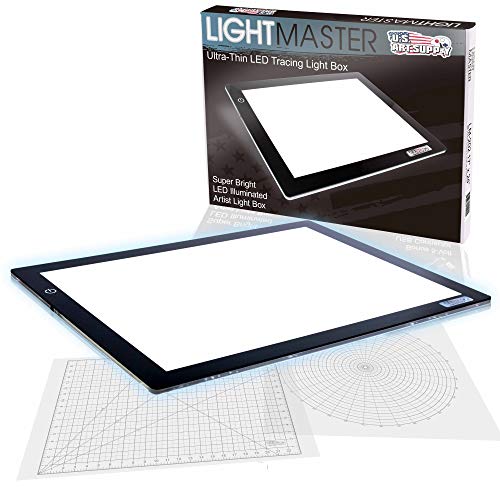
Finding the middle ground between basic affordability and professional performance often leads to the most practical solutions. The US Art Supply Lightbox offers a sturdy build that can withstand the daily rigors of a busy craft studio.
It strikes a balance with reliable brightness settings and a durable surface that resists scratches from pens or stylus tools. For knitters who frequently toggle between pattern tracing and other precision tasks, this unit offers a versatile middle-ground performance.
It may not have all the bells and whistles of high-end brands, but it rarely disappoints in daily execution. This is the dependable choice for those who want a reliable, long-term tool without overspending.
How to Pick the Right Light Pad Brightness Level
Brightness is not just about intensity; it is about contrast management against different materials. A high-lumen setting is necessary when working through thicker fabrics or heavy, high-GSM paper.
Conversely, a lower setting is often better for thin, delicate tracing paper, as it prevents the light from washing out fine pencil lines. Adjustable brightness allows for customized settings that minimize glare and prevent eye fatigue during long sessions.
Always prioritize pads that offer smooth dimming rather than fixed steps. Opt for a pad with a wide brightness range to ensure adaptability across various pattern weights.
A4 vs. A3: Choosing Your Ideal Pad Size
The choice between A4 and A3 dimensions often dictates the efficiency of the workflow. An A4 pad is perfectly sized for standard letter-sized printouts and small-scale pattern drafting, making it highly portable.
An A3 pad, however, is a game-changer when working on full-scale garment blocks or oversized schematics. It prevents the frustration of “stitching” together multiple images to create one continuous pattern.
Consider the largest item that will be traced before buying, as sizing up is almost always preferred over needing more space later. If the project scope includes full-garment schematics, go for the A3 size.
Corded vs. Cordless: Which is Right for You?
Cordless pads offer unparalleled convenience, especially for crafters who prefer to move their workspace from a desk to a cozy corner. The ability to place the light anywhere without searching for an outlet is a significant benefit.
Corded options are generally more powerful and eliminate the concern of recharging cycles or battery degradation. For those who keep a dedicated studio space, a corded model is often more reliable and cost-effective.
Evaluate whether the priority is an unrestricted workspace or constant, high-intensity illumination. Choose cordless for flexibility, but lean toward corded for heavy, daily studio use.
Tips for Tracing Patterns onto Dark Fabric
Tracing onto dark fabric is notoriously difficult, but not impossible with the right techniques. Start by using a high-contrast marking tool, such as a white tailors’ chalk or a heat-erasable gel pen, which remains visible under the light pad’s glow.
If the fabric is thick or opaque, even the brightest LED might struggle to illuminate the pattern lines underneath. In these instances, try securing the pattern to the top of the fabric and using a “light box sandwich” approach to press the lines through with a blunt tracing wheel.
Always test your marking tool on a scrap of the same fiber—whether it is raw wool, cotton, or a synthetic blend—to ensure it can be fully removed after the stitching is complete. Precision in the setup phase saves hours of frustration during the actual project assembly.
Investing in a quality light pad transforms the often tedious process of pattern transfer into a seamless part of the design cycle. By selecting a device that matches your specific project needs and workspace habits, you ensure that every line you mark is a step toward a finished project that fits and functions exactly as intended.