7 Best Embroidery Spool Racks For Thread Display
Organize your sewing space with our top 7 embroidery spool racks for thread display. Shop our expert recommendations to find the perfect storage solution today.
A disorganized thread stash is the quickest way to kill the momentum of a multi-stranded colorwork project or a complex embroidery detail. When threads are tangled, dusty, or hidden in deep drawers, the sheer friction of finding the right shade often leads to project abandonment. Proper storage isn’t just about aesthetics; it is about visibility, access, and maintaining the structural integrity of your fibers over time. Finding the right rack transforms a chaotic workspace into a professional studio, ensuring your supplies stay ready for the next stitch.
Embroidex 60-Spool Rack: Best Overall Display


The Embroidex 60-Spool Rack strikes a balance between capacity and footprint that works for most mid-sized studios. It accommodates the standard small-to-medium spools used in decorative stitching without overwhelming a desk surface.
Sturdiness is the primary benefit here, as the wooden construction provides a reliable foundation that won’t tip when a single heavy spool is removed. The pegs are spaced generously, allowing for easy access even when the rack is fully loaded with varying fiber types.
This is the ideal choice for makers who prioritize order and want their color palette visible at a glance. It eliminates the “digging” process that often results in snapped thread or tangled ends.
June Tailor Mega-Rack: For Massive Collections

If the workspace resembles a professional design studio, the June Tailor Mega-Rack is the logical expansion point. Designed to hold up to 120 spools, it is intended for those who treat their thread collection as a serious inventory of artistic possibilities.
The dual-column design maximizes vertical wall space, keeping the floor clear for sewing tables and yarn bins. It is constructed to handle the weight of larger professional spools, making it a robust option for long-term storage.
Consider this rack if color-matching is a core part of the process, such as when selecting specific embroidery shades to complement a hand-dyed merino wool sweater. The scale of this unit demands a dedicated wall area, but the trade-off is unparalleled organization.
New brothread 120 Rack: Top Wall-Mount Pick

Wall-mounted storage is essential for makers working in tighter footprints, and the New brothread 120 Rack excels in this category. It lifts the entire thread inventory off the work surface, creating a visual “thread wall” that acts as both storage and inspiration.
Installation is straightforward, though the weight of a fully loaded rack requires solid mounting hardware. Once secured, it provides a stable, dust-free environment for threads that are used less frequently but need to be accessible.
The peg height on this model is calibrated to prevent smaller spools from vibrating off during heavy sewing machine use nearby. It is a clean, utilitarian solution that keeps high-traffic supplies within arm’s reach.
Sew-Mate 30-Spool Holder: Best Budget Pick

The Sew-Mate 30-Spool Holder is a modest, highly functional entry point for those just beginning to build a thread library. It is compact enough to tuck into a shelf or sit at the edge of a sewing station without requiring a major spatial commitment.
While it lacks the massive capacity of wall-mounted systems, it offers portability that larger racks cannot match. You can easily lift this rack and move it closer to your primary workspace or take it to a workshop.
Budget-friendly doesn’t have to mean flimsy. This holder provides the basic functionality required to keep thread organized, preventing the frustration of tangled ends while working on delicate embroidery or finishing seams.
Simp-Lee-Done Metal Rack: Best Modern Design
The Simp-Lee-Done Metal Rack stands out for its durability and contemporary aesthetic. Metal construction prevents the warping or splintering that can occur with wooden racks over years of changing temperature and humidity.
Its sleek, open-frame design allows for better airflow around the threads, which is a subtle but critical detail for maintaining natural fibers like silk or high-quality cotton. If the studio is prone to shifts in climate, a metal rack offers superior longevity.
The modern finish integrates well into non-traditional crafting spaces, like a living room corner or a shared home office. It is the sophisticated choice for makers who want their equipment to be as well-designed as their finished products.
ThreadNanny Cone Rack: Best for Larger Spools
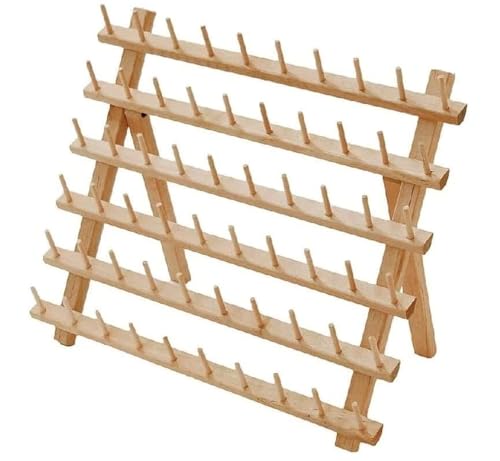
Embroidery and serging often require large cones that simply won’t fit on standard-sized pegs. The ThreadNanny Cone Rack is specifically engineered with wider, taller pegs to accommodate these larger footprints securely.
Trying to cram large-diameter cones onto a standard rack will lead to leaning and overcrowding, which can cause threads to slip off or rub against one another. This rack solves that problem by providing the necessary clearance for professional-grade supplies.
If your projects involve long, uninterrupted runs—such as edging dozens of garments—this rack is an essential upgrade. It keeps bulkier spools upright and tension-ready.
Bee Sturdy Folding Rack: Most Versatile Choice
The Bee Sturdy Folding Rack offers a clever mechanical advantage: it can be used flat on a table or folded into an angled display. This versatility is perfect for changing needs, such as moving from a permanent sewing desk to a temporary kitchen table setup.
The folding mechanism is robust enough to support daily use, making it an excellent bridge between portability and permanent storage. It occupies minimal space when stored away, which is a major advantage in multi-purpose crafting rooms.
Opt for this if your creative process is fluid and frequently moves between different locations. It provides the stability of a stationary rack with the convenience of a portable tool.
Spool Rack Buying Guide: Key Features to Check
When evaluating a rack, look first at the peg spacing. If your collection consists of a mix of small metallic embroidery thread and large polyester serging cones, ensure the rack accommodates both without crowding.
Material durability is the second factor. Wood can be beautiful, but cheap, unfinished pine might splinter and snag delicate threads over time. Sealed wood or powder-coated metal are the preferred choices for longevity.
- Peg Length: Must be long enough to secure the spool but not so long that they are cumbersome.
- Base Stability: Freestanding units need a wide, weighted base to prevent tipping when the rack is partially full.
- Mounting Hardware: If wall-mounting, verify the included hardware is sufficient for the wall type (drywall vs. studs).
Always prioritize a system that makes the threads easy to see. If you have to hide them behind one another, you will inevitably forget what you have, leading to redundant purchases and wasted supplies.
Wall-Mounted vs. Freestanding: Which is Best?
Wall-mounted racks are the undisputed winners for space efficiency. By utilizing vertical wall real estate, you keep your table surface clear for fabric manipulation, cutting, and the actual sewing or embroidery process.
However, wall-mounted units are semi-permanent. If you anticipate rearranging your studio layout, consider the time and effort required to remove and re-anchor these units.
Freestanding racks offer modularity. They can be moved to wherever the light is best or positioned next to your machine for quick color changes. If you work in a shared space where the studio must be cleared away at the end of the day, a freestanding rack that can be tucked into a closet is the superior choice.
Will My Spools Fit? A Guide to Spool Types
Thread spools vary wildly in diameter, from narrow wooden vintage spools to thick, plastic-based modern cones. A rack with uniform peg spacing may struggle with this variety.
Before purchasing, measure the base diameter of your largest spool. If the pegs are placed too close together, you will find yourself able to use only every other peg, effectively cutting your rack’s advertised capacity in half.
- Standard Sewing Spools: Usually fit on any rack; height is rarely an issue.
- Embroidery Cones: Feature a wide base; verify that the peg spacing allows for at least 1.5 inches of clearance between centers.
- Vintage Wood Spools: Often have very small holes in the center; ensure the pegs are slender enough to pass through.
Consistency is key. While it is tempting to mix types, sorting by spool size and brand on your rack will keep the collection visually coherent and prevent the “domino effect” of spools knocking into each other.
Choosing the right thread storage is an investment in the efficiency and longevity of your craft. Whether you opt for a wall-mounted display to maximize desk space or a sturdy tabletop rack for quick access, the goal remains the same: spend less time searching for thread and more time creating. Invest in quality hardware now, and your future projects will flow with significantly less frustration.