6 Craft Mats For Cutting Fabric Worth Considering
Upgrade your sewing projects with the best craft mats for cutting fabric. Explore our top 6 recommendations and find the perfect surface for your workspace today.
Precision in fabric preparation is just as vital to a successful sewing project as choosing the right yarn weight is to a sweater’s drape. When the time comes to cut fabric for linings, quilt blocks, or project bags, a high-quality cutting mat acts as the foundation for clean, accurate edges. A dull blade on an uneven surface leads to jagged cuts and wasted fabric, while the right mat protects both the tabletop and the rotary cutter blade. This guide explores six reliable cutting mats to help ensure that every cut supports the integrity of the finished work.
OLFA Self-Healing Rotary Mat: The Gold Standard


The OLFA self-healing mat remains a benchmark in the industry for good reason. Its proprietary composition allows the surface to close back up after a blade passes through, significantly extending the life of rotary cutter blades.
For those who frequently cut heavy-weight fabrics like canvas or dense wools, this durability is essential. A self-healing surface prevents the deep grooves that can cause a blade to skip or veer off course during a long, straight cut.
Ultimately, this mat is an investment in consistency. If the goal is a tool that maintains its structural integrity through years of heavy-duty use, the OLFA is the reliable choice.
Fiskars Self-Healing Craft Mat: Best Budget Pick

The Fiskars self-healing mat offers a dependable surface that balances affordability with functional performance. While it may not possess the same extreme longevity as higher-end professional mats, it performs admirably for the casual garment maker or occasional quilter.
This mat works exceptionally well for lighter tasks, such as trimming interfacing or cutting lightweight cottons for quilt piecing. The grid markings are clear and high-contrast, which helps maintain accuracy when cutting strips or squares.
The tradeoff here is depth: under very heavy, repetitive pressure, the surface may show signs of wear faster than premium alternatives. However, for those just starting to build a sewing studio, the Fiskars mat provides the necessary performance without the premium price tag.
Cricut Self-Healing Mat: For the All-Around Crafter

The Cricut self-healing mat is designed to serve a dual purpose, functioning well for both traditional rotary cutting and the demands of digital crafting machines. It features a robust, double-sided surface that is slightly more rigid than traditional quilting mats.
This rigidity is an advantage when moving the mat across a workspace or storing it vertically. It resists warping and bending, which is critical when working with precise pattern pieces that require perfectly straight edges.
Because it bridges the gap between digital and analog crafting, it is an excellent choice for makers who use a Cricut for cutting intricate applique shapes while also performing manual cutting for larger project components. It offers versatility that specialized quilting mats sometimes lack.
OLFA Rotating Rotary Mat: A Quilter’s Dream Tool

A rotating mat changes the mechanics of cutting, especially when working on complex quilt blocks. Instead of shifting the fabric or the body position, the mat itself spins 360 degrees on a smooth, ball-bearing base.
This tool is a game-changer for cutting small, intricate shapes or squaring up blocks that would otherwise require constant repositioning. It minimizes fabric shifting, which is the primary cause of inaccurate cuts in detailed quilting work.
While it is smaller than standard workspace mats, its utility is unmatched for detail-oriented tasks. It should be used as a companion to a larger surface, providing a dedicated station for precise geometric cuts.
Dahle Vantage Self-Healing Mat: The Pro’s Choice
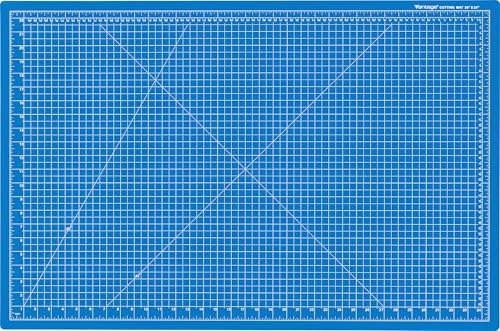
The Dahle Vantage mat is engineered for those who demand professional-grade resilience. It features a five-layer construction that is notably thicker and more resistant to deep scoring than most standard craft mats.
This thickness provides a reassuring, solid feel under the rotary blade, which is helpful when applying firm pressure to cut through thick, folded layers of wool or denim. It is less prone to the “curling” that can plague thinner, lower-quality mats over time.
For anyone who considers their sewing space a permanent workstation, the Dahle offers superior longevity. It is a heavy-duty solution that handles the wear and tear of a prolific maker who cuts fabric daily.
U.S. Art Supply Cutting Mat: A Solid XL Option

Large-scale projects often require expansive workspace, and the U.S. Art Supply XL mats offer an excellent solution for covering entire tables. These mats are typically double-sided, which essentially doubles the lifespan of the surface by allowing for rotation.
The primary benefit of an extra-large mat is the ability to lay out full garment patterns without having to constantly shift fabric. This prevents stretching the bias of the fabric and ensures that large pieces remain aligned with the grainline.
While these mats are significant in size, they are still prone to environmental factors like heat. Keep them away from direct sunlight or heat vents to prevent warping, which is a common issue with larger plastic-based surfaces.
How To Choose The Right Cutting Mat Size for You
- Measure your workspace: Ensure the mat leaves room for tools, not just the fabric.
- Match the project scale: If the focus is on small accessories or quilts, a 18″x24″ mat is sufficient.
- Go big for garments: If cutting full-length dress patterns, prioritize a 24″x36″ or larger surface.
- Think about storage: A mat that is too large for the storage area will eventually become warped or damaged.
Extend Your Mat’s Life: Cleaning & Storage Tips
Even the best self-healing mat requires proper care to remain effective. Avoid using heavy-duty soaps or harsh chemicals, which can break down the internal fibers of the mat; a simple wipe-down with a damp, lint-free cloth is usually enough to remove dust and fibers.
Always store mats flat whenever possible. If space dictates vertical storage, ensure they are braced against a hard, flat surface so they do not sag, which can create permanent bows in the material.
Finally, keep the blade sharp. Using a dull blade requires more downward pressure, which cuts deeper into the mat and causes faster degradation. A sharp blade glides over the surface, preserving the “healing” capability of the material.
Reading the Grid: Using Your Mat’s Markings
The grid printed on a cutting mat is the most effective tool for maintaining grain alignment. Use the vertical and horizontal lines to square up the fabric before making the first cut, ensuring that the selvage is parallel to a grid line.
Many mats include 30, 45, and 60-degree angle lines, which are indispensable for cutting bias strips or triangular quilt pieces. Aligning the fabric edge with these markings eliminates the need for a separate quilting ruler for basic angles.
Always verify the mat’s grid against a high-quality quilting ruler periodically. Over time, plastic-based mats can experience minor expansion or contraction, and relying solely on the mat’s grid for high-precision pattern drafting can lead to subtle errors.
Self-Healing Mats vs. Other Surfaces: Why It Matters
A dedicated self-healing mat is engineered with a multi-layered, soft-yet-resilient plastic compound that allows a blade to penetrate and then “seal” the cut behind it. Using a household surface, such as a dining table or a piece of cardboard, is counterproductive.
Cardboard and other hard surfaces quickly ruin the edge of a rotary blade. A dull blade then requires extra force to cut, which increases the risk of the blade slipping and causing injury.
Investing in a proper mat protects the cutting edge, the fabric, and the underlying furniture. It is the single most important purchase for achieving the clean lines that make a finished handmade garment look professional.
Choosing the right cutting mat is an investment in both your tools and your technique. By matching the mat’s features to your specific project needs—whether it is high-volume quilting or occasional garment construction—you create a reliable environment that encourages precision. With proper maintenance, these mats serve as the silent, steady partner to every successful cut.