6 Best Jewelry Calipers For Precise Measurements
Find the 6 best jewelry calipers for precise measurements in our expert guide. Compare top tools to ensure professional accuracy for your designs. Shop now.
Precision is the silent partner to every successful knitting project, turning guesswork into consistent results. Whether verifying the diameter of a hand-spun yarn or checking the sizing of vintage needles, a reliable caliper is an indispensable tool in the maker’s kit. This guide explores six top-tier calipers suited for the specific demands of fiber arts, where even a fraction of a millimeter changes the drape of a garment. Selecting the right measuring instrument ensures that the time spent at the needles translates exactly into the finished piece envisioned.
iGaging EZCal Digital Caliper: Best Overall


The iGaging EZCal strikes an ideal balance between professional accuracy and user-friendly operation. Its most notable feature is the inductive sensor system, which resists oil, water, and dust—common hazards in a busy craft room where yarn fibers and lotions often linger on surfaces.
For the knitter who frequently switches between projects, this model offers a smooth, reliable slide that prevents snagging on delicate fibers. The display is bright and large, making it easy to read measurements even under the lower lighting conditions often preferred during late-night knitting sessions.
The bottom line: It offers a professional-grade experience without the steep learning curve. It is the most sensible choice for the serious maker who wants one tool to last through years of gauge swatching and needle verification.
Mitutoyo 500-196-30: Best Premium Option

If precision is the absolute priority, the Mitutoyo 500-196-30 is the gold standard used by machinists and jewelers alike. While significantly more expensive than other options, the build quality is unmatched, offering a level of repeatability that remains consistent over thousands of measurements.
This caliper is recommended for the advanced maker or those who work with high-value materials like silk, cashmere, or expensive hand-dyed yarns where exact WPI (Wraps Per Inch) data is vital. The sheer durability of the hardened stainless steel construction means this tool will likely be the last caliper ever purchased.
The tradeoff here is the cost and the fact that it is perhaps over-engineered for basic craft room use. However, for those who demand the finest precision in every aspect of their craft, this instrument provides complete confidence in every measurement.
Neiko 01407A Digital Caliper: Best Budget Buy
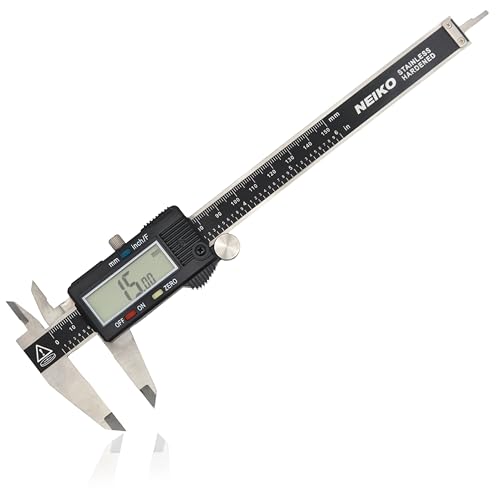
The Neiko 01407A is a highly capable tool that proves one does not need to overspend to get reliable results. It features a stainless steel body and a clear, easy-to-read screen, which is perfectly adequate for measuring the diameter of standard knitting needles or the thickness of various yarn plies.
This model is a fantastic addition for beginners who are just starting to build their toolkit and need to verify the size of unlabeled vintage needles found at thrift stores. It performs the basic tasks of measuring diameter and width with satisfying consistency.
It is worth noting that it lacks the high-end waterproofing of more expensive models, so it requires a bit more care to keep the electronic components clean. For the casual knitter, however, this represents the best value-to-performance ratio currently available.
General Tools 147 Brass Caliper: Best Analog
Analog calipers offer a timeless, mechanical simplicity that appeals to knitters who prefer avoiding batteries and digital screens. The General Tools 147 is made of solid brass, which is non-magnetic and gentle on delicate items, ensuring there is no risk of damaging surface finishes on specialized needle materials.
Because it operates on a sliding scale rather than a digital readout, it requires the user to read the measurements manually, which encourages a deeper tactile connection to the tool. It is perfect for those who want a reliable, battery-free backup that lives permanently in their knitting bag.
While it lacks the instant digital readout of modern alternatives, its durability and classic design make it a favorite for traditionalists. It is a simple, effective, and elegant solution for quick measurements.
VINCA DCLA-0605 Caliper: Great Value Choice

The VINCA DCLA-0605 stands out for its high-quality construction and included extra battery, a small but thoughtful touch that keeps the tool functional for a long time. The interface is intuitive, and the conversion between millimeters and inches is instant, which is helpful when switching between US and metric needle patterns.
This caliper is well-suited for knitters who want a step up in quality from entry-level budget models without moving into the premium price bracket. It handles the repetitive task of checking multiple needle sets with ease and remains accurate through extended use.
Consistency is the hallmark of this device, making it a reliable workhorse for maintaining an organized collection of notions. For those looking for a balanced, mid-tier option, this model delivers exactly what is promised.
Kynup Digital Caliper: Top User-Friendly Pick
The Kynup Digital Caliper features a large, ultra-clear LCD screen that makes reading measurements effortless. This is particularly helpful for those who struggle with fine print, as the high-contrast display leaves no room for ambiguity when checking if a needle is 3.5mm or 3.75mm.
The ergonomic design allows for a steady grip, which helps prevent slipping when measuring yarn or thin needle tips. It also includes an auto-off feature that preserves battery life, a small detail that prevents the frustration of reaching for a tool only to find a dead screen.
This is a top-tier choice for the knitter who prioritizes ease of use and immediate, readable results. It removes the guesswork and makes the technical side of knitting feel accessible and straightforward.
How to Choose the Right Caliper for Knitting
Selecting a caliper for knitting requires focusing on accuracy in the millimeter range. Since most knitting projects rely on needle sizes that increment by as little as 0.25mm, the tool must be precise and easy to read.
Look for a caliper that features a clear digital display or a high-resolution analog scale. Avoid plastic models, as they can warp or provide inaccurate readings over time, which can lead to disastrous gauge inconsistencies in large projects like sweaters.
Consider the following when narrowing down the choice: * Accuracy: Ensure the tool reads to at least 0.01mm. * Durability: Metal construction is preferred for long-term reliability. * Readability: A large, high-contrast screen is vital for ease of use. * Battery Life: Look for auto-off features if choosing a digital model.
Why Use Calipers Instead of a Needle Gauge?
While a plastic needle gauge is a staple in most knitting bags, it often lacks the precision needed to identify worn or mislabeled needles. Over years of use, some needles can slightly deform, or their laser-etched sizes can rub off, making a caliper the only reliable way to check the actual diameter.
A caliper also allows for measurements that a standard gauge cannot provide, such as the exact thickness of a hand-spun yarn or the width of a specific decorative trim. Using a caliper shifts the maker from relying on potentially inaccurate manufacturing labels to knowing the exact dimensions of their tools.
It provides a level of quality control that a simple hole-based gauge simply cannot match. For the dedicated knitter, it is an essential piece of equipment for ensuring consistency across every project.
Measuring Yarn WPI with Your New Calipers
Measuring WPI (Wraps Per Inch) is a critical step when substituting yarns or identifying the weight of mystery skeins. While the traditional method involves wrapping yarn around a ruler, using a caliper to measure the thickness of the yarn directly provides a more scientific baseline for gauge calculations.
To use your caliper for this purpose, measure the diameter of the yarn strand, ensuring you do not compress the fiber. This raw measurement can then be compared against standard charts to determine if the yarn matches the weight requirements of a pattern.
This technique is especially useful for those working with erratic, hand-spun fibers where thickness can vary significantly. By taking multiple measurements along the strand with a caliper, a knitter can develop a much better understanding of the yarn’s true character.
Digital vs. Analog Calipers: Key Differences
Digital calipers offer instant, precise readouts, removing the need for manual interpretation. They are ideal for knitters who want to quickly verify needle sizes and move on to the actual work of knitting, prioritizing speed and clarity.
Analog calipers, on the other hand, provide a battery-free experience that is perfect for long-term durability and those who appreciate the tactile nature of mechanical tools. They do not require a screen or power, meaning they are always ready to work, regardless of how long they have been tucked away in a drawer.
The final decision often comes down to the knitter’s preference for convenience versus mechanical longevity. Both types are capable of providing the necessary precision, provided they are built with quality materials and handled with care.
A well-chosen caliper is a modest investment that pays dividends in project success and consistency. By accurately gauging needles and yarn, you eliminate the variables that often lead to sizing frustrations. Whether opting for a high-tech digital model or a classic analog piece, the precision gained will elevate your knitting practice significantly.