7 Best Task Lighting For Sewing Tables To Improve Focus
Illuminate your craft with the 7 best task lighting for sewing tables. Improve your focus and reduce eye strain today. Click here to find your perfect light!
Precision is the cornerstone of every successful fiber arts project, whether one is executing a delicate lace chart or managing intricate stranded colorwork. Poor lighting leads to eye strain, missed dropped stitches, and the frustration of misidentifying yarn colors in low-light environments. A dedicated task light transforms a shadowy corner into a high-visibility workspace, ensuring every loop and purl is placed with absolute confidence. Investing in the right illumination is just as critical as choosing the correct needle material or yarn weight for the task at hand.
OttLite Dual Head LED Lamp: Best for Large Tables


Large sewing tables often suffer from uneven lighting, leaving the edges of a sprawling quilt or a large garment piece in total darkness. The dual-head design of this lamp allows for a sweeping span of light that covers a wider surface area than standard single-bulb lamps. By adjusting the two heads, you can eliminate dark spots across an entire workspace.
This configuration is particularly beneficial when you are juggling multiple tools, such as stitch markers, cable needles, and circular needle cords. It prevents the shadowing that occurs when one hand blocks the light path of a single-source lamp. If you are working on a multi-part project that requires frequent switching between sewing and knitting tools, this extra breadth is a massive advantage.
The main trade-off here is the physical footprint, which requires significant table space for the base. If your table is already cluttered with yarn baskets and cutting mats, ensure you have the clearance for the dual-arm span. For those managing complex projects that demand a panoramic view, the trade-off in space is well worth the increased visibility.
Daylight Lumi Task Lamp: For True Color Accuracy

Identifying the subtle differences between similar dye lots or matching thread to fabric requires exceptional color rendering. The Daylight Lumi provides high-quality light that mimics natural daylight, which is essential for ensuring that the colors you see in your workspace match the finished product. This accuracy is vital when working with natural fibers that react differently to various light temperatures.
When you are stranded colorwork knitting, selecting yarn shades that look identical in yellow household light can lead to a washed-out final result. This lamp prevents that disappointment by revealing the true undertones of your wool or cotton. It effectively removes the “graying” effect caused by standard office bulbs, allowing for precise color matching.
This lamp is often a favorite among professional tailors and designers who cannot afford to guess at hues. While the price point reflects its high-end performance, the reduction in visual fatigue is tangible. If color precision is your top priority for complex projects, this is a non-negotiable tool.
Brightech Litespan LED Lamp: Best Budget Floor Model
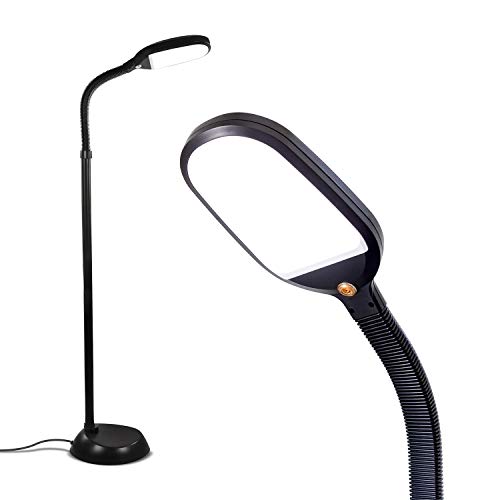
For those with limited surface space, a floor lamp that arches over the sewing table is the ideal solution. The Brightech Litespan offers a sleek, unobtrusive design that provides consistent illumination without requiring a precious inch of table surface. It is a practical choice for makers who need their tabletop clear for large fabric layouts or blocking boards.
This model is remarkably user-friendly for those who frequently transition from sewing to knitting. The gooseneck design allows for quick adjustments, enabling you to pull the light directly over your lap when moving from the machine to a favorite armchair for hand-finishing or grafting. It is a versatile workhorse that doesn’t demand a high budget.
However, note that because it is a floor model, the light source is further from the work surface than a direct desk lamp. While it provides excellent ambient task lighting, you might need to adjust your seating position to ensure the light is focused precisely on your needle tips. It is the best balance of value and function for the space-conscious crafter.
BenQ e-Reading LED Desk Lamp: Premium Wide-Area Light

This lamp is engineered specifically to provide a wide, even glow across a massive workspace, making it ideal for large-scale projects like long-row knitting or expansive fabric cutting. The curved design is not just aesthetic; it physically spreads the light outward to illuminate the entire width of a table without creating hot spots. It is a significant step up for anyone tired of constantly moving their lamp to follow their progress.
One standout feature is the automatic brightness adjustment, which senses the ambient light in the room and compensates accordingly. If you are knitting in the late evening, the lamp will automatically soften its intensity to match your surroundings. This minimizes the harsh contrast that often leads to headaches during long hours of focused work.
While this represents a significant investment, the build quality and the “eye-care” technology justify the price for dedicated makers. It is a long-term tool for those who spend hours every day at their crafting station. If you value seamless transitions and uniform lighting, the BenQ is an elite choice.
Neatfi XL Bifocals Super LED Lamp: Brightest Overall

When you are dealing with very dark-colored yarn—like midnight blue or black wool—the struggle to see your stitches is real. This lamp offers an intense, high-output beam that cuts through dark fibers, making it significantly easier to count rows and identify gauge. It is effectively a spotlight for your most demanding tasks.
The integrated magnification is a massive boon for fine detail work, such as fixing dropped stitches on tiny sock yarn or inspecting the tension of intricate bobbles. It provides the clarity needed to see every single ply of the yarn. This is essential for preventing the frustration that comes from blindly picking up loops in low-visibility projects.
The trade-off is the sheer intensity of the light, which can be overwhelming if not adjusted properly. It is built for function first, and the aesthetic is strictly clinical. If you frequently find yourself squinting at your work, the raw brightness of the Neatfi is the most effective corrective tool available.
Tomons Swing Arm Desk Lamp: Most Stylish Desk Pick

If your sewing space is also a shared room in your home, you likely want a lamp that doesn’t look like medical equipment. The Tomons swing arm lamp features a charming, minimalist wood-and-metal design that blends beautifully with home decor. It offers a classic, adjustable aesthetic that looks polished and intentional.
Functionally, the swing arm allows for precise height and angle control, which is vital when you need to switch between sewing a flat seam and knitting a rounded sleeve. You can articulate the lamp to get the light exactly where you need it, then tuck it away when you are finished. It is sturdy enough for daily use but delicate enough to look refined.
Remember that this lamp relies on a replaceable bulb, meaning your choice of light bulb will dictate the quality of the illumination. Use a high-CRI (Color Rendering Index) LED bulb to ensure you get the best color representation possible. It is the perfect choice for the knitter who demands both style and substance.
Phive LED Architect Lamp: Best Clamp-On Versatility
Clamp-on lamps are the unsung heroes of small sewing rooms because they keep your entire work surface free of clutter. The Phive Architect lamp features a robust, secure clamp that attaches to almost any table edge. Its wide, flat head is specifically designed to cast a long, even light that follows your hands as you move across a pattern or fabric piece.
The dimming settings are particularly impressive, offering multiple levels of intensity and warmth. This allows you to set the perfect “mood” for your knitting—warmer, softer light for relaxing evening projects and cooler, sharper light for daytime precision work. The build quality is industrial-grade, ensuring it stays exactly where you position it.
This is the ultimate space-saving solution for cramped apartments or crowded craft rooms. The only consideration is ensuring your table edge is sturdy enough to hold the clamp securely. It is a high-performance, reliable choice for anyone who wants a “set it and forget it” lighting solution.
How to Choose the Right Light for Your Sewing Space
The primary goal of your task light is to reduce visual strain, not just “add light” to the room. When selecting a lamp, evaluate the physical constraints of your workspace first: do you need a floor lamp to keep the table clear, or is a clamp-on model better for a small, fixed area? Think about the specific projects you undertake most often, such as fine needlepoint or large-scale knitting.
- Adjustability: Can the lamp articulate enough to reach every corner of your work area?
- Mounting: Will a heavy base take up too much table space, or is a clamp-on model more efficient?
- Dimming: Does the lamp offer multiple brightness levels to accommodate different times of day?
- Light Range: Does the head cover a wide enough area to eliminate moving the lamp every few minutes?
Always prioritize lamps that offer a high range of motion. A lamp that is “stiff” will eventually lead to frustration as you grow into different types of projects. Invest in hardware that moves with you, rather than forcing you to move your body to suit the light.
Understanding Lumens, Kelvin, and CRI for Crafting
Most crafters shop by price, but you must shop by specifications to ensure the light actually helps your eyes. Lumens measure the brightness; for detailed fiber work, look for a lamp that offers at least 800 to 1,000 lumens to ensure deep shadows are completely banished. Kelvin measures color temperature, where 5000K-6000K provides a crisp, cool white light that is best for identifying stitches and colors without eye strain.
CRI (Color Rendering Index) is the most overlooked spec, yet it is the most vital for fiber arts. CRI measures how accurately a light source reveals the true colors of an object compared to natural sunlight. Aim for a CRI of 90 or higher to ensure your deep jewel-toned wools or vibrant cottons don’t look muddy or distorted under your task light.
Do not be fooled by cheap LED desk lamps that claim to be “bright” but offer low CRI. If the colors don’t look right on your work table, your project will look different the moment you walk into a sunlit room. Always check the fine print for a CRI rating; if it isn’t listed, move on to a brand that takes pride in its light quality.
Where to Position Your Lamp to Eliminate Shadows
The secret to a perfect workspace is positioning the light source slightly to the side and slightly above your primary work zone. If you are right-handed, place the lamp on your left side to prevent your hand and needle from casting a shadow over your work as you knit or sew. Conversely, left-handed crafters should position the light on the right.
For large tables, overhead or centered placement is key to maintaining consistent light as you shift your gaze. Never place the lamp directly in front of your eyes, as this causes glare, especially if you are working with reflective, smooth needles like nickel-plated aluminum. If you find yourself experiencing glare, try tilting the lamp head slightly to bounce the light off the table surface rather than pointing it directly at your work.
Proper placement is an iterative process; don’t be afraid to move your lamp during a project to find the “sweet spot” where the light is sufficient but the glare is minimal. A few minutes spent adjusting the angle of your lamp will save you hours of eye fatigue and potential mistakes. Take the time to get the positioning right, and your focus will naturally sharpen.
A well-lit sewing table is the mark of a thoughtful crafter who values the longevity of their eyesight and the quality of their work. By choosing the right tool for your specific setup, you remove the physical barriers to finishing those complex, rewarding projects you love. May your needles stay bright, your colors stay true, and your stitches remain clear.