6 Best Needle Threaders For Hosiery Mending Worth Having
Struggling with snags? Discover our top 6 best needle threaders for hosiery mending to simplify your repairs. Shop our expert recommendations and save your tights.
Mending hosiery requires a delicate touch and the right equipment to ensure the snag-prone fibers remain intact. When a ladder forms or a heel begins to thin, using the correct needle threader can save hours of frustration and prevent accidental fabric damage. Achieving success depends on pairing the right threader with the specific weight of the thread and the diameter of the needle eye. This guide evaluates top tools to help navigate the tricky mechanics of invisible mending and reinforcement.
Dritz Looped Needle Threader: Best for All-Around Use


The Dritz Looped Needle Threader remains the industry standard for a reason. Its simple wire loop design provides enough flexibility to navigate most standard sewing needles used for darning fine hosiery.
This tool is ideal for knitters who need a quick solution without complicated mechanics. It handles varying thread weights easily, from thin silk mending thread to slightly thicker synthetic reinforcements.
While the wire is prone to bending over time, its low cost makes it a disposable necessity. Keep a few on hand, as these are the workhorses of the knitting bag.
Dritz LED Needle Threader: Top Pick for Low Light

Precision mending, especially on dark-colored socks or fine-gauge stockings, demands excellent visibility. The Dritz LED Needle Threader illuminates the needle eye, which significantly reduces eye strain during intricate repairs.
This feature is particularly valuable when working with low-contrast yarns or in dim lighting conditions. The integrated light acts as a visual guide, allowing for rapid threading when the needle eye seems invisible.
Be aware that the bulkier handle is less ergonomic for some, but the utility of the light outweighs the size for most menders. It is a specialized tool that excels where standard threaders fail.
Clover Desk Needle Threader: Easiest on Your Hands

For those dealing with arthritis or limited dexterity, the Clover Desk Needle Threader offers a stationary solution. The device holds the needle in place while the machine-like mechanism threads the eye effortlessly.
It is particularly effective for those working with ultra-fine needles that are difficult to hold steady. This tool removes the need for fine motor coordination, making it perfect for lengthy mending sessions.
While it lacks portability, the consistency it provides is unmatched. Consider this a permanent addition to the workstation for high-volume mending tasks.
Bohin Needle Threader: Premium French Quality Pick

Bohin is synonymous with precision manufacturing in the needle arts world. This French-made threader utilizes a high-quality steel wire that is both sturdier and more resilient than generic alternatives.
The construction allows for finer precision when threading needles intended for delicate hosiery. It resists the common issue of the wire pulling out of the handle, which happens frequently with cheaper models.
Investing in quality tools pays off when working with fragile, expensive hosiery that cannot be replaced easily. It is a reliable, long-term asset for any serious fiber artist.
Clover Black Gold Threader: For Ultra-Fine Needles
When mending hosiery at a fine gauge, standard needles often have eyes that are barely visible. The Clover Black Gold Threader is specifically engineered to handle these microscopic openings.
The wire is engineered for extreme flexibility without sacrificing strength. It slides through the tightest needle eyes without deforming, ensuring the thread stays securely in the loop during the pull-through.
It is essential to match this threader with high-quality embroidery or darning needles. Used correctly, it provides the clean passage required for invisible mending on high-twist yarns.
Colonial Needle Threader: Most Durable Wire Design
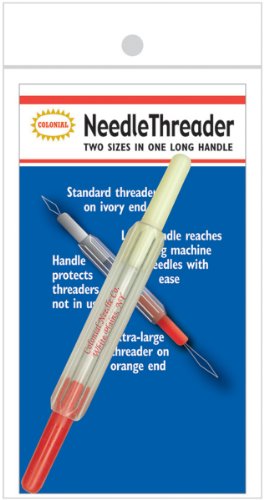
Durability is the primary concern when choosing a threader for frequent use. The Colonial Needle Threader features a reinforced wire design that withstands repeated stress better than almost any other manual tool.
This design choice prevents the wire from “mushrooming” or snapping after only a few uses. It is an excellent middle-ground option for those who want a portable tool that lasts significantly longer than the standard wire loop.
The handle provides a secure grip, reducing the chance of the threader slipping while navigating the needle eye. It is a practical, no-nonsense choice for the active mender.
Choosing a Threader for Delicate Hosiery Mending
Selection should always be dictated by the needle size required for the weight of the hosiery. For fine-gauge stockings, use a threader with a thin, flexible wire that won’t distort the eye of a size 9 or 10 needle.
Consider the material of the thread as well, as sticky fibers like raw silk or fuzzy mohair blends can get caught on the wire. A smooth, coated wire will perform better with these tricky, high-friction fibers.
Finally, evaluate the physical comfort of the tool. If the mending involves large areas of reinforcement, prioritize a threader with a handle that offers a substantial, ergonomic grip.
How to Use a Threader Without Snagging Hosiery
The greatest risk when mending is catching a loop of the hosiery fabric with the needle or the threader wire itself. Always ensure the hosiery is pulled taut, but not stretched to the point of distorting the stitches, during the process.
Use a light touch when pulling the thread through the needle eye. If resistance is felt, do not force the threader; back it out and ensure the thread is not doubled over in a way that creates unnecessary bulk.
Keep a spare needle available so the threader can be kept in a “loaded” state when moving between stitches. This prevents the wire from getting caught on the host fabric when not in active use.
Wire Loop vs. Hook: Which Threader Type Is Better?
Wire loop threaders are generally superior for fine-gauge hosiery because they are thinner and more precise. They offer a larger target for the thread while keeping the needle profile slim.
Hooks, while excellent for bulky yarns, are often too large for the eyes of needles used in hosiery repair. They can force the eye open over time, potentially damaging the fabric during the weave.
Reserve hook-style threaders for thick repairs like patching denim or heavy sweaters. For fine hosiery, stick to the flexibility and narrow profile of a high-quality wire loop.
Making Your Needle Threader Last: Simple Tips
To extend the lifespan of any wire-based threader, avoid bending the loop at harsh, sharp angles. Store the threader in a dedicated case or a pincushion where the wire cannot be crushed or snagged by other tools.
If the wire starts to lose its shape, gently reshape it with your fingers rather than using pliers, which can create weak points. A single sharp bend is often where a threader will eventually break.
Keep the tool clean of lint and fiber buildup, as these can snag on the delicate wires. A quick wipe with a dry, lint-free cloth after each session keeps the tool in peak condition.
Choosing the right needle threader is as important as selecting the right yarn for a project. By balancing the size of the needle, the nature of the hosiery fiber, and the ergonomics of the tool, mending becomes a seamless and satisfying extension of the knitting craft. Invest in quality options, and your delicate knits will stay in rotation for years to come.