
6 Best Swift Stands For Organized Skeining Options
Discover the top 6 swift stands for seamless yarn winding. Our guide compares features to help you find the best tool for efficient, tangle-free skeining.
Transforming a tangled, hand-dyed skein into a neat, workable yarn cake is a rite of passage for every dedicated knitter. Without the right tool, you risk frustrating knots and uneven tension that can ruin your gauge before you even pick up your needles. A reliable swift acts as your extra set of hands, ensuring your yarn flows smoothly during the winding process. Finding the perfect model depends on your space, your budget, and how often you find yourself falling in love with beautiful, untwisted hanks.
Stanwood Needlecraft Tabletop Swift: Best Overall
This swift is the gold standard for most home knitters because of its rock-solid construction and smooth, ball-bearing rotation. It handles a wide range of skein sizes without wobbling, which is vital when you are winding high-twist merino or delicate lace-weight yarns.
The metal hardware ensures it won’t warp over time, a common issue with cheaper wooden models that sit in humid craft rooms. If you frequently wind expensive hand-dyed wool, the consistent tension provided by this swift prevents the yarn from stretching or snapping.
While it does require a bit of desk space, the stability it offers is unmatched. It is a true "buy it once" tool that will serve you through years of sweater projects and sock knitting marathons.
Amish-Style Wooden Yarn Swift: Best Space Saver
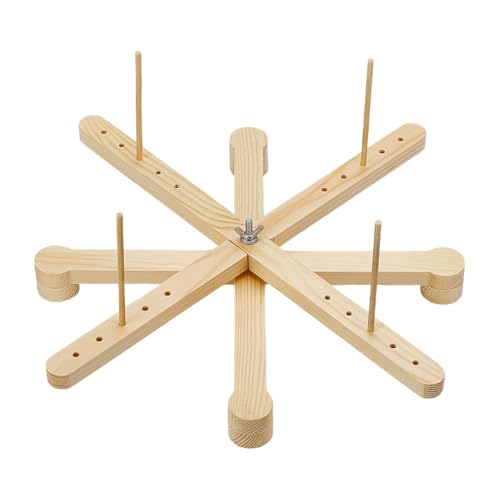

If your knitting space is also your dining table or a small corner of the living room, the Amish-style swift is a brilliant solution. Because it lies flat when not in use, it tucks away easily into a drawer or a narrow shelf.
Unlike umbrella swifts, this design uses adjustable wooden pegs to accommodate various skein circumferences. It is incredibly intuitive to set up, though you should ensure the pegs are tightened securely to avoid the yarn jumping off during a fast wind.
The trade-off here is speed; it doesn’t spin as freely as a ball-bearing tabletop model, so you’ll need to wind at a more measured pace. However, for the knitter who values a clutter-free home, this is the most practical choice available.
Lacis Wooden Umbrella Swift: Best for Heavy Use
The Lacis umbrella swift is built for the knitter who regularly works through large stashes or manages multiple projects at once. Its sturdy wooden frame and classic umbrella mechanism allow for quick deployment and effortless rotation.
The design is particularly effective at maintaining a wide, even circle, which is crucial for preventing yarn from slipping off the arms. If you are winding large, 100-gram hanks of bulky yarn, the structural integrity of this swift keeps everything centered and tangle-free.
Be aware that these models can be bulky when fully extended, so ensure you have a sturdy table to clamp it onto. It is a workhorse tool that rewards you with years of reliable, heavy-duty service.
KnitPicks Yarn Swift: Best Value for Beginners
When you are just starting your journey with hand-dyed yarns, you don’t necessarily need the most expensive equipment on the market. The KnitPicks swift offers a functional, accessible entry point that gets the job done without breaking your yarn budget.
It is lightweight and portable, making it easy to take to knitting group meetings or workshops. While it lacks the heavy-duty bearings of professional-grade models, it is perfectly capable of handling standard worsted or fingering weight skeins.
Treat it with a little extra care, and it will last you through your first dozen sweaters. It is the perfect tool for the knitter who is just beginning to transition from pre-wound balls to the wonderful world of skeined yarn.
Strauch Jumbo Ball Winder and Swift: Best Pro Set
For the serious fiber artist who buys yarn in massive quantities or spins their own wool, the Strauch set is the ultimate investment. This is professional-grade equipment designed to handle large, heavy skeins without any friction or struggle.
The synchronization between the swift and the winder is seamless, resulting in perfectly shaped cakes that won’t collapse. When you are winding a massive 400-yard skein of lace weight, the smooth operation prevents the "yarn barf" that often happens with lesser tools.
This set is a significant financial commitment, but it is an essential upgrade for anyone who views yarn preparation as a core part of their craft. It turns a chore into a satisfying, efficient experience.
Fiber Artist Supply Co. Swift: Best Handcrafted
There is a distinct pleasure in using tools made by fellow makers who understand the tactile nature of fiber arts. These handcrafted wooden swifts are not only functional but also beautiful enough to leave out on display in your studio.
The craftsmanship ensures that the wood is sanded perfectly smooth, so there are no rough edges to snag your precious silk or alpaca blends. Because they are made from quality hardwoods, they are durable, stable, and have a natural weight that keeps them grounded while you wind.

Choosing this option supports small-scale manufacturing and provides you with a tool that feels personal and curated. It is an excellent choice for the knitter who wants their gear to be as high-quality as the yarn they knit.
Essential Factors for Choosing a Reliable Swift
- Clamping Mechanism: Ensure the clamp is wide enough to fit your specific table or desk edge.
- Rotation Smoothness: Ball bearings are superior for high-speed winding, while wooden pivots require more manual effort.
- Material Quality: Hardwoods and metal hardware generally offer better longevity than plastic or soft pine.
- Skein Capacity: Consider the circumference of your typical yarn purchases to ensure the swift arms can expand far enough.
Proper Techniques for Setting Up Your Skein
Always untwist your skein completely before placing it on the swift, and make sure to remove the ties carefully. If you leave a single twist in the yarn, you will experience sudden, jarring stops that can cause the yarn to jump off the swift.
Place the skein onto the swift and expand the arms until the yarn is taut, but not stretched. If you pull the yarn too tight, you risk permanently altering the elasticity of the fiber, which can lead to unexpected gauge changes in your finished garment.
Finally, always start your wind slowly. Use your hand to guide the yarn onto the winder, ensuring that the tension remains consistent throughout the entire process.
How to Maintain Your Swift for Smooth Rotation
Wooden swifts benefit from an occasional light sanding if the wood begins to feel "grabby" or rough. You can also apply a small amount of beeswax to moving parts to keep them rotating silently and smoothly.
Avoid storing your swift in areas with extreme temperature fluctuations, such as a damp basement or an uninsulated attic. Wood is a natural material that expands and contracts, and consistent storage conditions will prevent the arms from warping or sticking.
If your swift uses metal bearings, a tiny drop of sewing machine oil can work wonders if you notice any squeaking. Keep it clean of dust and lint, and it will remain a reliable part of your knitting kit for decades.
Troubleshooting Common Skeining Issues at Home
- Yarn Jumping: Usually caused by the swift being under-expanded or the yarn being wound too quickly.
- Tangled Skeins: If you encounter a knot in the skein, stop immediately; never try to "power through" a tangle, as it will only tighten the knot.
- Uneven Cakes: This is often a sign that you are holding the yarn too close to the winder; keep your hand further back to allow the yarn to feed evenly.
- Slippage: If your swift is sliding on the table, use a rubber shelf liner between the clamp and the table surface for extra grip.
Investing in a quality swift is one of the most practical upgrades you can make to your knitting practice. By removing the physical struggle of untangling and winding, you free up your energy for the actual joy of creating. Choose the model that fits your space and your volume of work, and you will find that your yarn preparation becomes a meditative part of your process. Happy winding, and may your cakes always be perfectly tensioned for your next project.

