6 Best Beading Needles For Lace Weight Yarn
Discover the 6 best beading needles for lace weight yarn. Learn which tools offer the durability and precision needed for delicate, intricate fiber projects.
Adding beads to lace weight yarn transforms a simple shawl into an heirloom-quality piece of art. However, the wrong needle can snag delicate fibers or cause frustration during the threading process. Choosing the right tool is the difference between an enjoyable crafting session and a project that sits unfinished in your basket. This guide explores the best needles designed to help you navigate the fine, slippery nature of lace weight yarn.
Tulip Beading Needles: The Professional Choice


Tulip needles are widely considered the gold standard for high-end lace projects. They feature a unique, polished surface that allows the needle to glide through even the most delicate silk or lace-weight merino without catching on the plies.
These needles are exceptionally straight and possess a degree of flexibility that prevents them from snapping under pressure. When you are working with hundreds of beads on a complex lace chart, the last thing you want is a needle that bends permanently or snaps mid-row.
The trade-off here is the price point, as they are significantly more expensive than mass-market options. However, for a long-term project where you are handling thousands of beads, the investment pays for itself in reduced frustration and fiber protection.
John James Beading Needles: Best for Durability
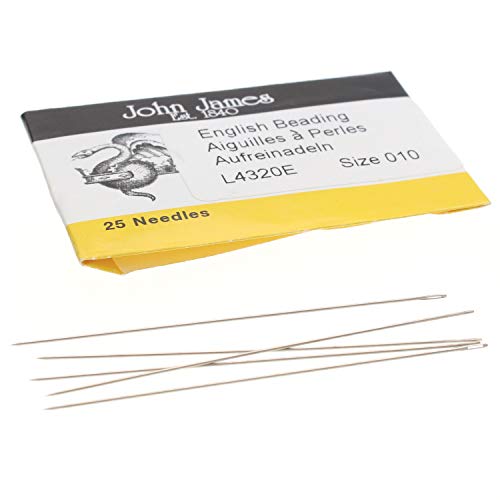
John James has been manufacturing needles for generations, and their beading line reflects that heritage of reliability. These needles are crafted from high-quality steel, making them incredibly sturdy and resistant to the bending that often occurs when forcing a needle through a tight bead hole.
If you are working with glass beads that have slightly irregular or sharp edges, you need a needle that won’t burr or scratch. John James needles maintain their integrity through hours of repetitive motion, ensuring your yarn remains smooth from start to finish.
They are less flexible than some specialized embroidery needles, which some knitters prefer for stability. If you find that overly flexible needles make you feel like you’ve lost control of your threading, these are a perfect, solid alternative.
Beadsmith Collapsible Eye: Best for Ease of Use
The Beadsmith collapsible eye needle is a game-changer for anyone who struggles with eyesight or the fine motor coordination required for traditional needles. The entire body of the needle is essentially a long, flexible loop that collapses flat when it passes through a bead.
This design allows you to thread your lace yarn through the large "eye" with ease, even if the yarn is slightly fuzzy or has a tendency to split. Once the yarn is loaded, the eye collapses to the width of the yarn itself, allowing it to slide through the bead effortlessly.
The main drawback is that the wire can eventually lose its shape or snap after heavy use. Keep a few spares on hand, as these are designed for convenience rather than extreme longevity.
Pony Beading Needles: Best Budget-Friendly Option

Pony needles are the reliable workhorse of the knitting world, offering consistent quality at a price that won’t break the bank. These are ideal for the knitter who wants to experiment with adding beads to lace without committing to a premium toolset.
They are generally thinner than other brands, which is a massive advantage when working with tiny 11/0 or 15/0 seed beads. Because they are so slender, they fit through the smallest bead apertures where other needles might get stuck.
While they may not have the same polished finish as a Tulip needle, they are perfectly functional for most lace projects. Just be mindful of the metal finish; if you find them catching on your yarn, a quick wipe with a clean, dry cloth can remove any residual manufacturing oils.
Miyuki Twisted Wire Needles: Best for Precision

Miyuki is world-renowned for their precision-cut beads, and their needles are designed with that same level of detail in mind. These twisted wire needles are incredibly thin, making them the superior choice for high-precision lace work where the bead hole is exceptionally small.
The twisted wire construction acts like a spring, holding onto the yarn firmly while you navigate the bead. This tension is helpful when you are working with slippery materials like silk or bamboo lace yarns that like to unthread themselves.
Because they are made of wire, they are more delicate than solid steel needles. Avoid using them to force a bead that is clearly too small for your yarn, as the wire can distort or break under excessive tension.
Darice Beading Needles: Best for Beginners

Darice needles are widely available and serve as a perfect introduction to the world of beaded knitting. They are typically sold in multi-packs, which is a great safety net for beginners who might accidentally lose or bend their first few needles.
These needles are straightforward and lack the bells and whistles of professional-grade tools. For a beginner learning the "hook" or "pre-stringing" method, having a simple, no-nonsense needle allows you to focus on the technique rather than the equipment.
They are a fantastic "utility" needle to keep in your knitting bag for non-lace tasks as well, such as weaving in ends on fine-gauge garments. They aren’t the most refined, but they get the job done reliably every time.
How to Choose the Right Needle for Lace Projects
The most important factor in choosing a needle is the relationship between your yarn weight and the bead hole size. Always test your needle and bead combination with a scrap piece of your project yarn before you start the actual knitting.
Consider the following factors when making your selection:
- The Bead Aperture: Does the needle pass through the bead with room to spare for the yarn?
- Yarn Texture: Is your yarn a smooth silk (which slips easily) or a fuzzy mohair (which catches)?
- Project Duration: Are you adding a few beads or thousands? Higher volume projects require higher quality, more durable needles.
If you are a tight knitter, you may find that you need a stronger needle that won’t bend as you pull the yarn through the stitch. Conversely, if you have a loose gauge, you might prefer a thinner, more flexible needle that won’t distort your loops.
Understanding Needle Sizes for Fine Lace Yarns
Beading needles are typically sized by numbers, but unlike knitting needles, the numbering system can be counter-intuitive. Generally, the higher the number, the thinner the needle.
For lace weight yarn, you will almost exclusively be looking at sizes 10 through 15. A size 10 is slightly thicker and easier to handle, while a size 15 is extremely fine and intended for the smallest beads.
Be aware that these sizes are not standardized across all manufacturers. A size 12 from one brand may feel slightly different than a size 12 from another, so stick to one brand once you find a size that works for your specific yarn and bead combination.
Essential Tips for Threading Delicate Lace Yarn
Threading lace yarn can be the most frustrating part of the process, especially if the yarn is plied and prone to splitting. To make this easier, try cutting your yarn at a sharp angle to create a tapered end before attempting to thread it.
If your yarn is particularly fuzzy, a tiny dab of beeswax or a specialized thread conditioner can help smooth down the fibers. This makes the yarn more compact and less likely to snag on the eye of the needle.
Always ensure you have good lighting when threading, and don’t be afraid to use a magnifying glass. If you continue to struggle, try the "loop method," where you thread a piece of fine sewing thread through the needle to create a larger loop, then pull your yarn through that loop.
Frequently Asked Questions About Beaded Knitting
Q: Can I reuse my beading needles? A: Yes, most high-quality steel needles can be reused indefinitely. However, check them periodically for burrs or bends that could damage your yarn.
Q: What if my bead won’t fit over the yarn? A: If the bead is too small, do not force it. It is better to switch to a larger bead or a thinner yarn than to risk breaking the bead or damaging your knitting.
Q: Should I pre-string my beads or add them as I go? A: Pre-stringing is common for simple patterns, but for complex lace, adding them as you go using a crochet hook is often more manageable. Use the needle method if you prefer the look of beads sitting specifically on the yarn strand.
Mastering the art of beaded lace is a journey that rewards patience and the right choice of tools. By selecting a needle that complements your specific yarn and project, you eliminate the technical hurdles that stand between you and your finished garment. Remember that every knitter’s tension and preference are unique, so don’t hesitate to experiment until you find your perfect match. Happy knitting, and may your beads always slide perfectly into place.