
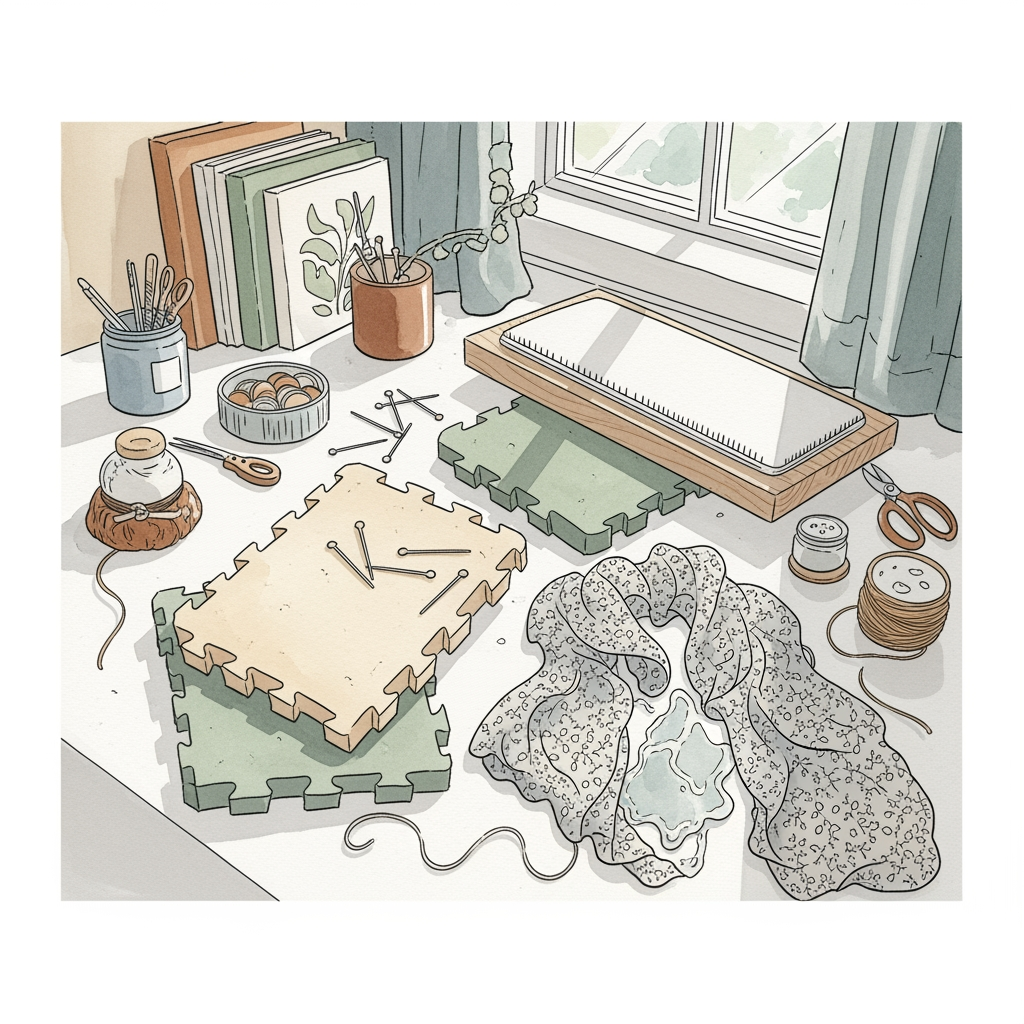
6 Best Knit Blocking Boards for Circular Items Reviewed
Struggling to shape circular knits? We review the 6 best blocking boards to ensure your projects maintain perfect symmetry and professional results every time.
Achieving the perfect drape in a circular shawl or a lace doily requires more than just patience; it demands a reliable foundation for shaping. Without a stable blocking surface, your intricate stitch patterns will remain distorted and uneven, hiding the true beauty of your hard work. Choosing the right blocking board transforms a lumpy, puckered project into a professional, gallery-ready piece. This guide navigates the best tools available to ensure your circular items maintain their intended symmetry and tension.
Knitter’s Pride Knit Blockers: Best Overall Pick
These aren’t your standard T-pins; they are essentially plastic bars embedded with multiple stainless steel pins that cover a significant surface area in one motion. When you are blocking a large circular shawl with a complex picot bind-off, these blockers save your fingers from the repetitive strain of placing dozens of individual pins.
The primary advantage here is the consistent tension they provide along a straight or curved edge. Because the pins are set in a rigid bar, they naturally pull the fabric with uniform force, preventing the "scalloping" effect that often happens when individual pins are spaced inconsistently.
However, be mindful that they are quite rigid. If you are working on a very tight, small-scale circle, the length of the blocker might be too cumbersome to follow a sharp curve. For most projects, though, they are the gold standard for efficiency.
Boye Interlocking Foam Mats: Best Budget Option


If you are just starting your journey into lace knitting, you don’t need to break the bank to get professional results. These interlocking foam mats are the workhorses of the knitting world, offering a generous, customizable surface that can be expanded as your project grows.
The foam is dense enough to hold a pin firmly, but soft enough that you won’t struggle to push them in. I often see knitters try to use towels on a carpeted floor, which leads to uneven drying and a lack of proper shape; these mats solve that by providing a flat, elevated plane.
The trade-off is that they are lightweight and can slide on hardwood floors. I recommend placing them on a rug or using a bit of shelf liner underneath if you find them slipping while you are pinning out a large circular piece.
Cocoknits Blocking Tiles: Best Modular Design
Cocoknits has mastered the art of the "maker’s aesthetic" by creating tiles that are as functional as they are beautiful. These tiles feature a grid printed directly on the surface, which is an absolute game-changer for ensuring your circular item is perfectly centered.
The modular nature allows you to build a surface that fits your specific project, whether you are blocking a tiny hat or a massive, sprawling circular tablecloth. The material is also heat-resistant, which is crucial if you are using a steam iron to set your stitches.
One minor downside is the price point, which is higher than standard foam mats. However, if you value precision and durability, the investment pays for itself in the time you save measuring and re-measuring your symmetry.
Lacis Blocking Board: Best for Circular Items

This is a specialized tool that feels like a throwback to traditional crafting, often featuring a circular grid layout. For knitters who focus exclusively on round projects like mandalas or circular vests, this board is incredibly intuitive.
The board’s design allows you to pin from the center outward, which is the most effective way to ensure a circle stays perfectly round. You aren’t fighting against a square grid; you are working with the geometry of your project.
It is a more niche purchase, certainly, but it removes the guesswork. If you find yourself constantly measuring from the center point to the edge to check for "lopsidedness," this board is your solution.
Clover Blocking Mats: Best for Precision Work
Clover is synonymous with quality, and their blocking mats are no exception. They are exceptionally dense, which means they hold pins at a perfect 90-degree angle without the "wobble" you might get with cheaper, thinner foam.
When you are working with delicate lace weight yarns, the last thing you want is a pin tilting and distorting your stitches. The density of these mats ensures that the pin stays exactly where you put it, preserving the integrity of your lace holes.
They are smaller than some of the "jumbo" tile sets, so they are best suited for smaller circular items like socks, cowls, or doilies. If you are blocking a full-sized sweater, you might need two sets to get the coverage you require.
ArtBin Foam Blocking Tiles: Best Large Surface
Sometimes you have a massive project—like a circular shawl that spans five feet across—and you need a surface that won’t fall apart under the weight. ArtBin tiles are robust and provide a massive, stable footprint for your largest endeavors.
The interlocking mechanism is exceptionally secure, meaning the tiles won’t drift apart while you are stretching your wool. This is vital when blocking natural fibers like wool or alpaca, which have a "memory" and will try to snap back if the board isn’t rock-solid.
Because they are so large, they can be difficult to store if you don’t have a dedicated craft room. I suggest keeping them stacked in a closet or under a bed, as they are too bulky to leave out permanently if you live in a smaller space.
Why Circular Items Require Specialized Blocking
Circular items are notoriously difficult to block because any uneven tension results in a wavy, "potato chip" edge. When a garment is meant to be flat, the stitches must be distributed equally around the entire circumference.
If you don’t use a circular-friendly blocking method, you will likely end up with a shape that is more oval than round. This isn’t just an aesthetic issue; it can affect how a garment hangs on the body, causing unwanted bulk or pulling.
Always remember that blocking is the final step of the design process. It is where you "set" the stitches, essentially telling the yarn how it should behave once it is dry and off the needles.
Selecting the Best Material for Blocking Boards
- Dense Foam: The best all-around choice for durability and pin retention.
- Cork: Excellent for heat resistance, but can become brittle and crumble over many years.
- Wood/Plywood: Great for heavy-duty, permanent setups, though they require specific pin types and can be heavy to move.
- Avoid Cardboard: It absorbs moisture from your wet project, which can lead to mold or warping.
Always choose a material that is moisture-resistant. Since you are pinning a wet garment to the board, the surface must be able to withstand water without degrading or transferring color to your yarn.
Essential Tools for Perfect Circular Shaping
To achieve a perfect circle, you need more than just a board; you need a system. A measuring tape is non-negotiable for checking the distance from the center to the edge at multiple points.
- T-Pins: Rust-proof stainless steel is mandatory to avoid staining your fibers.
- Blocking Wires: These are flexible metal wires you thread through the edge of your project to create smooth, sweeping curves.
- Rust-proof pins: Never use standard sewing pins, as they will rust the moment they touch wet wool.
Using blocking wires in combination with your board is the secret to professional-looking circular lace. They take the tension off individual pins and distribute it along the entire circumference of the project.
How to Maintain Your Blocking Mats for Longevity
After you finish blocking, let your mats air dry completely before stacking them away. If you put them away while they are still damp, you risk trapping moisture, which can lead to unpleasant odors or mildew.
If the surface gets dusty or picks up lint, a quick pass with a lint roller is usually enough to clean it. Avoid using harsh chemical cleaners, as they can break down the cellular structure of the foam over time.
Finally, treat your mats with care when pinning. Don’t shove the pins in at a sharp angle; insert them straight down to preserve the density of the material. A well-maintained set of blocking tiles can easily last a decade of heavy knitting.
Blocking is the bridge between a finished object and a professional garment, turning your hard work into a polished masterpiece. Whether you choose the modular flexibility of Cocoknits or the robust surface of ArtBin, the right board will make the process feel like a reward rather than a chore. Take your time with the pinning process, trust your measurements, and enjoy the transformation of your stitches. Your circular projects deserve a foundation that highlights every purposeful loop and yarn-over.
