7 Best Blocking Mats For Drying Damp Knits Compared
Discover the 7 best blocking mats for your damp knits. We compare durability, grid precision, and size to help you achieve a perfect, professional finish.
Blocking is the final, transformative step that turns a puckered, uneven piece of fabric into a professional-looking garment. Without the right surface to pin your work, your stitches will never achieve their full potential or consistent drape. Whether you are working with delicate lace or rustic wool, these mats provide the essential foundation for success. Investing in a quality blocking surface is the single most effective way to elevate your finished projects.
Knitter’s Pride Knit Blockers: Best Overall Pick


These aren’t just mats; they are a comprehensive system that changes how you approach finishing. The Knit Blockers feature multiple pins embedded into a single plastic housing, which saves you from the tedious task of placing individual T-pins.
If you have ever spent an hour pinning out a large shawl, you know how quickly your hands can tire. This tool allows you to secure long straight edges in seconds, keeping your tension perfectly uniform across the entire span.
The trade-off here is that these are best for straight edges and larger projects. For complex, organic curves, you will still want to keep a few individual pins on hand to capture those tricky corners.
Boye Interlocking Foam Mats: Best Budget Choice

Sometimes, you don’t need fancy features; you just need a reliable, heat-resistant surface that gets the job done. The Boye mats are a staple in many knitting bags because they are lightweight, affordable, and easy to store.
They function exactly as you would expect, interlocking like a standard puzzle floor. They provide enough depth for a standard T-pin to sink in securely without hitting the floor underneath.
While they lack the specialized grids or extra-thick density of premium options, they provide a perfectly functional workspace. If you are a beginner on a budget, these will serve you well for years before you feel the need to upgrade.
Clover Blocking Mats: Best for Delicate Lace
When you are working with fine-gauge lace or fragile silk blends, you need a surface that is exceptionally gentle and precise. Clover’s mats are renowned for their smooth texture, which prevents snagging on delicate fibers.
The material is firm enough to hold tension without "creeping" while you pin. This is vital when you are aggressively stretching a lace project to open up the pattern motifs and reveal the true design.
Because these mats are designed with high-quality, closed-cell foam, they resist water absorption better than cheaper alternatives. This means they won’t stay damp or develop odors if you leave a project pinned for several days.
Exerpeutic Puzzle Mats: Best Large Surface Area
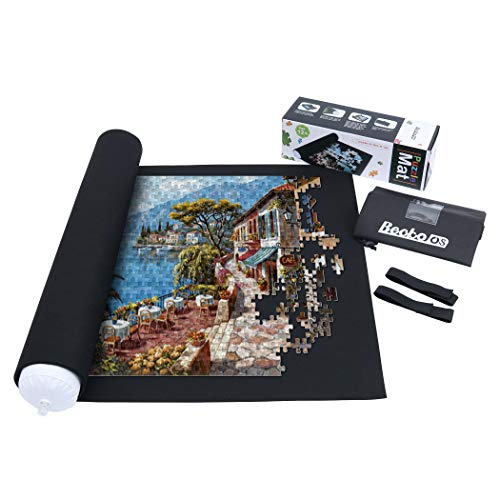
If you primarily knit sweaters or large afghans, standard small tiles will drive you crazy with their constant seams. Many experienced knitters bypass the craft aisle entirely and opt for large-format exercise mats like these.
The primary benefit is the sheer scale of the workspace. You can lay out an entire sweater back or a king-sized blanket without having to worry about your pins catching on a seam between tiles.
The downside is that these mats are often thinner and slightly firmer than dedicated knitting mats. You may need to use slightly shorter pins to ensure they don’t poke through the other side and scratch your floor.
Magknits Blocking Tiles: Best Grid Alignment

The greatest enemy of a well-blocked sweater is asymmetry. Magknits tiles come with a printed grid that acts as a visual guide, ensuring your pieces are perfectly square and identical in size.
This is a game-changer for colorwork projects where keeping your motifs aligned is critical. By following the lines, you can easily verify that your left and right sleeves are blocked to the exact same dimensions.
The grid is also incredibly helpful for beginners who are still learning how much tension to apply. It provides a concrete reference point, removing the guesswork from the blocking process.
KnitIQ Blocking Mats: Best Extra Thick Surface
Thickness matters when you are working with heavy, dense wools that require firm pinning. KnitIQ mats offer a significant increase in depth, allowing your T-pins to stand upright without leaning or pulling out of the foam.
This extra density provides a very stable base, which is crucial if you are "steam blocking" or using heavy weights to help set a stubborn stitch pattern. The pins stay exactly where you put them, even under tension.
While they are bulkier to store, the durability is unmatched. If you frequently work with heavy cables or thick, worsted-weight yarns, this is the surface you want under your work.
Susan Bates Knit-N-Block: Best Travel Selection

For the knitter who never leaves home without a project, portability is the ultimate feature. The Susan Bates system is designed to be compact and travel-friendly, fitting easily into a standard project tote.
It sacrifices some total surface area for the sake of convenience. However, the included measuring tools are excellent for ensuring your gauge remains consistent even when you are blocking on the go.

This is not the mat for a full-sized blanket, but for socks, hats, and cowls, it is perfect. It’s a great "secondary" mat to have in your kit for quick finishes while traveling.
Why Blocking Mats Are Essential for Your Knits
Blocking is not just about making things look pretty; it is about evening out your tension. When you knit, your stitches are often cramped and distorted by the needles; a soak and a stretch allow them to bloom.
Without a dedicated mat, you are forced to use towels or beds, which are rarely flat or pin-friendly. A proper mat ensures that your fabric dries in the exact shape you intended, preventing "wonky" edges or uneven seams.
Furthermore, a dedicated mat allows for airflow. By elevating your project slightly and providing a firm, non-absorbent base, you ensure the piece dries evenly, which is vital for preventing mildew in natural fibers.
How to Choose the Perfect Blocking Mat Material
Not all foam is created equal, and your choice should depend on your most common project type. You want a material that is dense enough to hold a pin, yet soft enough not to damage your yarn.
- Closed-cell EVA foam: The gold standard; it doesn’t absorb water and is easy to wipe clean.
- Grid-printed surfaces: Ideal for those who struggle with symmetry or need to match dimensions precisely.
- Extra-thick mats: Essential for heavy-weight projects where pins need deep, vertical support.
Avoid using soft, porous materials that soak up water like a sponge. If your mat stays wet, your project will take twice as long to dry, which can be detrimental to delicate fibers like alpaca or cashmere.
Essential Tips for Proper Wet Blocking Technique
Always start by soaking your project in lukewarm water with a gentle wool wash. Never wring or twist the fabric; instead, roll it in a clean towel to press out the excess moisture before transferring it to your mat.
When pinning, start from the center and work your way out to the edges. This ensures that the tension is distributed evenly and prevents the fabric from becoming skewed or lopsided.
Finally, be patient. Let your project dry completely on the mat before removing the pins. If you unpin while the yarn is still damp, the fibers will "remember" their previous shape, and your hard work will disappear in an instant.
Choosing the right blocking mat is an investment in the longevity and appearance of your hand-knit wardrobe. By selecting a surface that matches your specific project needs, you ensure that every stitch is displayed to its best advantage. Take the time to pin carefully, be patient with the drying process, and you will see your knitting transform before your eyes. Happy blocking, and may all your seams be perfectly straight.