7 Best Craft Light Boxes For Pattern Visibility Tested
We tested 7 top craft light boxes for pattern visibility. Discover our rankings to find the best brightness, portability, and value for your next project.
Following intricate lace charts or deciphering complex stranded colorwork patterns can be a genuine strain on the eyes during long knitting sessions. A high-quality light box acts as a personal spotlight, illuminating every stitch and symbol to ensure your work remains accurate. After evaluating the most popular options on the market, I have curated a list of the top seven light boxes that truly deliver for fiber artists. These tools are game-changers for anyone looking to reduce frustration and elevate the precision of their finished projects.
Artograph LightPad 930: The Professional Standard


When you are working on a massive, heirloom-quality lace shawl with a chart that spans several pages, the Artograph LightPad 930 is the gold standard. It offers a generous, evenly lit surface that eliminates the "hot spots" often found in cheaper models.
The color-corrected LED technology provides a crisp, daylight-balanced glow that is essential when you are trying to distinguish between subtle yarn shades in a stranded colorwork chart. Its sturdy construction means it won’t slide around your craft table, even when you are shifting heavy skeins of wool around.
While the price point is significantly higher than entry-level boards, the durability is unmatched. If you are a prolific knitter who spends hours daily following complex motifs, this is an investment in your long-term comfort and accuracy.
LitEnergy A4 LED Light Box: Best Value Option

If you are just beginning your journey into charted patterns and don’t want to break the bank, the LitEnergy A4 is a fantastic entry point. It is lightweight, portable, and surprisingly bright for its modest price.
This model features a simple touch-sensitive button to adjust brightness, which is crucial when your eyes get tired late at night. It is thin enough to slide into a project bag alongside your circular needles and notions pouch, making it perfect for knitting group meetups.
The trade-off here is the build quality, which feels more plastic-heavy compared to professional-grade tools. However, for the occasional chart reader or someone working on standard-sized patterns, it performs exactly as needed without unnecessary bells and whistles.
Huion L4S Light Pad: Ultra-Thin Design Choice
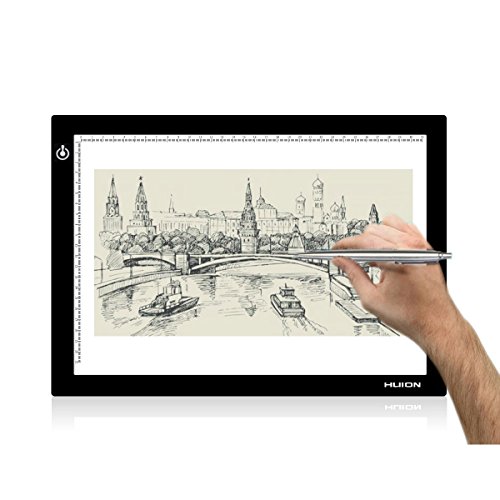
The Huion L4S is remarkably thin, resembling a sleek tablet more than a traditional light board. Its slim profile makes it incredibly easy to tuck under your pattern without creating an awkward height difference on your workspace.
I appreciate how this model uses a USB power source, meaning you can plug it directly into your laptop or a portable power bank while sitting in your favorite armchair. The surface is smooth and scratch-resistant, which is helpful if you accidentally drop a metal knitting needle or scissors on it.
Be aware that the edge-lit design can sometimes be slightly dimmer at the very center than at the perimeter. For most knitting charts, this is negligible, but it is worth noting if you are using it for detailed embroidery or fine-line drafting alongside your knitting.
HSK A4 LED Light Box: Reliable Daily Workhorse

The HSK A4 is a no-nonsense, reliable tool that consistently earns its place on a knitter’s desk. It offers a solid, flicker-free light source that prevents the visual fatigue that often leads to dropped stitches or misread rows.
Its surface is large enough to accommodate a standard A4 pattern sheet, allowing you to see your entire row repeat at a glance. The brightness levels are intuitive, allowing you to dial back the intensity if you are using a high-contrast chart that might otherwise glare.
It lacks some of the advanced features of premium pads, but its consistency is its greatest strength. If you need a tool that simply works every time you sit down to knit, this is a dependable choice that won’t let you down.
Cricut BrightPad Go: Best Portable Cordless Pick

For the knitter who loves to work on the go, the Cricut BrightPad Go is the ultimate luxury. Because it is cordless and rechargeable, you aren’t tethered to a wall outlet, which is a massive advantage when working in different rooms.
The surface is incredibly durable and designed to handle the rigors of frequent use, including accidental spills or contact with sharp needle tips. It also features a non-slip base, which is vital if you are working on a slick dining room table.
The main drawback is the price and the fact that you have to manage yet another battery-operated device. However, the freedom of movement it provides makes it worth the cost for those who knit in various spots around the house.
T-SIGN A4 LED Light Pad: Excellent Ergonomics

The T-SIGN A4 stands out for its thoughtful design, which includes an adjustable stand that allows you to tilt the light board toward you. This is a game-changer for ergonomics, as it allows you to maintain a better posture while following a pattern.
By angling the board, you reduce the need to hunch over your work, which saves your neck and shoulders during marathon knitting sessions. The lighting is bright and uniform, ensuring that your chart symbols are always sharp and clear.
While the stand adds a bit of bulk, the benefits to your physical comfort are undeniable. If you find yourself experiencing neck pain after a long night of knitting, this ergonomic approach is well worth the extra space it takes up.
Aibecy A4 LED Light Board: Best Budget Selection
The Aibecy A4 is perfect for the budget-conscious knitter who needs a functional light source without any expensive extras. It is a straightforward, lightweight board that does exactly what it promises.
It provides enough illumination to make even the most dense lace charts readable, even when using dark-colored yarns that might otherwise hide details. It is a simple tool, but in the world of knitting, sometimes simple is exactly what you need.
Expect basic materials and a standard power cable, which may not be as durable as higher-end models. However, if you are just testing the waters of using a light box, this is a low-risk way to see how it improves your pattern-reading speed and accuracy.
Why Knitters Need Light Boxes for Chart Reading
Light boxes are not just for artists; they are essential for knitters working with complex motifs like cables, lace, or stranded colorwork. By placing your chart on a backlit surface, you can place a magnetic marker or a piece of tape over your current row and see exactly where you are without squinting.
- Visibility: Helps distinguish between similar symbols in dense charts.
- Focus: Keeps your eyes locked on the current row, reducing the likelihood of skipping stitches.
- Accuracy: Makes it easier to count stitches in intricate lace repeats.
Many beginners struggle with "reading their knitting," and a light box provides the visual clarity needed to identify stitch patterns as they emerge on the needles. It transforms a frustrating, squinting experience into a meditative, smooth process.
Key Features to Prioritize for Fiber Crafting
When choosing a light box, look for features that specifically address the needs of a knitter. You want a surface that is large enough for your pattern but doesn’t take up your entire workspace, as you still need room for your needles and yarn.
- Adjustable Brightness: Essential for changing light conditions throughout the day.
- Flicker-Free Lighting: Prevents eye strain during long sessions.
- Surface Durability: Needs to withstand accidental contact with metal needles.
- Portability: Consider whether you prefer a corded model or a cordless, rechargeable one.
Avoid models that emit too much heat, as this can be uncomfortable if your hands are resting near the board. A cool-to-the-touch LED surface is the gold standard for fiber crafters.
Tips for Reducing Eye Strain During Night Work
Knitting at night can be hard on the eyes, especially when working with dark yarn or complex charts. Using a light box is a great first step, but you should also ensure your ambient lighting is balanced to prevent harsh contrast.
- Take Micro-Breaks: Every 20 minutes, look away from your knitting and focus on something 20 feet away.
- Adjust Brightness: Lower the intensity of your light box as the room gets darker to prevent glare.
- Use Proper Seating: Ensure your chair supports your back so you aren’t leaning too close to your work.
Remember that your eyes are your most important tool as a knitter. Investing in a good light box is not just about finishing your project faster; it is about preserving your ability to enjoy the craft for years to come.
Integrating a light box into your knitting toolkit is a simple adjustment that yields immediate, noticeable improvements in your accuracy and comfort. Whether you choose a professional-grade board or a budget-friendly option, the clarity provided will help you tackle those challenging patterns with newfound confidence. Take the time to consider your specific workspace and knitting habits to find the model that fits your needs perfectly. Happy knitting, and may your rows always be even and your charts crystal clear.