6 Best Sewing Measuring Tapes For Sizing Professionals
Looking for precision? Discover the 6 best sewing measuring tapes for sizing professionals and upgrade your toolkit with these top-rated, accurate essentials today.
Accurate measurements are the bedrock of any successful knit or crochet project. Whether calculating the required yardage for a complex cable sweater or adjusting a pattern for a custom fit, the tools used to capture these numbers determine the garment’s final drape and silhouette. Investing in a high-quality measuring tape prevents the common pitfalls of warped gauge and mismatched sizing that often plague handmade apparel. Selecting the right tool is not merely about convenience; it is about ensuring that the hard work put into every stitch translates into a garment that fits exactly as intended.
Dritz Soft Tape Measure: The Best Overall Pick


The Dritz Soft Tape Measure is a staple in most sewing baskets for a reason. Its flexible, vinyl-coated construction conforms seamlessly to the body, making it ideal for measuring circumference during sweater construction or checking the length of a growing sleeve.
This tape features large, easy-to-read numbers that simplify the process of taking measurements in low light. The metal ends provide a professional finish that prevents fraying, a common issue with cheaper alternatives.
While it lacks a retracting mechanism, its simplicity is its greatest strength. It is lightweight, reliable, and won’t get jammed when the pressure is on during a marathon knitting session.
Singer ProSeries Retractable: Best for Travel

For those who carry their knitting projects to workshops or travel frequently, the Singer ProSeries Retractable tape is a compact necessity. It fits effortlessly into a small notions bag, keeping the tape protected from dust and tangles between uses.
The push-button retraction is quick and intuitive, allowing for rapid measurements of gauge swatches or WIP (Work-In-Progress) dimensions. A locking mechanism keeps the tape extended at the desired length, providing a steady reading without the tape snapping back unexpectedly.
Be mindful that the internal spring mechanism can fail over years of heavy use. Treat it as a portable tool rather than a permanent studio fixture to extend its lifespan.
Clover Shiro Tape Measure: Most User-Friendly

The Clover Shiro Tape Measure stands out for its thoughtful, ergonomic design. It features a flat, stable housing that prevents the tape from twisting during measurement, ensuring consistent accuracy every time.
The tape itself is printed on both sides, which saves time when shifting between imperial and metric systems. This is particularly useful when working with international patterns that may switch between centimeters for garment lengths and inches for stitch gauge.
This tool is exceptionally smooth in operation. It offers a premium feel that justifies its price for makers who prioritize precision and ease of use in their daily practice.
Hoechstmass Rollfix: The Professional’s Choice
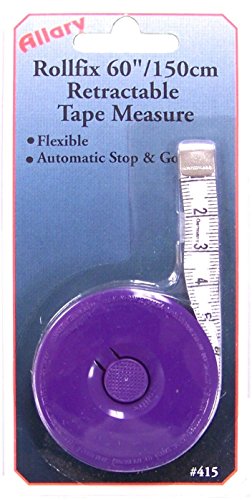
The Hoechstmass Rollfix is widely recognized for its German-engineered precision and durability. It is the gold standard for professionals who require a tool that remains accurate even after thousands of uses.
The tape material is exceptionally thin yet remains resistant to stretching over time. This lack of “stretch memory” is critical when measuring high-tension areas or blocked garments, where even a millimeter of deviation can alter the finished fit.
Because of its high-quality construction, it is a significant investment. However, for those dedicated to perfecting garment construction, it is a tool that rarely needs replacement.
Wawak Fiberglass Tape: The Best Non-Stretch Option

Fiberglass tapes like the Wawak variety are essential for those working with heavy or delicate fibers that require high-tension measurements. Unlike basic vinyl, fiberglass is dimensionally stable and will not deform when pulled taut.
This stability is vital when measuring long lengths, such as the total height of a floor-length shawl or the wingspan of a cardigan. It ensures that the measurement taken today remains consistent with the measurement taken after the piece has been blocked and dried.
These tapes are often sold as professional-grade, meaning they are functional and straightforward rather than aesthetic. Expect a utilitarian design that performs consistently in a high-volume workroom environment.
Lufkin Self-Centering Tape: For Pattern Makers
The Lufkin Self-Centering Tape is a specialized tool that simplifies the process of finding the middle point of a garment or a fabric piece. It features a scale that displays measurements starting from zero at the center and moving outward in both directions.
This is a game-changer for knitters who design their own patterns or perform complex modifications like centering a motif on a jumper front. It removes the need for mental math, reducing the risk of errors during the planning stage.
While not necessary for every knitter, it is an invaluable asset for those moving into advanced pattern drafting. It eliminates the guesswork when aligning lace repeats or cable panels across a garment body.
What to Look For in a Pro-Grade Measuring Tape
A pro-grade tape must offer high contrast between the background and the markings. Black markings on a white or yellow background are generally the easiest to read, especially when measuring dark-colored yarn or complex stitch patterns.
Check the start of the tape to ensure the metal or plastic tip is securely attached and does not obscure the zero-mark. A tape that begins with a gap or a bulky tab can lead to skewed measurements, particularly when gauging the length of a small, intricate project.
Finally, prioritize flexibility. A tape should drape naturally over the curves of the body or the weight of a heavy wool blanket without fighting against the material or causing the fabric to distort.
Fiberglass vs. Vinyl: Which Material Is Best?
Vinyl tapes are generally softer and more pliable, making them comfortable for body measurements. They are affordable and easy to find, though they can stretch slightly if tugged too hard over time, which compromises accuracy.
Fiberglass tapes are reinforced, making them immune to the stretching that affects vinyl. They are the preferred choice for measuring flat pieces, gauge swatches, and structural elements of a garment where absolute accuracy is non-negotiable.
Choose vinyl for measuring your body for a custom fit, but reach for fiberglass when measuring the actual dimensions of your knitted items. Using the right material for the specific task ensures that your math remains consistent from cast-on to bind-off.
Taking Accurate Body Measurements Every Single Time
Always measure while wearing the undergarments intended for the finished project. A sweater knit to be worn over a bulky base layer will fit poorly if measured against a thin t-shirt, as the added ease—the difference between body size and garment size—will be miscalculated.
Keep the tape level and parallel to the floor when measuring circumferences like the bust or hips. Standing in front of a mirror helps verify that the tape has not dipped or twisted, which is a common error that leads to an inaccurately tight garment.
Do not pull the tape tight against the skin. For a standard fit, the tape should feel snug but allow for the insertion of one or two fingers beneath it to ensure the finished knit has the appropriate amount of negative or positive ease.
How to Check Your Measuring Tape for Accuracy
Tape measures can wear out or lose their calibration over time. Occasionally check your tape against a trusted metal ruler to ensure the marks remain accurate.
If a discrepancy is found, compare the tape at different intervals, such as at the 10-inch or 25-centimeter mark. If the tape is consistently off, it is time to replace it rather than attempting to compensate for the error, which often leads to further mistakes.
Storing your tape rolled or retracted is the best way to maintain its integrity. Avoid leaving it in direct sunlight or extreme temperatures, which can cause the material to become brittle or warp over the course of several seasons.
Choosing the right measuring tape is an investment in the long-term success and wearability of every piece crafted. While individual preferences vary, selecting a tool based on material stability and readability will yield consistent, professional results. By maintaining and periodically verifying these tools, you ensure that every inch of your work is as precise as your stitches.