
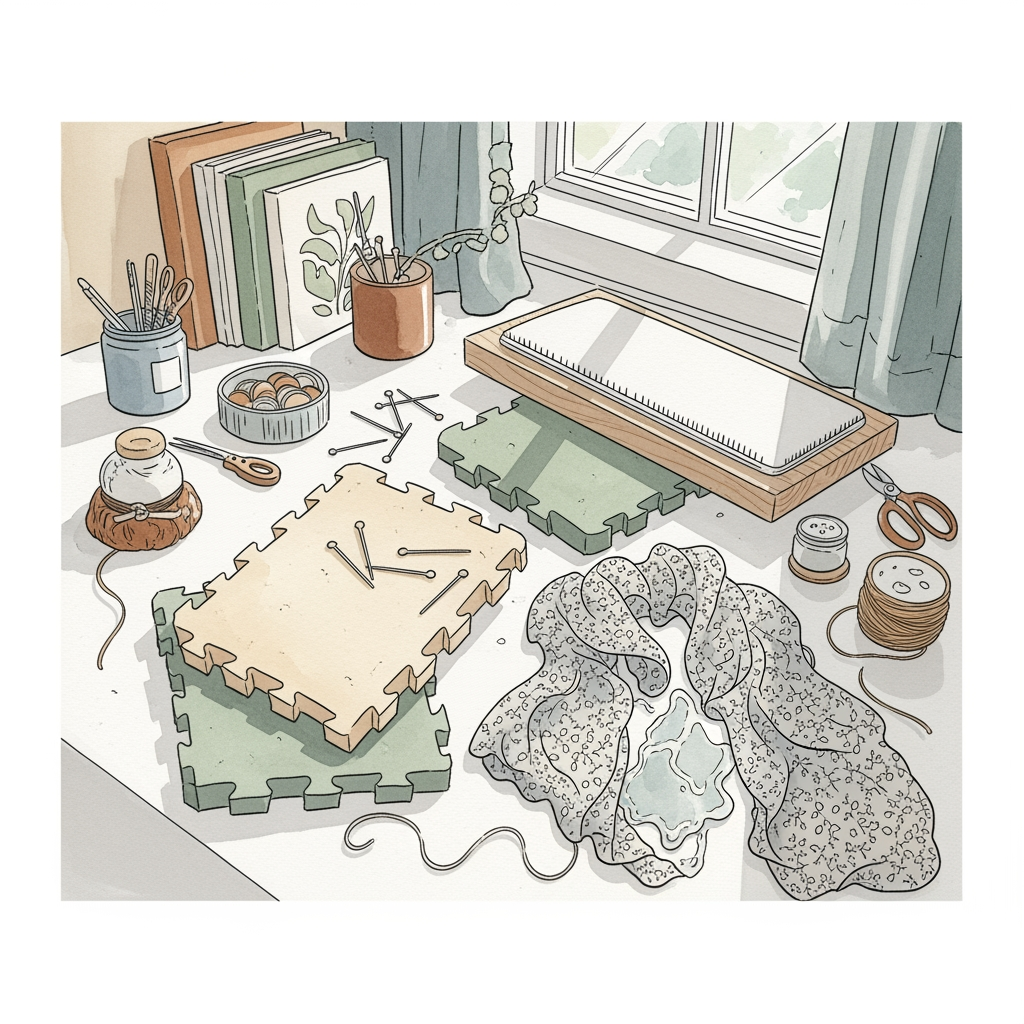
6 Best Puzzle Mats For Crafting Desks Worth Owning
Protect your workspace with the 6 best puzzle mats for crafting desks. Discover top-rated surfaces to organize your projects and shop our expert picks today.
Crafting requires a dedicated space, yet finding the right surface for intricate work often leads to cluttered tables and misplaced notions. A quality puzzle or craft mat serves as a multifunctional anchor for everything from lace blocking to organizing complex colorwork charts. Selecting the right foundation ensures that delicate fibers remain protected and essential tools stay within reach. This guide cuts through the noise to highlight the best surfaces for serious makers who value precision and workspace efficiency.
Lavievert Roll-Up Mat: Best for Portability


The Lavievert roll-up mat excels for those who lack a permanent, sprawling studio space. Its felt surface provides enough friction to hold lightweight items in place, making it ideal for laying out pattern pieces or holding light wool swatches while waiting for a yarn delivery.
Because it rolls up into a compact cylinder, storage becomes effortless when the dining room table must return to its primary purpose. However, be aware that the material can retain creases after long periods of storage. A quick steam iron session—taking care not to press directly on synthetic felt—usually resolves these stubborn marks.
This mat is the choice for the mobile maker who attends knitting guilds or workshops. If your craft routine involves moving between rooms or traveling to knit nights, this provides a reliable, dedicated surface anywhere you land.
Jigthings Jigboard 1000: Best Rigid Surface
A rigid surface is indispensable when the goal is to maintain absolute flatness for delicate blocking. The Jigboard 1000 features a sturdy construction that prevents warping, ensuring that lace shawls pinned to its surface remain symmetrical throughout the drying process.
The fabric cover is specifically engineered to provide a slight grip, which is highly advantageous when working with slippery silk-merino blends or silk mohair. These fibers tend to slide on hard plastic or glass, but the Jigboard’s texture acts as a gentle anchor.
Investing in a rigid board is a long-term decision. If you frequently work on large-scale blocking projects or require a flat, portable workstation that can be leaned against a wall without disrupting your current work, this remains a gold-standard choice.
Bits and Pieces Puzzle Board: Top Choice w/ Drawers
Organization is the hallmark of a master crafter, and this board elevates that practice through its integrated drawer system. These drawers provide the perfect cubbies for sorting stitch markers, cable needles, and small lengths of scrap yarn used for lifelines.
The surface is covered in a felt-like material that offers a secure base for pinning, yet the primary draw is the efficiency of the workflow. Imagine working on an intricate fair-isle project; the drawers keep your bobbins and contrasting color yarns organized so you never lose your rhythm or your place in the chart.
While the board is on the heavier side, its stability is unmatched. It is an excellent purchase for a dedicated crafting nook where the board can stay stationary, serving as a permanent command center for your most ambitious WIPs (works in progress).
Becko Puzzle Board: Great for Small Craft Spaces
Limited square footage often forces crafters to compromise, but the Becko board minimizes that trade-off. It provides a generous working area while maintaining a sleek, manageable profile that fits well on narrower desks.
The inclusion of a cover is a functional highlight. In a small space, dust and pet hair are constant enemies of delicate natural fibers like alpaca or cashmere. Covering the board keeps your work pristine, even when you must step away for hours or days.
This board is well-suited for someone who primarily works on smaller accessories like socks or mittens. Because it is lightweight yet durable, it bridges the gap between portability and a permanent setup.
Ravensburger Stow & Go: Best Budget-Friendly Pick
Budget-friendly does not mean low quality, especially when the tool serves a singular, clear purpose. The Ravensburger Stow & Go relies on an inflatable tube system to secure your work, which is surprisingly effective for light knitting projects that need to be cleared away in a hurry.
The mat surface is smooth, making it ideal for working with fibers that are prone to catching on rougher textures, such as delicate high-twist wools. It is straightforward, lightweight, and requires very little maintenance.
This is the perfect introductory mat for a knitter just beginning to understand the importance of a dedicated workspace. It provides the essential benefit of keeping work orderly without a significant financial commitment.
Tektalk Puzzle Board: The Ultimate Organizer Mat
The Tektalk board functions less like a mere mat and more like a comprehensive workstation. With a felt surface and a variety of adjustable features, it accommodates the needs of those who juggle multiple craft disciplines simultaneously.
The design emphasizes modularity, allowing for better management of tools and supplies. If your knitting habit frequently crosses paths with needlepoint or embroidery, this board offers the versatility needed to manage the disparate tools required for each task.
For the serious fiber artist who prefers a “everything in its place” methodology, Tektalk delivers on the promise of order. It is a robust tool designed for those who spend hours every week focused on the fine details of their craft.
How to Choose a Mat for Your Specific Craft Needs
When choosing a mat, the first factor to consider is the nature of your projects. If you frequently block large lace items, a rigid, flat surface is non-negotiable to ensure even tension across the finished piece.
- Surface Texture: Look for grippy materials if you work with slick fibers like bamboo or silk.
- Dimensions: Always measure your largest typical project.
- Portability: Assess whether the mat needs to travel or if it will have a permanent home.
The choice between a simple mat and a feature-rich board often comes down to storage capacity. If you have many tools, a board with drawers will save you more time in the long run than a basic roll-up mat ever could.
Puzzle Mat vs. Board: Which Is Best for Crafters?
A puzzle mat is essentially a flexible sheet, whereas a board is a rigid, structural frame. For blocking, boards are almost always superior because they provide a perfectly level plane.
Mats are better for crafters who need flexibility. If you are working on a piece that needs to be moved frequently or stored in a drawer, the thin profile of a mat is invaluable. Boards, by contrast, offer a sense of permanence and professional stability that mats lack.
The bottom line remains: choose a mat for travel and occasional use, but invest in a board if you want a dedicated workstation that supports precision.
Using a Puzzle Mat for Blocking Small Knitted Items
Blocking is a crucial step in finishing any knitted garment, and a puzzle mat is an excellent substitute for expensive, specialized foam blocking tiles. The felt or fabric surface provides enough friction to hold rust-proof T-pins securely while the garment relaxes into its final shape.
When blocking small items like socks or gloves, the mat allows for easy repositioning of pins without damaging the surface. Because the mat is often smaller than a full-room floor setup, it encourages you to focus on the specific tension of the garment’s edges.
Always ensure the mat is placed on a flat, waterproof surface, as the moisture from blocking could potentially transfer through a thin mat to the table beneath. Use a towel between the mat and your work if you are concerned about moisture retention or colorfastness.
What Size Mat Do You Really Need for Crafting?
The ideal size for a crafting mat is always larger than your biggest intended project. A common mistake is buying a mat that is only exactly as large as a finished scarf, which leaves no room for the pins or the necessary tensioning space around the edges.
A minimum size of 24×36 inches is recommended for those who knit shawls or sweater fronts. If you only work on smaller items like cowls or baby clothes, a 20×20 inch board will suffice.
Always account for the “working border”—the extra space outside the project area where you will place your needles, scissors, and yarn balls. A mat that feels too large at first is almost always the right choice as your skills and project complexity grow.
Selecting the right puzzle or craft mat is an investment in your process, providing the structure needed for cleaner, more professional results. Whether you prioritize the absolute flatness of a rigid board or the flexible convenience of a roll-up mat, the goal is to create a space that encourages creativity rather than clutter. By choosing tools that align with your specific fiber habits, you ensure that every minute spent knitting is focused on the work itself, rather than the search for a level, organized space.
