6 Best Bead Containers For Organization To Try
Tired of messy supplies? Discover the 6 best bead containers for organization to keep your workspace tidy and your projects easily accessible. Shop our top picks!
Beading transforms a standard lace shawl or a pair of heirloom socks into a shimmering work of art, but managing hundreds of tiny glass beads can quickly derail a project. Without an intentional storage system, these delicate components become a source of frustration rather than inspiration. Choosing the right container depends entirely on the scale of the beadwork and the specific requirements of the chosen yarn. This guide explores the most effective organization tools to keep projects flowing smoothly from cast-on to bind-off.
Darice Bead Organizer: The Classic Clear Choice


The Darice organizer serves as a dependable baseline for most knitters. Its clear, partitioned design allows for a quick visual inventory of colorways without the need to open multiple lids, which is vital when working with complex beaded colorwork.
These boxes typically feature a variety of fixed compartments, making them ideal for storing different sizes of beads alongside necessary knitting notions like stitch markers or tapestry needles. However, because the lid covers the entire unit, there is a risk of beads migrating between sections if the container is jostled inside a project bag.
When selecting this style, prioritize models with secure, snap-shut latches. A box that pops open mid-commute can turn a perfectly organized color palette into a nightmare of mixed-up glass seeds.
Elizabeth Ward Bead Trays: Best for Big Stashes

For the dedicated designer working on a beaded wedding veil or a heavy lace coverlet, the Elizabeth Ward system is the industry standard for sheer capacity. These modular trays allow for the segregation of beads by size, finish, and color, which is essential when a pattern calls for shifting between different textures.

The individual containers are removable, allowing for the creation of a “kit” for a specific project. A knitter can lift out only the containers needed for the current row, keeping the workspace clear of unnecessary clutter.
The primary trade-off is the physical footprint. These trays occupy significant table space and are better suited for a permanent crafting desk than for a mobile knitting kit that travels to local meetups.
ArtBin Hook & Latch Box: Top for Travel Safety
Travel knitting requires security above all else. The ArtBin Hook & Latch system offers a robust enclosure that prevents the accidental spills common with lighter-duty plastic boxes.
The latch mechanism is engineered for durability, ensuring that the container remains closed even when tossed into a heavy project tote. This provides peace of mind when carrying expensive silk or linen yarns that could be snagged or damaged by stray beads.
Consider the depth of these bins when purchasing. If the beads being used are particularly small—like size 15/0 seed beads—the extra depth can make it difficult to scoop them up with a crochet hook during the “knitting-on” process.
Beadsmith Flip-Top Pots: Perfect for Single Use
Flip-top pots are the gold standard for precision. Because each tiny pot has its own individual lid, the risk of cross-contamination between different bead colors is virtually eliminated.
These pots are especially useful when knitting with highly varied color charts, such as in Fair Isle designs that incorporate beads. Being able to access one specific color while keeping all others sealed protects the stash from potential spills and environmental factors like humidity.
While efficient, the sheer number of small lids can be tedious to manage. Use these primarily for the specific beads required for the current project rather than for long-term storage of an entire collection.
Stackable Round Jars: A Space-Saving Solution

Vertical storage is an often-overlooked strategy in the knitting room. Stackable round jars allow a knitter to maximize limited desk space, keeping beads within arm’s reach without cluttering the area reserved for circular needles and patterns.
The transparent nature of these jars makes them highly functional for aesthetic color planning. Lining up stacks of jars allows the knitter to visualize how different bead finishes—such as matte, metallic, or transparent—will interact with the sheen of the yarn being used.
The limitation here is accessibility. Reaching a jar at the bottom of a stack requires unstacking the entire column, which can be an interruption during a focused knitting session. Keep these for beads that are used less frequently.
Bead Tube Storage Tray: For Seed Bead Organization
Tube storage is the preferred method for anyone working primarily with seed beads. Tubes are easily labeled, allowing for an organized system where every bead type, size, and color has a designated home that is easy to identify at a glance.
Most of these trays are designed specifically to hold a set number of tubes upright. This ensures that when the time comes to thread beads onto the working yarn, the beads are positioned to be scooped up efficiently rather than tumbling around a flat tray.
When choosing a tray, look for one that features a stable base and non-slip feet. A tray that slides across the table every time a bead is picked up will quickly become a source of immense irritation.
What to Look For in a Bead Organization System
The most critical factor is the ease of access during the act of knitting. If a container is too deep or has sharp internal corners, picking up a single bead with a fine crochet hook becomes a chore.
Visibility is a close second. A knitter needs to see the bead’s finish clearly to ensure it matches the light-reflecting properties of the fiber. A matte bead on a lustrous silk yarn creates a different effect than a metallic bead on a wool-nylon blend.
Finally, consider the portability of the system. A system that works perfectly in the studio may fail during travel. Test the seals and latches thoroughly before trusting the container with a precious supply of beads.
Organizing Beads for a Specific Knitting Project
Organizing by project is often more effective than organizing by inventory. For a complex lace project, create a “project kit” that includes only the beads needed for that specific pattern.
Place these beads in a small, portable container that fits easily inside the project bag. This reduces the cognitive load during knitting, as the knitter is not sorting through irrelevant options.
Include a small sample of the yarn in the container to check bead fit. Some beads are too tight for the yarn’s diameter, and discovering this during the setup phase prevents frustrating mid-project breakage.
Fixed vs. Removable Dividers: Which is Better?
Fixed dividers offer durability and security. They prevent beads from slipping under the divider wall, a common issue with cheaper adjustable containers that have gaps at the bottom.
Removable dividers offer flexibility. As a collection grows or projects change, the ability to resize compartments can be a major advantage. However, be wary of “leakage” where the smallest beads migrate into neighboring sections.
When choosing, evaluate the size of the beads. If the collection consists mainly of large, uniform beads, fixed dividers are usually sufficient. If working with a wide range of sizes, the adaptability of removable dividers may be worth the extra maintenance.
Essential Tools for Beaded Knitting Success
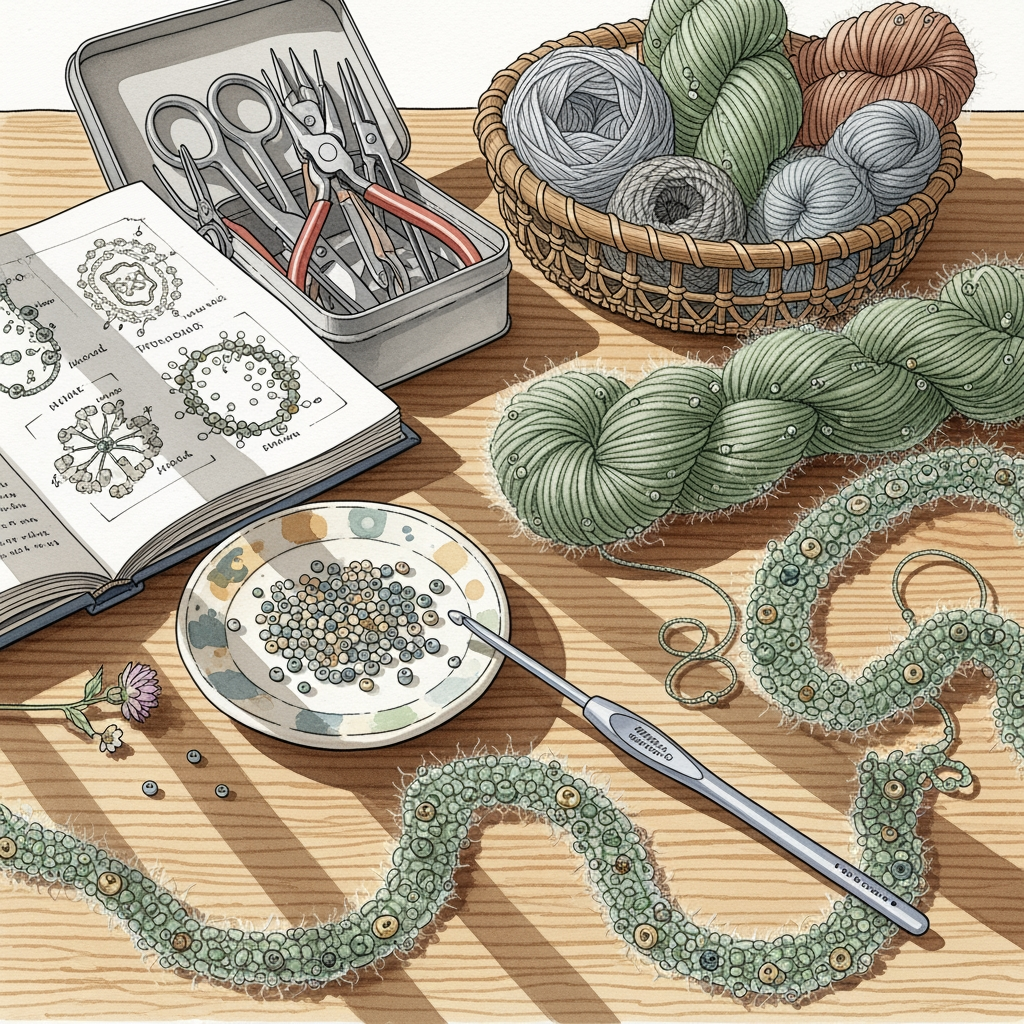
Beyond the containers themselves, the tools used to interact with the beads are vital. A fine-gauge crochet hook is the industry standard for placing beads into a stitch.
Keep a few spare hooks in the bead container. These small tools have a tendency to disappear, and having one taped to the inside of the lid or stored in a dedicated compartment ensures the project never stalls.
Lastly, keep a soft, felted mat or a microfiber cloth nearby. These surfaces prevent beads from bouncing or rolling away if dropped, saving precious time that would otherwise be spent crawling on the floor.

Selecting the right bead storage system is as much about streamlining the creative process as it is about organization. By balancing the need for security, visibility, and portability, a knitter can create a system that enhances the pleasure of adding beads to any fiber project. Test the storage requirements against the specific needs of the current project, and keep the most essential tools within immediate reach. With the right setup, the focus remains entirely on the stitch, the bead, and the beauty of the final fabric.