6 Best Layout Squares For Squaring Knitwear Pieces
Ensure your handmade garments have a professional finish. Discover the 6 best layout squares for squaring knitwear pieces and improve your blocking results today.
Achieving professional-grade results in knitwear often comes down to the final, crucial step of blocking. While many believe that needles and yarn do the heavy lifting, the structural integrity of a finished garment is defined by how it is shaped and set after the bind-off. Properly squared pieces ensure that sleeves match perfectly, necklines lay flat, and cables pop with clear definition. Investing in the right blocking mats is the difference between a project that looks handmade and one that looks truly hand-crafted.
KnitPicks Blocking Mats: Best Overall Value


These mats offer a balance of density and surface area that satisfies the majority of knitters. They provide a firm foundation that holds stainless steel T-pins securely without crumbling over time.

Because they come in a standard set, they are perfect for those who typically knit sweaters in pieces. The thickness is sufficient to protect surfaces underneath from moisture, yet they remain lightweight enough for easy storage in a closet or under a bed.
The bottom line: Choose these if you want a reliable, no-nonsense workspace that won’t break the budget. They are the workhorse of the blocking world, suitable for everything from basic stockinette to simple colorwork.
Knitter’s Pride Kit: Best All-in-One System
This system stands out by including not just the foam squares, but the essential pins and a specialized tool to keep everything organized. The inclusion of T-pins or lace pins as part of the package saves a trip to the notions store and ensures the pins are perfectly sized for the mat’s foam density.
These mats feature a grid pattern that is printed with high visibility. This is a game-changer when aligning rows of cables or checking for symmetry in a complicated lace border.
The tradeoff is that these kits often carry a higher price point due to the included accessories. However, the convenience of having a comprehensive blocking kit ready for immediate use is invaluable for the frequent garment knitter.
Cocoknits Knitter’s Block: The Premium Choice

This system moves beyond basic foam by utilizing heat-resistant, high-density materials that offer a superior pinning experience. The surface is specifically designed to work in harmony with the brand’s proprietary pinning and measuring tools.
The mats are marked with a very precise grid, which is essential for projects that require strict adherence to schematic measurements. If the project involves delicate fibers like lace-weight mohair or fine silk, the smooth surface ensures the yarn does not catch or pull during the pinning process.
While the cost is higher than standard interlocking mats, the durability is unmatched. It is a long-term investment for the knitter who plans to finish many heirloom-quality garments over the coming years.
Boye Interlocking Boards: Best Budget Pick
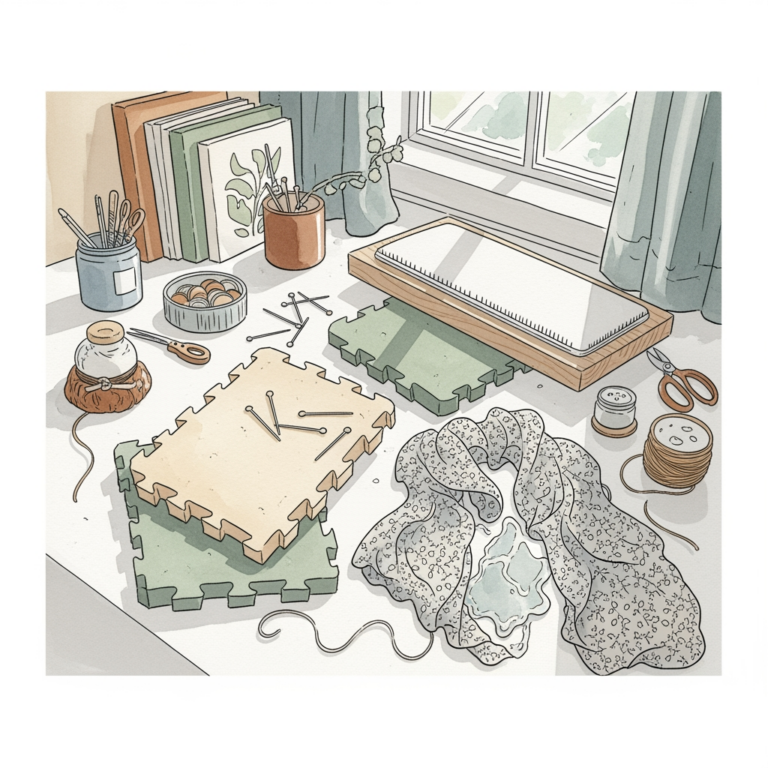
These mats function much like a puzzle, allowing for custom configurations based on the shape of the project. If the goal is to block a long, narrow scarf or a wide triangular shawl, the pieces can be rearranged to fit the specific footprint.
The foam is slightly softer, which makes them very easy to pin into, though they may show signs of wear sooner than high-density professional options. They are ideal for beginners who need a flexible solution without committing to a premium price tag.
The takeaway is that flexibility comes at the cost of long-term rigidity. These are perfect for occasional use or for those who frequently switch between knitting small accessories and larger garments.
Clover Stack ‘n Store Mats: Most Compact
Space is often the biggest constraint for knitters, and these mats address that directly with a design focused on small-footprint efficiency. They are exceptionally portable and stow away into a very small area when not in use.
The material is sturdy and holds pins firmly despite its slim profile. While the total surface area might be smaller than a full-size floor mat set, it is perfectly adequate for blocking individual sweater panels or hats.
If the workspace is limited to a small table or a cramped apartment, these are the logical choice. They offer professional-level stability in a size that respects the constraints of a smaller crafting environment.
WEBS Grid-Lined Mats: Best for Lace Work
Precision is the primary benefit of these mats, specifically regarding their detailed, accurate grid lines. When lace is wet-blocked, it needs to be stretched significantly to reveal the pattern, and these grids provide the necessary visual aid to ensure the stretch is uniform on both sides.
The material is firm, preventing the “bouncing” or unevenness that can occur with softer, cheaper foam. This stability is critical when working with slippery fibers like bamboo or mercerized cotton, which have a tendency to shift if the blocking surface isn’t perfectly consistent.
For the lace enthusiast, these are essential tools. They help take the guesswork out of complex repeats, ensuring that every point in a picot edge is consistent.
How Many Blocking Squares Do You Really Need?
A common mistake is buying too few squares and being forced to block a sweater in multiple phases. Ideally, one should have enough mats to lay out the largest piece of the garment—usually the back panel—in its entirety.
- For Socks/Mittens: Four squares are usually sufficient.
- For Sweaters: A set of nine to twelve squares is the industry standard for a full front, back, and two sleeves.
- For Shawls: Twelve or more squares are recommended to accommodate the wide wingspan of a crescent or triangular shawl.
Always err on the side of having more surface area than necessary. It is far easier to leave empty space on a mat than it is to struggle with pinning a project that hangs over the edge of the blocking area.
How Many Blocking Squares Do You Really Need? (Continued)
Consider the types of projects usually on the needles. If the focus is primarily on sweaters, look for a 9-piece kit to start. If the collection of projects is varied, look for interlocking systems where additional packs can be purchased later to expand the existing workspace.
The goal is to create a blocking station where the entire garment can be pinned out once, allowing the tension to distribute evenly across all seams. Trying to block in sections often leads to uneven stretching and difficult assembly.
Wet vs. Steam Blocking: Which Is Best for Mats?
Wet blocking involves soaking the garment in water and a delicate wool wash before pinning it to the mat. This is the gold standard for natural fibers like wool and alpaca, as it allows the fibers to relax completely and bloom.
Steam blocking, conversely, uses a steam iron or handheld steamer to set the shape. This is safer for acrylics or delicate blends that might lose their shape if over-saturated.
When choosing mats for steam blocking, ensure they are advertised as heat-resistant. Standard EVA foam mats can warp or melt if they come into direct contact with a hot iron, which ruins the surface grid and creates an uneven blocking plane.
Care and Storage Tips for Your Blocking Mats
After a project has dried, remove all pins and inspect the surface for debris or fiber bits. Use a soft brush to clear away any loose lint that might have transferred from the yarn to the foam.
Store the mats in a dry, flat, and cool environment to prevent warping. If the mats are interlocking, keep them assembled in a stack or stored in their original packaging to maintain their structural integrity over time.
Avoid leaving them in direct sunlight or near a heater, as heat can degrade the foam and cause it to become brittle. With proper care, a high-quality set of blocking mats will last for decades, serving as the foundation for every garment finished.
Proper blocking is the transformative step that elevates a knit item from a collection of stitches into a professional garment. By selecting a mat system that suits the specific needs of the projects, one gains a consistent, reliable tool for years of fiber arts excellence.