
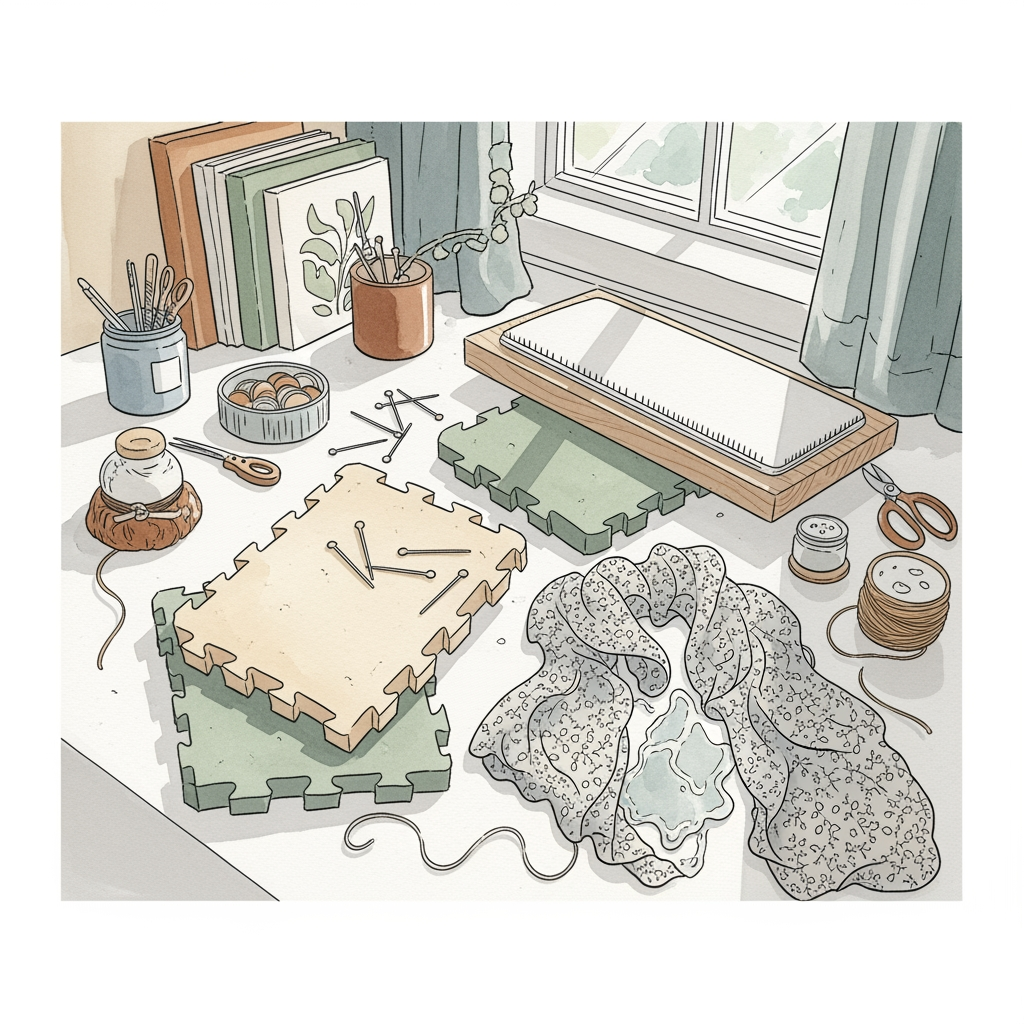
6 Best Blocking Grids For Measuring Symmetry To Use
Master symmetry with these 6 essential blocking grids. Discover how these tools improve precision, ensure balanced proportions, and elevate your craft projects.
Achieving professional-level results in your knitting often hinges on the final, crucial step of blocking. A reliable grid is the difference between a garment that looks handmade and one that looks truly custom-tailored. By providing a consistent reference point, these tools ensure your stitch patterns are balanced and your edges are perfectly straight. Mastering the grid is the fastest way to elevate the quality of your finished fiber projects.
Knitter’s Pride Knit Blockers and Gridded Mats


These mats are a staple in many studios because of their modular, interlocking design that allows you to customize your workspace. The surface is firm enough to hold pins securely, yet soft enough to allow for easy insertion without bending your wrists.
The real magic here is the accompanying Knit Blockers, which are essentially plastic combs with multiple pins. Instead of placing twenty individual T-pins, you can secure a long edge in seconds. This speed is invaluable when you are blocking a large, heavy wool sweater that might otherwise shift while you work.
However, keep in mind that these mats are primarily foam-based. Over time, frequent use with heavy-duty pins can cause the surface to develop small holes or "memory" where the pins were placed. If you work primarily with delicate lace, ensure you are using fine-gauge pins to prevent the grid lines from becoming obscured by wear.
Mindful Collection Lace Blocking Grid Tiles
The Mindful Collection offers a more aesthetic, serene approach to the blocking process with its signature color palette. These tiles are notably dense, providing a sturdy foundation for heavy items like cowls or blankets.
What sets these apart is the precision of the grid printing. When you are working with fine-gauge lace, even a millimeter of misalignment can be visible in the final drape of the fabric. The crisp lines on these tiles act as a reliable guide for ensuring your yarn-overs are perfectly symmetrical.
The tradeoff here is the price point, which is often higher than generic foam alternatives. If you are a casual knitter, you might find this an unnecessary luxury, but for the lace enthusiast, the added accuracy is worth the investment.
Clover Precision Blocking Mats and Pins Set

Clover is a brand that understands the ergonomics of crafting, and their blocking mats reflect that focus. The mats feature a grid that is specifically designed to be easy on the eyes, reducing strain during long blocking sessions.
The set usually includes high-quality T-pins that are rust-resistant, which is a non-negotiable feature when working with natural fibers like wool or mohair. There is nothing worse than finishing a project only to find a rust stain from a cheap pin left in the fabric.
Be aware that these mats are slightly smaller than some of the industrial-sized options on the market. They are perfect for garments and accessories, but if you are a prolific blanket knitter, you will likely need to purchase multiple sets to create a large enough surface area.
Boye Interlocking Foam Blocking Board Tiles

These tiles are the "workhorse" of the blocking world, offering a no-nonsense, budget-friendly solution for everyday projects. They interlock tightly, creating a stable surface that won’t shift while you are pinning down your work.
They are particularly well-suited for beginners who are just starting to experiment with blocking. Because they are affordable and durable, you don’t have to worry about "ruining" them as you learn the best techniques for pinning out your seams and edges.
The one downside is that the grid lines can sometimes fade or wear off after heavy use. If you rely heavily on the visual grid, you might eventually need to supplement these with a ruler or a tape measure to ensure your symmetry remains spot on.
Lacis Professional Blocking Board and Grids

If you are serious about historical garments or highly complex lace patterns, the Lacis board is a significant step up. This is often a more rigid, board-style surface rather than the typical soft foam, providing a different tactile experience.
This rigidity is a massive advantage when you need to exert tension on a piece without the mat bowing or flexing. For projects that require aggressive blocking—like opening up the stitches of a dense, stranded colorwork piece—this stability is unmatched.
It is, however, less portable than foam tiles. This is a tool designed for a dedicated craft space rather than a kitchen table that needs to be cleared for dinner. Consider your available space before committing to this professional-grade equipment.
ArtBin Foam Blocking Tiles for Fiber Projects

ArtBin tiles are excellent for knitters who appreciate modularity and storage efficiency. These tiles are often thicker than standard blocking mats, which allows for deeper pin penetration and a more secure hold for heavy or bulky yarn projects.
The material is quite resilient, resisting the "pitting" that happens with softer foam over time. This makes them a great choice if you find yourself blocking the same types of garments—like hats or scarves—on a weekly basis.
Because they are designed for general crafting, the grid lines are functional but not always as fine as those on specialized knitting mats. They are a fantastic "middle-ground" choice for the knitter who wants quality without the premium price tag.
Why Symmetry Matters in Professional Blocking
Symmetry is the hallmark of a professional finish, and it is the primary reason we block in the first place. When you knit, your stitches are often uneven due to tension variations during the process; blocking "relaxes" the yarn and evens out these inconsistencies.
If your garment is not symmetrical, the seams will not align during assembly, leading to twisted sleeves or a lopsided neckline. Using a grid allows you to measure exactly how many inches each side of a sweater extends, ensuring that when you sew it together, the geometry is perfect.
Remember that blocking is not just about size; it is about shape. By using the grid, you can ensure that your increases and decreases are mirrored perfectly, which is essential for the visual flow of complex stitch patterns like cables or lace.
How to Choose the Best Blocking Grid Material
Choosing the right mat depends entirely on what you knit most often. If you work with heavy wools that require aggressive pinning, you need a dense, thick foam that won’t collapse under the pressure of the pins.
For delicate fibers like silk or alpaca, you want a surface that is gentle and won’t snag the yarn. Always check the texture of the mat; a surface that is too "grippy" can actually pull at delicate fibers when you are trying to adjust the position of your work.
Consider the following when shopping:
- Density: Does the mat hold a pin firmly?
- Size: Can it accommodate your largest project?
- Grid Accuracy: Are the lines printed clearly and at true measurements?
- Storage: Does it fold or stack for easy cleanup?
Essential Tips for Perfect Garment Alignment
Always start by pinning your center points first. Whether it is the center back of a sweater or the middle of a lace shawl, anchoring the center allows you to work outward, distributing the tension evenly across the entire piece.
Use a measuring tape in addition to the grid lines. While the grid is excellent, it is easy to lose your place if the project is large; double-checking with a physical tape measure prevents "creeping" where one side ends up slightly longer than the other.
Never stretch your knitting beyond its natural capacity. If you force the fabric to fit the grid, you will distort the stitch pattern and potentially ruin the drape of the garment. The goal is to guide the fabric into its intended shape, not to force it into a new one.
Maintaining Your Blocking Mats for Longevity
To keep your mats in top shape, always remove pins by pulling them straight up rather than prying them sideways. Prying stretches the foam and creates larger holes, which will eventually make it impossible for the mat to hold a pin securely.
Store your mats in a cool, dry place away from direct sunlight. Sunlight can degrade the foam material over time, making it brittle and prone to crumbling, especially if the mats are colored or printed.
If your mats get dirty, a quick wipe-down with a damp cloth is usually sufficient. Avoid harsh chemicals or submersing them in water, as moisture trapped inside the foam can lead to mildew, which is the last thing you want near your clean, hand-knit garments.
Investing in a quality blocking grid is a transformative step for any knitter looking to refine their craft. By providing a clear, measurable framework, these tools take the guesswork out of finishing and allow your hard work to shine. Take your time to choose the surface that matches your project needs, and your finished garments will thank you with years of beautiful, symmetrical wear. Happy knitting, and may your edges always be straight.
