7 Best Sewing Spectacles For Long Pattern Reviews
Stop straining your eyes during long pattern reviews. Discover the 7 best sewing spectacles to improve your precision and comfort. Shop our top picks today!
Staring at a complex lace chart or dark, fingering-weight yarn for hours can lead to significant eye strain and fatigue. Even seasoned makers often find that their usual lighting setups fall short when navigating intricate cable patterns or identifying dropped stitches in mohair blends. Investing in proper magnification ensures that every tension adjustment and yarn-over is precise, keeping the craft enjoyable rather than taxing. These seven tools are designed to bridge the gap between vision and execution, providing clarity for even the most demanding projects.
MagniPro Hands-Free LED Magnifier: Best Overall


The MagniPro shines because it balances a wide field of view with a convenient, hands-free design that rests comfortably around the neck. This configuration is ideal for long sessions of stranded colorwork where the eyes must constantly toggle between the pattern chart and the needles.
Because it sits on the chest rather than weighing down the bridge of the nose, it eliminates the headache-inducing pressure common with heavy glasses. The integrated LED lights provide consistent illumination, which is essential when working with dark navy or black wool where stitch definition is naturally low.
While the neck strap style provides great stability, it may require a brief period of adjustment to find the optimal focal distance for seated knitting. For those who prioritize comfort over extended periods without sacrificing clarity, this remains the gold standard.
YOCTOSUN Headband Magnifier: Most Versatile Kit

For knitters who tackle a variety of projects—from heavy, chunky-weight blankets to delicate lace—the YOCTOSUN kit offers unmatched flexibility. It features a set of interchangeable lenses that allow for quick shifts in magnification strength depending on the needle size.
The headband design ensures the magnifier stays securely in place, even if there is frequent movement to check a pattern book or grab a different color yarn. The adjustable LED lights can also be angled to highlight the exact spot where the needle tip enters the stitch, which is helpful when performing intricate picking-up-stitches maneuvers.
Keep in mind that the headband adds some weight to the forehead, which might be noticeable during marathon knitting sessions. However, the ability to swap lenses makes this the most adaptable choice for a diverse stash of projects.
Donegan OptiVISOR Headband: Pro-Level Precision

The OptiVISOR is the choice for serious artisans who treat their fiber work with professional-grade rigor. These are built to last, featuring high-quality glass lenses that provide exceptional clarity without the distortion found in cheaper acrylic alternatives.
When working with fine lace weight yarn or repairing complex knitted fabric, the superior optics help distinguish between similar stitch types. The sturdy headband construction feels secure and balanced, allowing the magnifier to be flipped up and out of the way effortlessly when a break is needed.
These are an investment piece, but the durability and image quality justify the cost for anyone who spends daily time at their craft. If precision is the primary goal, skipping the budget options for this level of optical engineering is a wise decision.
Brightech LightView Pro Lamp: Best for Craft Stations
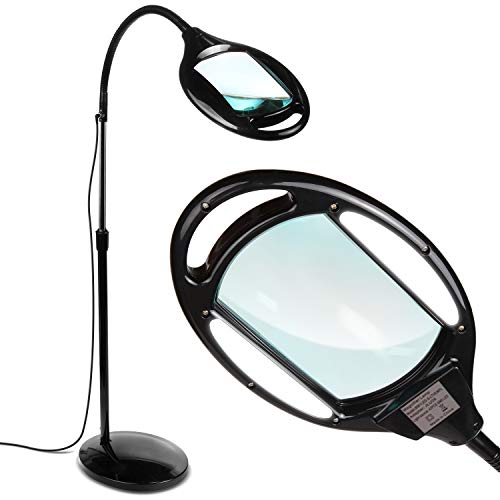
If knitting is mostly a stationary activity at a dedicated craft chair, a magnifying lamp is often superior to wearable glasses. The Brightech LightView Pro attaches to a table or craft stand, providing a massive, distortion-free viewing area that covers the entire lap.
This lamp is particularly useful when analyzing gauge swatches or troubleshooting a multi-row mistake in a complex cable pattern. Because it stands independently, it allows for total freedom of movement, meaning no glasses to push up or headbands to adjust.
The trade-off is portability; this setup is not meant for the traveling knitter who likes to take their work to the park or a cafe. For the dedicated home studio, however, the combination of brilliant light and wide-angle magnification is unbeatable.
Carson Optical Clip-On Magnifiers: Top for RX Users

Knitters who already rely on prescription eyewear for daily tasks often find headband magnifiers cumbersome and uncomfortable. The Carson Clip-On series solves this by attaching directly to the frames already in use, effectively turning current glasses into a customized magnification tool.
This is a subtle, lightweight solution that does not interfere with the natural line of sight or add unnecessary bulk to the head. It is perfect for identifying stitch counts in complex patterns while maintaining the necessary distance to avoid eye strain.
While the clip-on design is convenient, it is important to ensure the weight does not pull down on existing frames. Choose this option for its simplicity and the ability to integrate it seamlessly into an established eye-care routine.
Mighty Sight LED Glasses: Easiest to Use
Simplicity is the defining feature of the Mighty Sight LED glasses, which function just like a pair of standard reading glasses but with built-in magnification and illumination. There are no complicated straps, adjustments, or focal distances to master—just put them on and the work becomes instantly clearer.
These are excellent for beginners who are just starting to struggle with the finer details of yarn manipulation. The integrated lights are bright enough to illuminate a dark room without bothering anyone else, making them a great companion for late-night knitting on the sofa.
Because they offer a fixed focal range, they are best suited for steady-paced, consistent knitting rather than tasks requiring constant focal changes. They are the most user-friendly entry point for anyone needing a quick, effective boost to their vision.
Half-Frame Crafting Readers: Best Budget Pick
Half-frame readers are a classic, reliable tool that allows a knitter to look down through the magnification for the stitch work and up over the rim for a clear view of the room or a TV screen. This dual-use capability is vital for long-term project comfort, preventing the need to constantly remove and replace glasses.
They are incredibly lightweight and affordable, making them a perfect “keep in the knitting bag” accessory. While they lack the high-powered magnification of specialized visors, they provide just enough help to resolve common tension issues or stitch identification struggles.
Avoid these if significant, clinical-level magnification is required for extremely fine yarn. For most general-purpose knitting, however, these offer the best balance of price and functional utility.
How to Pick Your Perfect Magnification Strength
Magnification is measured in “diopters,” and higher numbers do not necessarily mean better results. A 1.5x or 2x magnification is usually sufficient for standard knitting with medium-weight yarns.
If the magnification is too high, the focal distance becomes extremely short, forcing the face uncomfortably close to the needles. Always consider the project type: * Lace and fingering weight: Higher magnification (2.5x to 3x) may be required. * Worsted and bulky weight: Lower magnification (1.5x to 2x) is usually plenty.
Test the preferred working distance before purchasing. Hold the project at the usual knitting distance and see if the magnification brings the needles into crisp focus without requiring an unnatural posture.
Headband, Neck, or Lamp: Which Style Is for You?
The choice of style depends almost entirely on the knitting environment. Headbands provide maximum stability and precision for delicate work but can become heavy during long sessions.
Neck-mounted magnifiers offer a middle ground, providing stability without the pressure on the head or forehead. Lamp-mounted options are the most comfortable for long-term studio work but are entirely sedentary.
Consider the physical constraints: if neck tension is an issue, avoid neck-mounted models. If there is a need to move between rooms with a project, a wearable magnifier is always the superior choice over a lamp.
Caring For Your Magnifier Lenses to Keep Them Clear
Magnifier lenses are susceptible to scratches, which can create distracting blurs that negate the benefits of the tool. Always clean the lenses with a dedicated microfiber cloth, avoiding paper towels or tissues that can leave microscopic abrasions.
If the lenses become oily or dusty, use a specialized optical cleaning spray rather than household glass cleaner, which can strip away anti-reflective coatings. When not in use, store the magnifier in a protective case to prevent accidental drops or surface damage.
Consistent care is the key to longevity. A clean, clear lens is the difference between a relaxing evening of knitting and a frustrating session spent fighting against blurry, undefined stitches.
Investing in these tools transforms the fiber arts experience from a potential chore into a source of enduring pleasure. By matching the right magnification to individual project needs, vision remains clear and comfort becomes the standard for every row worked. Whether choosing a precision visor or a simple pair of readers, the added clarity will undoubtedly result in better stitch consistency and a deeper appreciation for the work on the needles.