6 Best Row Counters For Precision Knitting To Try
Boost your knitting accuracy with our top 6 row counters. From manual clicks to digital trackers, discover the best tools to keep your patterns on track today.
Precision in knitting is the difference between a garment that fits perfectly and one that requires hours of frogging. Whether you are working on a complex cable sweater or a simple stockinette scarf, keeping an accurate count is non-negotiable. The right row counter acts as your project’s heartbeat, ensuring your pattern repeats align flawlessly. Finding the tool that fits your rhythm can transform your knitting experience from a guessing game into a meditative flow.
Cocoknits Maker’s Keep: Best Wearable Counter
If you find yourself constantly searching for your counter in the depths of your project bag, this is the solution you need. The Maker’s Keep is a magnetic wristband that holds your row counter and other small metal notions right where you need them.
Because it sits directly on your wrist, you never have to put your needles down to record a row. This is a game-changer for those working on intricate lace or delicate mohair, where constant needle manipulation can lead to dropped stitches or uneven tension.
The magnetic surface is strong enough to hold stitch markers, darning needles, and even small scissors. While it is an investment piece, the convenience of having your tools accessible at a glance often pays for itself in saved time.
Knitter’s Pride Rainbow Row Counter: Best Value


Sometimes the simplest tool is the most reliable. These classic, colorful counters slide directly onto your needle, making them perfect for those who prefer to keep their counting mechanics physically attached to their work.
These are best suited for straight needles or circulars where the counter doesn’t interfere with your hand placement. If you are knitting a dense, heavy wool project, the weight of a larger counter might be distracting, but these are lightweight enough to remain unobtrusive.
They are incredibly affordable, meaning you can keep one on every active project in your rotation. Just remember to check the size compatibility with your needle diameter, as they come in specific ranges to ensure they don’t slide off mid-row.
Clover Kacha-Kacha Click Counter: Best Durability

The "kacha-kacha" sound is iconic for a reason; it provides satisfying tactile feedback that lets you know your row has been recorded without even looking. This handheld unit is built to withstand years of heavy use in a craft bag.
Its mechanical nature means you never have to worry about batteries dying in the middle of a complex row. The button is large and responsive, making it an excellent choice for knitters who might struggle with the tiny, fiddly buttons found on smaller digital models.
While it is larger than a finger counter, it is robust and unlikely to break if dropped or buried under a skein of yarn. It is the workhorse of the knitting world, reliable and always ready for the next project.
KnitIQ Digital Finger Counter: Best for Precision

If you prefer a low-profile tool that stays out of your way, a digital finger counter is the gold standard. The KnitIQ version is particularly popular for its clear display and comfortable, adjustable strap.
This tool is ideal for knitters who work with slippery fibers like silk or bamboo, where every second counts and you don’t want to break your momentum. The digital screen is easy to read even in low light, which is a major advantage for those who knit in the evenings.
Be aware that because these are digital, they do have a battery life to consider. However, the precision of a digital click ensures you never accidentally advance the count by bumping a dial, a common issue with mechanical alternatives.
ChiaoGoo Needle Gauge Counter: Best Two-in-One

Every knitter knows the frustration of losing their needle gauge just when they need to check a needle size. This tool combines a row counter with a needle sizer, making it a highly practical addition to your notions tin.
This is particularly useful for stash-busting projects where you might be using needles of unknown origins or sizes. By having the gauge integrated, you can verify your needle size and track your rows simultaneously, reducing the number of tools cluttering your workspace.
It is a mechanical dial design, which keeps it simple and battery-free. While it may be slightly bulkier than a dedicated counter, the dual-functionality makes it a favorite for traveling knitters who want to pack light.
Susan Bates Handheld Counter: Best for Beginners
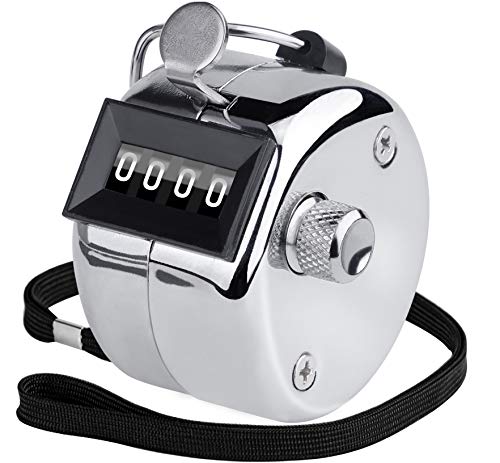
When you are first learning to read patterns and manage your tension, you don’t need fancy technology. The Susan Bates handheld counter is a classic, straightforward tool that helps you build the habit of counting without any learning curve.
Its simple dial mechanism is intuitive, and the construction is solid enough to survive the learning process. If you are just starting out, mastering the habit of clicking at the end of every row is more important than the features of the tool itself.
It is an inexpensive, no-nonsense option that allows you to focus on your stitches rather than your equipment. Once you have built your confidence, you can decide if you want to upgrade to a wearable or digital model.
Why Precision Row Counting Matters for Your Knits
Precision in counting is critical when your project involves specific pattern repeats, such as cables, lace, or colorwork. If you miss a row, the entire symmetry of your design can be thrown off, leading to a finished piece that looks "off" even if the tension is perfect.
For garments, row counting is essential for shaping. Whether you are increasing for a sleeve or decreasing for a neckline, your row count dictates exactly where those changes occur.
When you lose your place, you risk having mismatched sleeves or a sweater body that is shorter on one side. Consistent tracking ensures that your finished project is professional, balanced, and fits exactly as the designer intended.
Mechanical vs Digital Counters: Which Suits You?
Mechanical counters are generally more durable and don’t require power, making them great for long-term projects that might sit in a bag for months. They provide a tactile, physical "click" that many knitters find reassuring.
Digital counters offer more precision and often include helpful features like backlighting or locking buttons to prevent accidental resets. They are usually more compact, which is a major benefit if you tend to knit on the go.
The choice ultimately comes down to your personal workflow. If you are prone to misplacing things or dislike charging devices, stick with mechanical; if you value a streamlined, quiet, and highly visible interface, digital is the way to go.
Tips for Keeping Track During Complex Lace Work
Lace knitting is unforgiving, and a single missed row can ruin a complex pattern repeat. I always recommend using a "lifeline"—a piece of scrap yarn threaded through your stitches—every few repeats so you have a safe place to return to if things go wrong.
When working on lace, try to count your rows out loud as you finish them. This engages another sense and helps cement the count in your memory, reducing the chance of a mental lapse.
Additionally, keep your row counter in a fixed location, like a specific pocket in your project bag. If you are working on a large shawl, consider using two counters: one for the overall project and one for the current pattern repeat.
How to Recover Your Place After a Dropped Stitch
If you realize you have lost your place, don’t panic; it happens to the best of us. First, stop and examine your work to identify the last completed pattern repeat by counting the "V" shapes in your stitches.
If you have dropped a stitch, use a crochet hook to ladder it back up to the current row before you attempt to recalibrate your counter. Once your stitches are secure, compare your current row to the pattern chart to see where you left off.
If you are truly lost, it is often better to count the number of rows from a known landmark, like a color change or a cable crossing. Adjust your counter to match your physical work, not the other way around, to ensure your next row is correct.
Choosing the right row counter is about finding a tool that integrates seamlessly into your unique knitting style. Whether you prefer the tactile click of a mechanical dial or the sleek convenience of a digital display, the best tool is the one you actually remember to use. By prioritizing consistent tracking, you protect your hard work and ensure every project reaches its full potential. Happy knitting, and may your rows always stay perfectly on count.