6 Best Table Looms For Small Apartment Weaving
Looking for the best table looms for small apartment weaving? Discover our top six space-saving picks and start your next fiber arts project today. Read more.
Living in a small apartment often forces a choice between giving up a beloved craft or sacrificing the dining room table to a bulky loom. Fortunately, modern table looms are engineered specifically for the constraints of urban living without forcing compromises on the quality of the finished textile. Selecting the right frame involves balancing the square footage of the studio with the complexity of the desired weave structure. This guide breaks down the best options for maximizing output in a minimal footprint.
Ashford SampleIt: The Ultimate Tiny Space Starter


The Ashford SampleIt is designed for the weaver who wants to experiment with textures and color without committing to a piece of furniture that dominates the room. Its compact footprint makes it ideal for crafters who need to stow their projects inside a closet or under a bed between sessions.
Because it is a rigid heddle loom, it remains incredibly lightweight and portable. While it lacks the complexity of a floor loom, it is perfect for sampling draft ideas or creating narrow items like scarves, bookmarks, and wall hangings.
Do not be fooled by the “sample” in the name; this tool handles everything from delicate silk yarns to chunky, hand-spun wools with ease. If the goal is to master basic warping techniques, this is the most approachable starting point.
Schacht Cricket: The Fan-Favorite Rigid Heddle
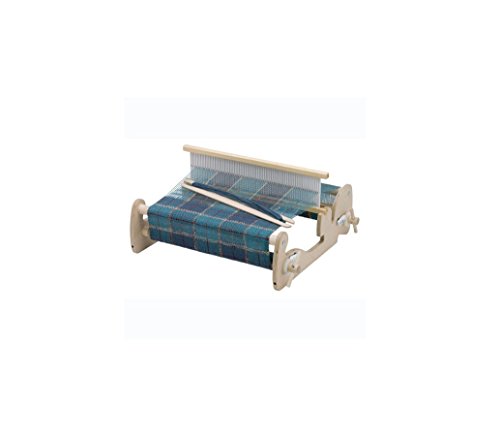
The Schacht Cricket is arguably the gold standard for beginners looking for a sturdy, reliable entry point into weaving. Its design is intuitive, focusing on a straightforward shedding mechanism that allows for quick project turnover.
The loom’s side support braces provide stability that many other small looms lack, preventing the frame from bowing under tension. This is critical when working with high-twist yarns that require consistent tension to maintain an even gauge across the web.
It comes in two sizes, 10-inch and 15-inch widths, offering enough surface area for small projects without requiring a dedicated weaving studio. If the priority is a loom that feels like a permanent, well-built instrument rather than a plastic toy, the Cricket delivers.
Kromski Harp Forte: Best for Easy Portability

The Kromski Harp Forte stands out due to its clever folding mechanism, which allows the loom to remain warped while in transit or storage. For apartment dwellers who move their craft from a desk to a kitchen table, this feature is a game-changer.
The wooden construction is not only aesthetically pleasing but provides a solid weight that keeps the loom from sliding during the beating process. A steady beat is essential for achieving a professional-looking fabric density, especially when alternating between soft merino and more abrasive linen yarns.
Choosing this loom means prioritizing versatility in movement. It integrates well into a lifestyle where the workspace must double as a living space at the end of the day.
Ashford Rigid Heddle: A Versatile Workhorse

The Ashford Rigid Heddle loom is widely regarded as the most versatile of the non-shaft options. It is available in a variety of widths, allowing the user to match the loom size to the specific project requirements rather than the other way around.
Because of the vast aftermarket ecosystem of accessories, this loom can grow with the weaver. One can easily add a second heddle kit to enable double-width weaving or more intricate patterns that standard rigid heddle looms cannot achieve.
If the intention is to stay with weaving for the long term and perhaps eventually sell finished goods, this loom provides the necessary professional features. It is a workhorse that handles high-tension projects without compromising the integrity of the frame.
Schacht Wolf Pup LT: Your First Four-Shaft Loom

Moving from a rigid heddle to a four-shaft loom opens up a world of complex patterns, such as twills and overshot weaves. The Schacht Wolf Pup LT is a table-top powerhouse that offers the sophisticated shedding of a floor loom in a miniature package.
The “LT” model features an overhead beater, which creates a cleaner shed and more consistent tension. This is vital when working with delicate fibers like alpaca or cashmere that can break if the friction within the warp is too high.
While it requires a steeper learning curve than a rigid heddle, the creative possibilities are exponentially greater. This is the logical step for the knitter who wants to translate complex lace or cable charts into woven structures.
Louet Erica: Compact Multi-Shaft Powerhouse
The Louet Erica is a folding, four-shaft loom that emphasizes ergonomic design and ease of operation. Its unique parallel countermarch system ensures a crisp shed even when the warp is under significant tension.
This loom is particularly well-suited for weavers who deal with wrist or hand fatigue, as the levers are designed to be operated with minimal force. In a small apartment, the ability to fold the loom down to a height of just a few inches allows for storage under most standard sofas.
While the learning curve is substantial compared to simpler looms, the precision it offers is unmatched in its size class. If the objective is to produce professional-grade yardage or intricate table linens, the Erica is a long-term investment.
How To Choose The Right Loom For Your Space
Selecting a loom begins with an honest assessment of storage capabilities and the desired end project. If the apartment lacks a dedicated desk, a folding model is non-negotiable.
Consider the following factors before purchasing: * Warping Capacity: Does the project require a long warp, or are small items the primary focus? * Mechanical Complexity: Are four shafts necessary for pattern work, or will a simple plain weave suffice? * Ergonomics: Is the height comfortable for the seated position, and do the levers require too much force?
Always prioritize the loom that allows for the most consistent tension. Inconsistent tension leads to “draw-in” or uneven selvages, which are difficult to correct during the blocking process.
Rigid Heddle vs. Shaft Looms: A Quick Guide
Rigid heddle looms operate on a simple up-and-down shed, making them ideal for plain weaves, striped fabrics, and basic colorwork. They are inexpensive, easy to set up, and perfect for the beginner who wants to start weaving within an hour of opening the box.
Shaft looms use multiple shafts to control individual warp threads, allowing for complex patterns like houndstooth, lace, and twills. While they take longer to warp and require more technical knowledge, the fabric density and design potential are significantly higher.
The choice essentially comes down to the desired speed of output versus the depth of pattern capability. Beginners often start with rigid heddle looms to learn fiber behavior before graduating to the structural complexity of shaft looms.
Weaving Width Explained for Small Apartments
Weaving width refers to the maximum width of the fabric that can be created on the loom. A common misconception is that a wider loom is always better; however, a wider loom requires more space to operate and more effort to maintain even tension across the entire width.
For small apartments, a 15-inch to 20-inch width is typically the “sweet spot.” It is wide enough for scarves and small runners but narrow enough to sit comfortably on a standard coffee table or desk without overwhelming the room.
Remember that the fabric will pull in slightly, or “draw-in,” as it is woven. Always select a loom width slightly larger than the final desired project width to accommodate this natural movement of the threads.
Beyond the Loom: Essential Weaving Accessories
The loom is only one part of the weaving equation. To ensure success, invest in high-quality shuttles, which hold the weft yarn and determine how easily the weaver can pass the yarn through the shed.
A sturdy warping board or peg is also necessary for measuring the warp threads accurately before they are put on the loom. Without precise measurements, the warp will be uneven, leading to loops or tension issues during the weaving process.
Finally, keep a collection of reeds and heddles that correspond to the yarn weight being used. Matching the density of the reed (measured in dents per inch) to the thickness of the yarn is the most effective way to ensure a balanced, professional-looking textile.
Mastering the loom requires time, patience, and the right equipment to match the limitations of your physical environment. By choosing a device that fits your specific needs and dedicating time to understanding its mechanics, you can produce professional textiles in even the most compact home. Happy weaving!