6 Best Studio Lamps For Accurate Color Rendering
Discover the 6 best studio lamps for accurate color rendering in your workspace. Compare top-rated lighting solutions and improve your creative projects today.
Struggling to distinguish between navy blue and midnight black while working on a late-night cabling project is a rite of passage every knitter eventually faces. Poor lighting doesn’t just strain the eyes; it leads to missed dropped stitches, incorrect increases, and frustrating mistakes in complex lace motifs. Investing in a studio-grade lamp transforms the workspace, ensuring the true hue of hand-dyed merino and the subtle texture of alpaca fibers are visible even in the dimmest conditions. Selecting the right light source is as crucial to the finished garment as choosing the correct needle material for a specific yarn weight.
OttLite TrueColor Floor Lamp: Best Overall


The OttLite TrueColor series remains the gold standard for fiber artists who demand consistency above all else. Its proprietary bulb technology is specifically engineered to mimic the spectral output of sunlight, which is the only way to see true color saturation in variegated yarns.
When working with complex stranded colorwork, subtle shifts in tone can make or break the design’s success. This lamp provides the crisp clarity needed to ensure that a sage green doesn’t accidentally fade into a muddy brown under artificial living room lighting.
The weighted base provides stability on carpeted surfaces, preventing the wobbles that often occur in cheaper floor lamps. While the reach is somewhat limited compared to industrial task lights, its balance of brightness and color accuracy makes it the top choice for most dedicated knitting corners.
Brightech Litespan LED Lamp: Best Budget Pick
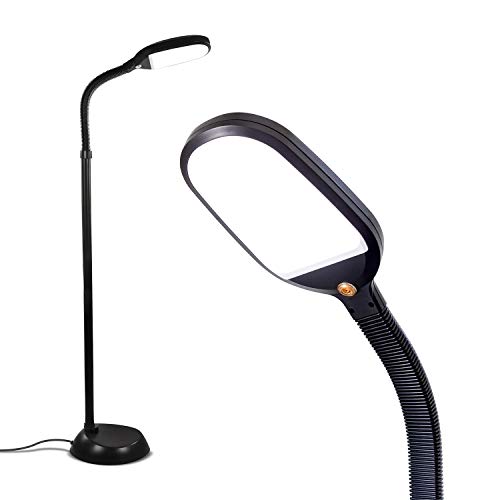
The Brightech Litespan offers a high-performance entry point for those who cannot justify a premium investment immediately. Its primary strength lies in its modular neck, which allows for precise positioning over a lap full of chunky wool or an intricate embroidery hoop.
Budget lighting options often fall into the trap of flickering, which causes significant eye fatigue during long knitting sessions. The Litespan utilizes a stable, flicker-free driver that protects the eyes during those marathon sessions of working on a complex lace shawl.
The trade-off here is a slightly more utilitarian light quality that lacks the warmth of higher-end lamps. For someone working primarily with high-contrast, solid-color acrylics or wools, this is perfectly adequate and highly functional.
BenQ e-Reading LED Lamp: Best for Small Spaces

Small-apartment knitters or those with limited bedside table real estate benefit immensely from the BenQ e-Reading lamp’s curved design. The arch shape illuminates a wide, desk-spanning area without cluttering the surface with a bulky footprint.
This lamp excels at reducing glare on polished surfaces, which is essential if you keep your pattern notes on a tablet or smartphone. If the eyes tire easily after reading fine print on a complex pattern, the dimming feature allows for a quick transition from bright focus to ambient relaxation.
While the price point is steep, the build quality and space-saving design provide immense value for anyone working in a cramped craft nook. It ensures that the workspace remains uncluttered, allowing for a clear area to manage yarn balls and project bags.
Daylight Company Lumi Task Lamp: For Big Projects

Large-scale projects, such as an oversized wool blanket or a full-size cabled afghan, require light that spans a significant physical area. The Daylight Company Lumi is designed with a wide head that casts an even, shadow-free glow across the entire lap.
Uneven lighting often leads to “shading” errors, where the knitter misjudges the tension or stitch count because one side of the work is darker than the other. This lamp eliminates those dark spots, providing a consistent workspace that stretches across the entirety of a large project.
It is a heavy-duty tool that prioritizes function over aesthetics, making it a staple for professional makers. If you find yourself frequently working on bulky items that shift under the needles, the added coverage of this lamp is a non-negotiable upgrade.
Neatfi Bifocals Magnifying Lamp: Top Magnifier

Fine-gauge knitting on 2.00mm needles can be a challenge even for the keenest eyesight, especially when working with dark, fuzzy mohair. The Neatfi Bifocals lamp combines high-quality LED illumination with a professional-grade magnifying lens to make tiny stitches visible again.
The magnification allows for accurate identification of yarn overs and stitch counts when fixing mistakes in delicate lace. Rather than guessing whether a loop is a purl or a knit when tinkling back, the lens provides a clear, enlarged view of the stitch architecture.
Because this lamp is a specialized tool, it is best utilized as a supplemental light rather than a primary room-filling lamp. It serves as the ultimate “troubleshooting” station for those times when a mistake feels impossible to locate.
TaoTronics LED Desk Lamp: Most Adjustable Option
Versatility is the primary selling point of the TaoTronics LED desk lamp, which features an articulating arm that reaches almost any angle. Whether the knitting is held high near the chest or low in the lap, this lamp can pivot to follow the movement of the needles.
Multiple color temperature modes allow the user to switch between “cool” light for seeing clear stitch definition and “warm” light for relaxing evenings. This adjustability helps avoid the harshness that can sometimes occur with static LED lamps late at night.
It may lack the sheer light output of premium craft lamps, but the price-to-performance ratio is difficult to beat. It is a fantastic option for the knitter who enjoys changing their seating arrangement frequently throughout the house.
Understanding CRI, Lumens, and Color Temperature
- CRI (Color Rendering Index): A scale from 0-100 indicating how accurately a light source reveals colors. Always aim for a CRI of 90 or higher for knitting.
- Lumens: This measures the brightness of the light. For close-up handwork, aim for 800 to 1,200 lumens to avoid squinting.
- Color Temperature (Kelvin): Measured in K; 3000K is warm yellow, while 5000K-6000K is cool daylight. 5000K is the sweet spot for color matching yarn.
Understanding these metrics is vital because a lamp can be bright without being accurate. A high-lumen light with a low CRI will still make your neon pink yarn look dull and greyish, leading to poor color coordination in stranded work.
LED vs. Natural Daylight: What’s Best for Color?
While natural sunlight is theoretically the perfect light source, it is notoriously unreliable for consistent knitting. It shifts in temperature throughout the day and disappears entirely at night, leaving the knitter with no way to maintain color consistency.
Full-spectrum LED lamps are superior because they replicate the stable conditions of a clear midday sky at any hour. This allows for seamless color transitions and precise matching, even when working on a project over the course of several weeks or months.
Always prioritize LED technology over incandescent bulbs, which cast a yellow tint that masks the true undertones of fiber. Consistent, man-made light beats erratic natural light every time when precision is required.
Setting Up Your Light for Photographing Your Knits
Proper lighting is as important for your Instagram feed or Ravelry project page as it is for the actual knitting process. When photographing your work, position the lamp at a 45-degree angle to the knitting to highlight the texture of cables and lace.
Direct, front-facing light flattens the appearance of the knit, making it look like a smooth piece of fabric rather than a dimensional creation. By using side-lighting, the shadows cast by the stitches define the depth and complexity of the pattern.
Consider using a diffuser if the lamp light feels too harsh on shiny fibers like silk or bamboo. A simple piece of parchment paper or a light cloth over the lamp head can soften the output and prevent blown-out highlights in your photos.
Floor Lamp vs. Desk Lamp: Which One is for You?
Floor lamps are ideal for knitters who prefer to sit in a dedicated armchair or sofa, as they provide an overhead sweep of light that is difficult to replicate. They are generally better for those who need to keep their side tables free for mugs of tea and pattern binders.
Desk lamps offer greater control over positioning and are superior for knitters who work at a fixed table or desk surface. If your knitting involves a lot of chart reading and accessory management, a desk lamp can be brought closer to the page for better readability.
Assess your seating habits before buying; if you move around the house, a floor lamp with a sturdy, weighted base is the better investment. If you are a stationary knitter who needs targeted, adjustable light for complex patterns, a desk-mounted lamp is the superior choice.
Choosing the right lamp is an investment in the longevity of your craft and the health of your eyes. By prioritizing high color accuracy and adjustable positioning, you ensure that every stitch is accounted for and every color choice is made with total confidence.